Department of Gastroenterology, 74566The First Affiliated Hospital of Soochow University, Jiangsu, China.
Department of Gastroenterology, Nanjing Gaochun Hospital of Chinese Medicine, Jiangsu, China.
Int J Immunopathol Pharmacol. 2023 Jan-Dec;37:3946320231161174. doi: 10.1177/03946320231161174.
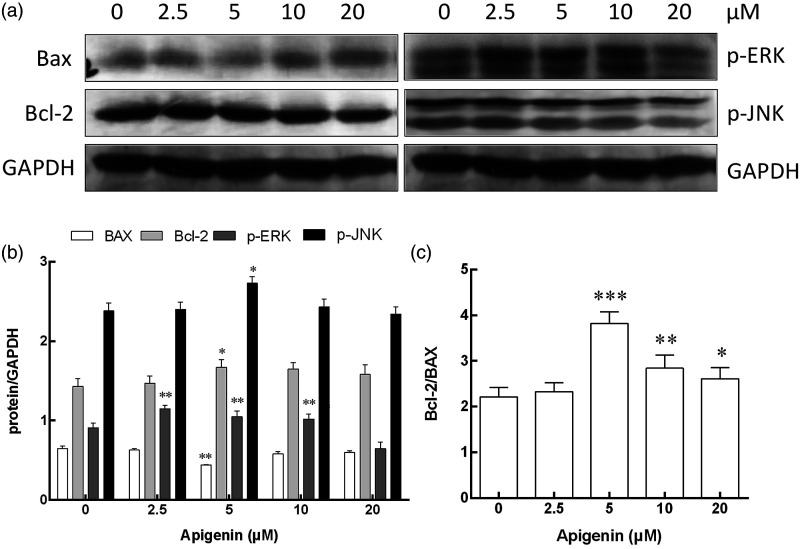
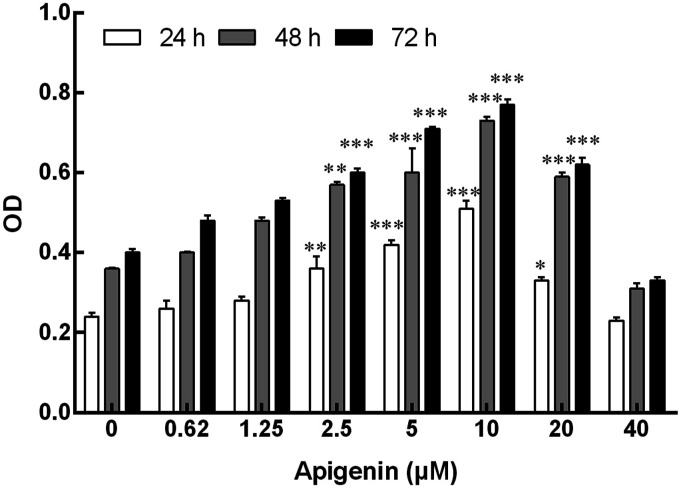
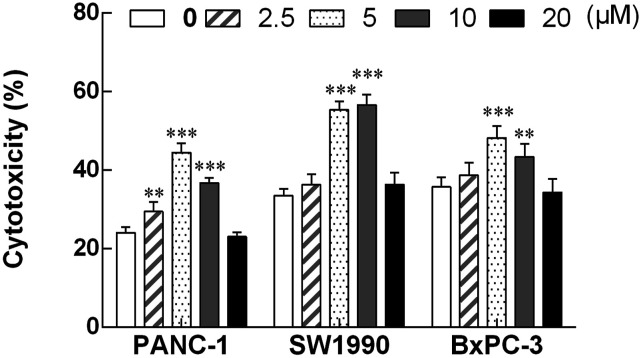
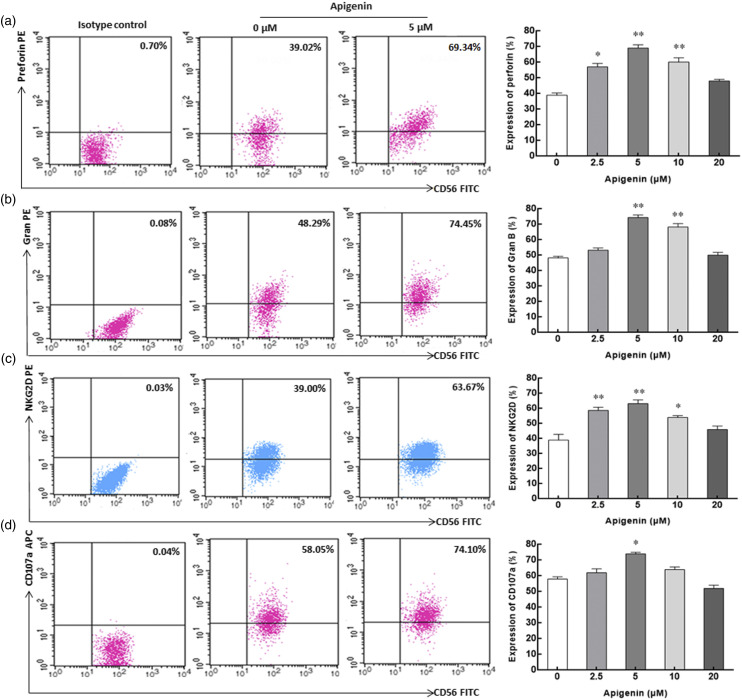
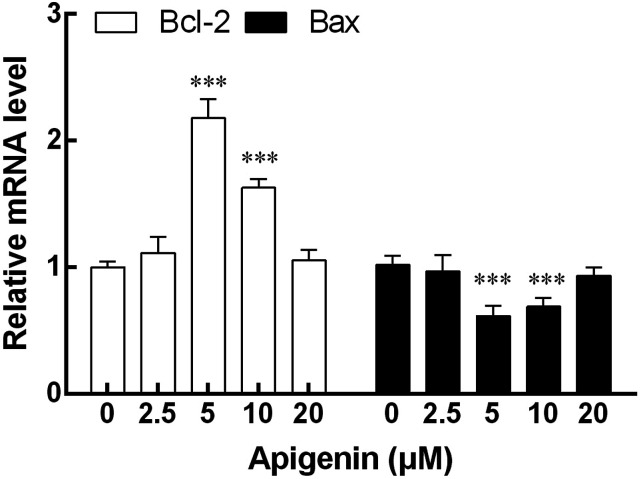
Apigenin is a kind of flavonoid with many beneficial biological effects. It not only has direct cytotoxicity to tumor cells, but also can boost the antitumor effect of immune cells by modulating immune system. The purpose of this study was to investigate the proliferation of NK cells treated with apigenin and its cytotoxicity to pancreatic cancer cells in vitro, and explore its potential molecular mechanism. In this study, the effect of apigenin on NK cell proliferation and killing pancreatic cancer cells were measured by CCK-8 assay. Perforin, granzyme B (Gran B), CD107a, and NKG2D expressions of NK cells induced with apigenin were detected by flow cytometry (FCM). The mRNA expression of Bcl-2, Bax and protein expression of Bcl-2, Bax, p-ERK, and p-JNK in NK cells were evaluated by qRT-PCR and western blotting analysis, respectively. The results showed that appropriate concentration of apigenin could significantly promote the proliferation of NK cells in vitro and enhance the killing activity of NK cells against pancreatic cancer cells. The expressions of surface antigen NKG2D and intracellular antigen perforin and Gran B of NK cells were upregulated after treating with apigenin. Bcl-2 mRNA expression was increased, while Bax mRNA expression was decreased. Similarly, the expression of Bcl-2, p-JNK, and p-ERK protein was upregulated, and the expression of Bax protein was downregulated. The molecular mechanism of the immunopotentiation effects of apigenin may be that it up-regulates Bcl-2 and down-regulates Bax expression at the gene and protein levels to facilitate NK cell proliferation, and up-regulates the expression of perforin, Gran B, and NKG2D through the activation of JNK and ERK pathways to enhance NK cell cytotoxicity.
芹菜素是一种具有多种有益生物学效应的类黄酮。它不仅对肿瘤细胞具有直接的细胞毒性,还可以通过调节免疫系统来增强免疫细胞的抗肿瘤作用。本研究旨在探讨芹菜素对 NK 细胞体外增殖及其对胰腺癌细胞的细胞毒性作用,并探讨其潜在的分子机制。在本研究中,通过 CCK-8 法测定了芹菜素对 NK 细胞增殖和杀伤胰腺癌细胞的影响。通过流式细胞术(FCM)检测了芹菜素诱导的 NK 细胞中穿孔素、颗粒酶 B(Gran B)、CD107a 和 NKG2D 的表达。通过 qRT-PCR 和 Western blot 分析分别评估了 NK 细胞中 Bcl-2、Bax 的 mRNA 表达和 Bcl-2、Bax、p-ERK 和 p-JNK 的蛋白表达。结果表明,适当浓度的芹菜素可显著促进 NK 细胞在体外的增殖,并增强 NK 细胞对胰腺癌细胞的杀伤活性。用芹菜素处理后,NK 细胞表面抗原 NKG2D 和细胞内抗原穿孔素和 Gran B 的表达上调。Bcl-2mRNA 表达增加,而 Bax mRNA 表达减少。同样,Bcl-2、p-JNK 和 p-ERK 蛋白的表达上调,Bax 蛋白的表达下调。芹菜素免疫增强作用的分子机制可能是通过上调 Bcl-2 和下调 Bax 的基因和蛋白表达来促进 NK 细胞的增殖,并通过 JNK 和 ERK 通路的激活上调穿孔素、Gran B 和 NKG2D 的表达,从而增强 NK 细胞的细胞毒性。