Instituto de Psicologia E de Ciências da Educação (IPCE), Universidade Lusíada Porto, Porto, Portugal.
Centro de Investigação Em Psicologia Para O Desenvolvimento (CIPD), Lisbon, Portugal.
Sci Rep. 2023 Feb 27;13(1):3353. doi: 10.1038/s41598-023-29642-5.
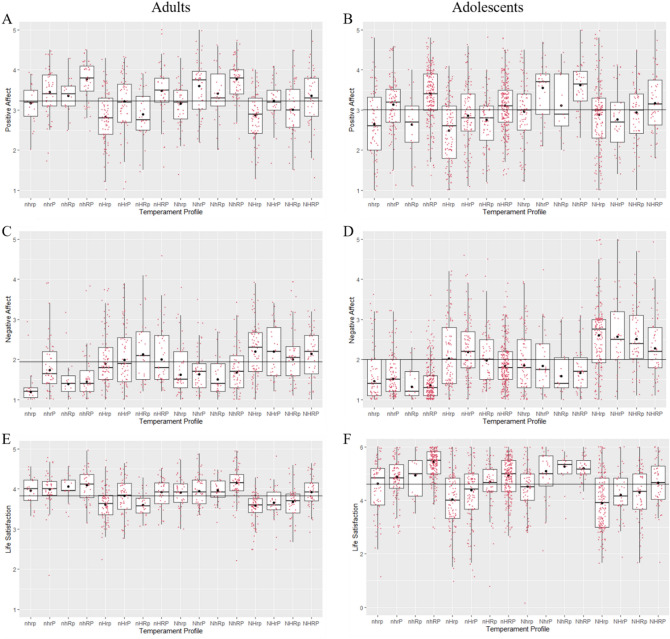
Recent genomic, psychological, and developmental research shows that human personality is organized as a complex hierarchy that ascends from individual traits in many specific situations to multi-trait profiles in two domains that regulate emotional reactivity (temperament) or goals and values (character), and finally to three integrated temperament-character networks that regulate learning to maintain well-being in changing conditions. We carried out person-centered analyses of the components of subjective well-being (positive affect, negative affect, and life satisfaction) to personality in both adolescents (N = 1739) and adults (N = 897). Personality was considered at each level of its organization (trait, temperament or character profiles, and joint temperament-character networks). We show for the first time that negative affect and life satisfaction are dependent on the personality network for intentional self-control, whereas positive affect is dependent on the personality network for self-awareness that underlies the human capacities for healthy longevity, creativity, and prosocial values.
最近的基因组学、心理学和发展研究表明,人类的个性是一个复杂的层次结构,它从许多特定情境中的个体特质上升到两个领域的多特质特征,这两个领域调节情绪反应(气质)或目标和价值观(性格),最后到三个综合的气质-性格网络,这些网络调节学习以维持在变化条件下的幸福感。我们对主观幸福感的组成部分(积极情绪、消极情绪和生活满意度)进行了以个体为中心的分析,分别针对青少年(N=1739)和成年人(N=897)。在其组织的各个层面(特质、气质或性格特征,以及联合气质-性格网络)考虑个性。我们首次表明,消极情绪和生活满意度取决于有意自我控制的人格网络,而积极情绪则取决于自我意识的人格网络,而自我意识是人类健康长寿、创造力和亲社会价值观的基础。