
季节性细颗粒物的化学成分及其跨代效应
Chemical Composition and Transgenerational Effects on of Seasonal Fine Particulate Matter.
作者信息
Yang Rongying, Ge Pengxiang, Liu Xiaoming, Chen Wankang, Yan Zhansheng, Chen Mindong
机构信息
Collaborative Innovation Center of Atmospheric Environment and Equipment Technology, Jiangsu Key Laboratory of Atmospheric Environment Monitoring and Pollution Control, School of Environmental Science and Engineering, Nanjing University of Information Science & Technology, Nanjing 210044, China.
出版信息
Toxics. 2023 Jan 24;11(2):116. doi: 10.3390/toxics11020116.
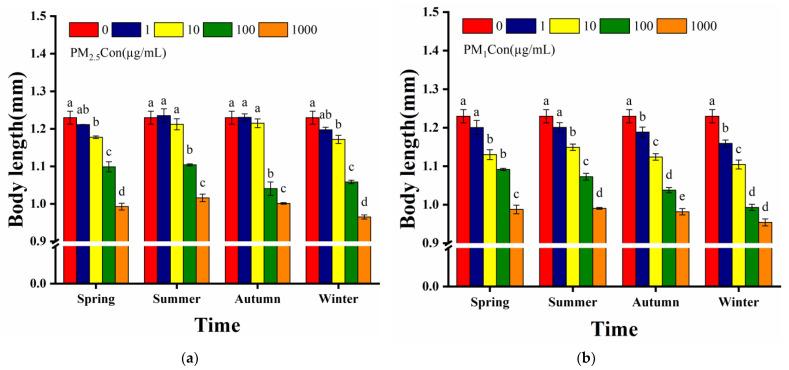
While numerous studies have demonstrated the adverse effects of fine particulate matter (PM) on human health, little attention has been paid to its impact on offspring health. The multigenerational toxic effects on () were investigated by acute exposure. PM and PM samples were collected and analysed for their chemical composition (inorganic ions, metals, OM, PAHs) in different seasons from April 2019 to January 2020 in Lin'an, China. A higher proportion of organic carbon components (34.3%, 35.9%) and PAHs (0.0144%, 0.0200%) occupied the PM and PM samples in winter, respectively. PM in summer was enriched with some metal elements (2.7%). Exposure to fine PM caused developmental slowing and increased germ cell apoptosis, as well as inducing intestinal autofluorescence and reactive oxygen species (ROS) production. PM caused stronger toxic effects than PM. The correlation between PM component and F0 generation toxicity index was analysed. Body length, germ cell apoptosis and intestinal autofluorescence were all highly correlated with Cu, As, Pb, OC and PAHs, most strongly with PAHs. The highest correlation coefficients between ROS and each component are SO (R = 0.743), Cd (R = 0.816) and OC (R = 0.716). The results imply that OC, PAHs and some transition metals play an important role in the toxicity of fine PM to , where the organic fraction may be the key toxicogenic component. The multigenerational studies show that PM toxicity can be passed from parent to offspring, and gradually returns to control levels in the F3-F4 generation with germ cell apoptosis being restored in the F4 generation. Therefore, the adverse effects of PM on reproductive damage are more profound.
虽然众多研究已证明细颗粒物(PM)对人类健康有不利影响,但人们对其对后代健康的影响关注甚少。通过急性暴露研究了对()的多代毒性作用。于2019年4月至2020年1月在中国临安的不同季节收集了PM和PM样本,并对其化学成分(无机离子、金属、有机物质、多环芳烃)进行了分析。冬季,有机碳成分(34.3%,35.9%)和多环芳烃(0.0144%,0.0200%)在PM和PM样本中所占比例较高。夏季的PM富含一些金属元素(2.7%)。暴露于细颗粒物会导致发育迟缓、生殖细胞凋亡增加,还会诱导肠道自发荧光和活性氧(ROS)生成。PM比PM产生更强的毒性作用。分析了PM成分与F0代毒性指数之间的相关性。体长、生殖细胞凋亡和肠道自发荧光均与铜、砷、铅、有机碳和多环芳烃高度相关,与多环芳烃的相关性最强。ROS与各成分之间的最高相关系数分别为SO(R = 0.743)、镉(R = 0.816)和有机碳(R = 0.716)。结果表明,有机碳、多环芳烃和一些过渡金属在细颗粒物对()的毒性中起重要作用,其中有机部分可能是关键的毒性生成成分。多代研究表明,PM毒性可从亲代传递给子代,并在F3 - F4代逐渐恢复到对照水平,F4代生殖细胞凋亡得以恢复。因此,PM对生殖损伤的不利影响更为深远。


 Zotero 插件