Tartrakoon Wandee, Charoensook Rangsun, Incharoen Tossaporn, Numthuam Sonthaya, Pechrkong Thitima, Onoda Satoru, Shoji Gaku, Brenig Bertram
Division of Animal Science and Feed Technology, Department of Agricultural Sciences, Faculty of Agriculture, Natural Resources and Environment, Naresuan University, Phitsanulok 65000, Thailand.
Center of Excellence for Agricultural and Livestock Innovations, Faculty of Agriculture, Natural Resources and Environment, Naresuan University, Phitsanulok 65000, Thailand.
Vet Sci. 2023 Jan 24;10(2):87. doi: 10.3390/vetsci10020087.
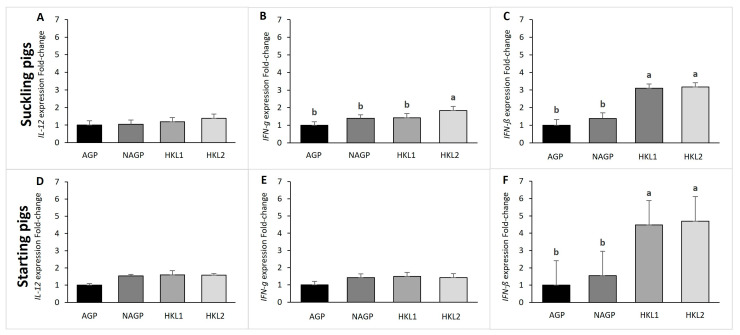
In the present study, the effects of dietary heat-killed L-137 (HK L-137) on the productive performance, intestinal morphology, and cytokine gene expression of suckling-to-fattening pigs were investigated. A total of 100 suckling pigs [(Large White × Landrace) × Duroc; 4.5 ± 0.54 kg initial body weight (BW)] were used and assigned to each of the four dietary treatments as follows: (1) a control diet with antibiotics as a growth promoter (AGP) from the suckling phase to the grower phase and no supplement in the finisher phases; (2) a control diet without antibiotics as a growth promoter (NAGP); (3) a control diet with HK L-137 at 20 mg/kg from the suckling phase to the starter phase and no supplement from the grower phase to the finisher phases (HKL1); and (4) a control diet with HK L-137 at 20 mg/kg from the suckling phase to the weaner phase, at 4 mg/kg from the starter phase to the finisher 1 phase, and no supplement in the finisher 2 phase (HKL2). During the weaner-starter period, the pigs fed on the AGP and HKL2 diets showed significantly higher weight gain and average daily gain (ADG) than those in the NAGP group ( < 0.05). The pigs in the AGP, HKL1, and HKL2 groups showed greater ADG than those in the NAGP groups ( < 0.05) throughout the grower-finisher period. The suckling pigs in the HKL1 and HKL2 groups showed a higher platelet count (484,500 and 575,750) than in the others ( < 0.05); however, there were no significant differences in the other hematological parameters among the treatment groups. The relative mRNA expression level of of the suckling and starter pigs were significantly higher in the HKL1 and HKL2 groups than in the others ( < 0.05), while the showed the highest level in the HKL2 suckling pigs ( < 0.05). These results demonstrate that a HK L-137 supplementation could stimulate the immune response in suckling and starter pigs and promote the growth performance in finishing pigs.
在本研究中,调查了日粮中热灭活的L-137(HK L-137)对哺乳仔猪至育肥猪生产性能、肠道形态和细胞因子基因表达的影响。总共使用了100头哺乳仔猪[(大白猪×长白猪)×杜洛克猪;初始体重(BW)为4.5±0.54千克],并将其分配到以下四种日粮处理组中:(1)从哺乳阶段到生长阶段添加抗生素作为生长促进剂(AGP)的对照日粮,育肥阶段不添加;(2)不添加抗生素作为生长促进剂的对照日粮(NAGP);(3)从哺乳阶段到起始阶段添加20毫克/千克HK L-137的对照日粮,从生长阶段到育肥阶段不添加(HKL1);(4)从哺乳阶段到断奶阶段添加20毫克/千克HK L-137,从起始阶段到育肥1阶段添加4毫克/千克,育肥2阶段不添加的对照日粮(HKL2)。在断奶-起始期,饲喂AGP和HKL2日粮的仔猪体重增加和平均日增重(ADG)显著高于NAGP组(P<0.05)。在整个生长-育肥期,AGP、HKL1和HKL2组的仔猪ADG高于NAGP组(P<0.05)。HKL1和HKL2组的哺乳仔猪血小板计数较高(分别为484,500和575,750),高于其他组(P<0.05);然而,各处理组间其他血液学参数无显著差异。HKL1和HKL2组哺乳仔猪和起始仔猪的相对mRNA表达水平显著高于其他组(P<0.05),而HKL2哺乳仔猪中该基因表达水平最高(P<0.05)。这些结果表明,添加HK L-137可刺激哺乳仔猪和起始仔猪的免疫反应,并促进育肥猪的生长性能。