Lundström Lina, Flygare Oskar, Ivanova Ekaterina, Mataix-Cols David, Enander Jesper, Pascal Diana, Chen Long-Long, Andersson Erik, Rück Christian
Centre for Psychiatry Research, Department of Clinical Neuroscience, Karolinska Institutet, and Stockholm Health Care Services, Region Stockholm, Karolinska University Hospital, SE-141 86 Stockholm, Sweden.
Centre for Psychiatry Research, Department of Clinical Neuroscience, Karolinska Institutet, SE-113 30 Stockholm, Sweden.
Internet Interv. 2023 Feb 15;31:100608. doi: 10.1016/j.invent.2023.100608. eCollection 2023 Mar.
Therapist-guided internet-delivered cognitive behaviour therapy (ICBT) is an efficacious treatment for obsessive-compulsive disorder (OCD) and body dysmorphic disorder (BDD), but it is unclear if the results obtained in controlled trials can be reproduced in clinical settings. We evaluated the implementation of ICBT for OCD (OCD-NET) and BDD (BDD-NET) in the Swedish public health system.
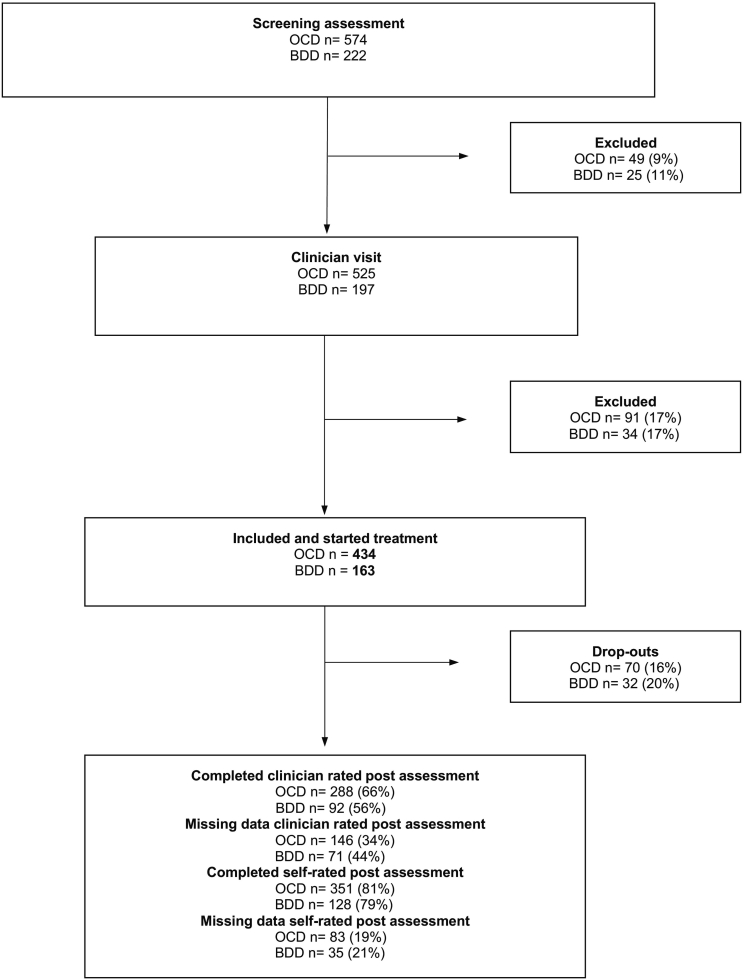
Consecutive referrals to an outpatient psychiatric clinic providing ICBT, with a primary diagnosis of OCD or BDD, were included in the study. Four hundred and thirty-four participants started OCD-NET and 163 started BDD-NET. The primary outcome measures were the Yale Brown Obsessive Compulsive Scale (Y-BOCS) and the Y-BOCS for BDD (BDD-YBOCS), respectively. Participants were assessed before treatment, weekly during treatment, and after treatment. The study used the RE-AIM implementation framework, and the elements of reach, effectiveness, adoption, and implementation for the evaluation.
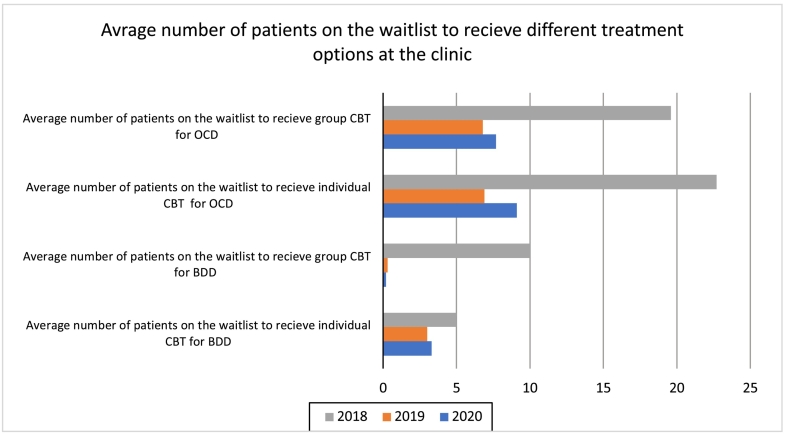
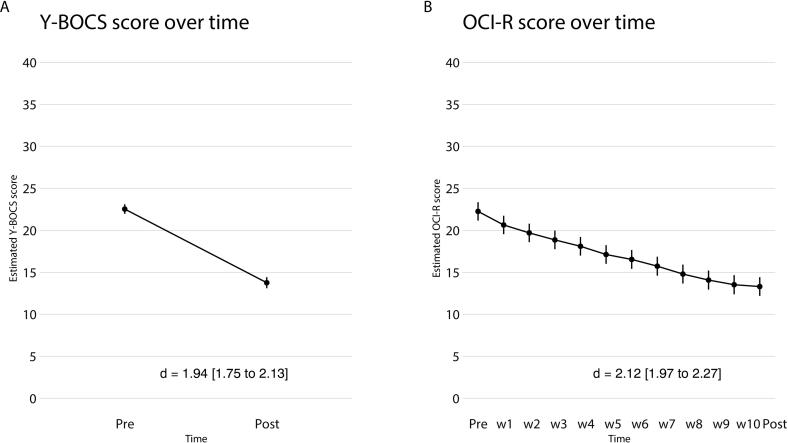
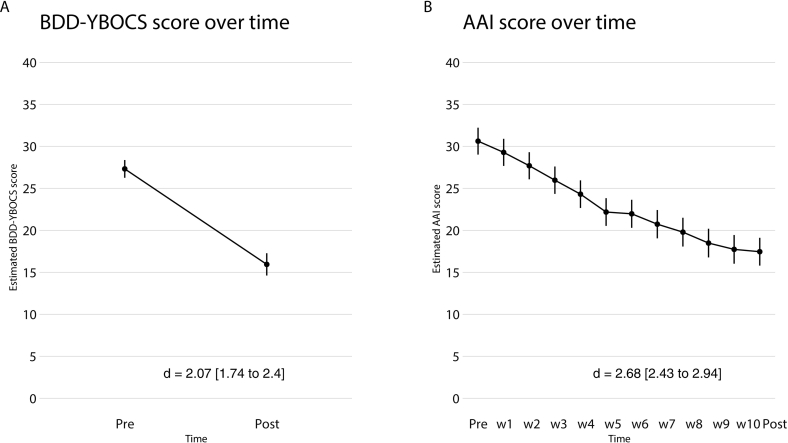
Intention to treat analysis of the OCD-NET sample ( = 434) showed a significant decrease in OCD symptoms from pre-treatment to post-treatment (mean reduction = -8.77 [95 % CI -9.48 to -8.05] < .001, = 1.94 [95 % CI 1.75 to 2.13]). Forty-nine percent (95 % CI 43 % to 56 %) of the participants in OCD-NET were classified as treatment responders and 21 % (95 % CI 16 % to 27 %) were in remission. Participants in BDD-NET ( = 163) also showed a significant decrease in BDD symptoms from pre-post treatment (mean reduction = -11.37 [95 % CI -12.9 to -9.87] < .001, = 2.07 [95 % CI 1.74 to 2.40]) and 69 % (95 % CI 58 % to 79 %) of the participants were classified as treatment responders and 48 % (95 % CI 38 % to 58 %) were in full or partial remission. Eighty-seven percent of the participants in OCD-NET and 78 % in BDD-NET were treatment completers and participants in both treatment groups reported a high treatment satisfaction at post treatment (OCD-NET = 87 %, BDD-NET = 79 %). The most reported negative effects attributed to the treatments were transient experiences of unpleasant feelings (52 %) and anxiety (50 %). The implementation also influenced treatment delivery and dramatically decreased the mean number of patients waiting to receive face-to-face treatment at the clinic.
Our results indicate that OCD-NET and BDD-NET are suitable treatments for implementation in a Swedish public health service.
治疗师指导的互联网认知行为疗法(ICBT)是治疗强迫症(OCD)和躯体变形障碍(BDD)的有效方法,但在临床环境中能否再现对照试验的结果尚不清楚。我们评估了ICBT在瑞典公共卫生系统中对强迫症(OCD-NET)和躯体变形障碍(BDD-NET)的实施情况。
连续转诊至提供ICBT的门诊精神科诊所,且初步诊断为OCD或BDD的患者纳入本研究。434名参与者开始接受OCD-NET治疗,163名参与者开始接受BDD-NET治疗。主要结局指标分别为耶鲁布朗强迫症量表(Y-BOCS)和BDD的Y-BOCS(BDD-YBOCS)。在治疗前、治疗期间每周以及治疗后对参与者进行评估。本研究采用RE-AIM实施框架,并使用可及性、有效性、采用率和实施情况等要素进行评估。
对OCD-NET样本(n = 434)的意向性分析显示,从治疗前到治疗后,OCD症状显著减轻(平均减轻=-8.77 [95%CI -9.48至-8.05],P <.001,d = 1.94 [95%CI 1.75至2.13])。OCD-NET中49%(95%CI 43%至56%)的参与者被归类为治疗反应者,21%(95%CI 16%至27%)达到缓解。BDD-NET(n = 163)的参与者从治疗前到治疗后BDD症状也显著减轻(平均减轻=-11.37 [95%CI -12.9至-9.87],P <.001,d = 2.07 [95%CI 1.74至2.40]),69%(95%CI 58%至79%)的参与者被归类为治疗反应者,48%(95%CI 38%至58%)达到完全或部分缓解。OCD-NET中87%的参与者和BDD-NET中78%的参与者完成了治疗,两个治疗组的参与者在治疗后均报告了较高的治疗满意度(OCD-NET = 87%,BDD-NET = 79%)。报告最多的与治疗相关的负面影响是短暂的不愉快情绪体验(52%)和焦虑(50%)。该实施还影响了治疗的提供,并显著减少了在诊所等待接受面对面治疗的患者平均人数。
我们的结果表明,OCD-NET和BDD-NET适合在瑞典公共卫生服务中实施。