Pharmacognosy and Natural Products Department, Faculty of Pharmacy, Pharos University, Alexandria, Egypt.
Clinical Pharmacology Department, Faculty of Medicine, Alexandria University, Alexandria, Egypt.
PLoS One. 2023 Feb 28;18(2):e0282246. doi: 10.1371/journal.pone.0282246. eCollection 2023.
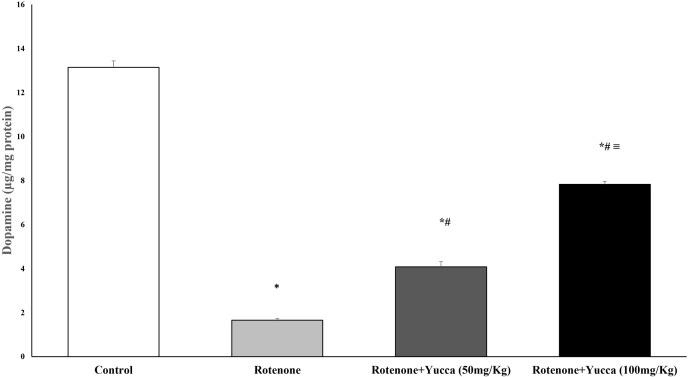
Yucca aloifolia L. fruit (Yucca or Spanish bayonet, family Asparagaceae) is recognized for its purplish red color reflecting its anthocyanin content, which has a powerful antioxidant activity. This study aimed to investigate yucca (YA) fruit extract's protective effect on Parkinson's disease (PD). In vitro study, the anti-inflammatory activity of yucca fruit extracts was explored by measuring tumor necrosis factor receptor 2 (TNF-R2) and nuclear factor kappa B (NF-KB) to choose the most effective extract. Afterward, a detailed in vivo investigation of the protective effect of the most active extract on rotenone-induced PD was performed on male albino Wister rats. First, the safety of the extract in two different doses (50 and 100 mg/kg in 0.9% saline orally) was confirmed by a toxicological study. The rats were divided into four groups: 1) normal control (NC); 2) rotenone group; and third and fourth groups received 50 and 100 mg/kg yucca extract, respectively. The neurobehavioral and locomotor activities of the rats were tested by rotarod, open field, and forced swim tests. Striatal dopamine, renal and liver functions, and oxidative stress markers were assessed. Western blot analysis of brain tissue samples was performed for p-AMPK, Wnt3a, and β-catenin. Histopathological examination of striatal tissue samples was performed by light and electron microscopy (EM). The metabolites of the active extract were characterized using high-resolution LC-MS/MS, and the results showed the prevalence of anthocyanins, saponins, phenolics, and choline. Biochemical and histopathological tests revealed a dose-dependent improvement with oral Yucca extract. The current study suggests a possible neuroprotective effect of the acidified 50% ethanol extract (YA-C) of the edible Yucca fruit, making it a promising therapeutic target for PD.
丝兰(Yucca aloifolia L.,天门冬科丝兰属)的果实因呈现出紫红色而闻名,这是其所含花青苷的显色效果,而花青苷具有强大的抗氧化活性。本研究旨在探讨丝兰(YA)果提取物对帕金森病(PD)的保护作用。体外研究通过测量肿瘤坏死因子受体 2(TNF-R2)和核因子 kappa B(NF-KB)来探索丝兰果提取物的抗炎活性,从而选择最有效的提取物。随后,对最有效提取物在鱼藤酮诱导的 PD 中的保护作用进行了详细的体内研究,研究对象为雄性白化 Wister 大鼠。首先,通过毒理学研究证实了该提取物在两种不同剂量(50 和 100mg/kg,口服 0.9%生理盐水)下的安全性。将大鼠分为四组:1)正常对照组(NC);2)鱼藤酮组;第三和第四组分别给予 50 和 100mg/kg 丝兰提取物。通过转棒、旷场和强迫游泳试验测试大鼠的神经行为和运动活动。评估纹状体多巴胺、肾和肝功能以及氧化应激标志物。对脑组织样品进行 Western blot 分析,检测 p-AMPK、Wnt3a 和 β-catenin。通过光镜和电子显微镜(EM)对纹状体组织样品进行组织病理学检查。使用高分辨率 LC-MS/MS 对活性提取物的代谢物进行表征,结果表明存在花青苷、皂苷、酚类和胆碱。生化和组织病理学测试表明,口服丝兰提取物具有剂量依赖性的改善作用。本研究表明,食用丝兰的酸化 50%乙醇提取物(YA-C)可能具有神经保护作用,使其成为 PD 的有希望的治疗靶点。