Department of Mechanical Engineering, Faculty of Engineering, Diponegoro University, Semarang, 50275, Central Java, Indonesia.
Department of Mechanical Engineering, Faculty of Engineering, Pasundan University, Bandung, 40153, West Java, Indonesia.
Sci Rep. 2023 Mar 2;13(1):3564. doi: 10.1038/s41598-023-30725-6.
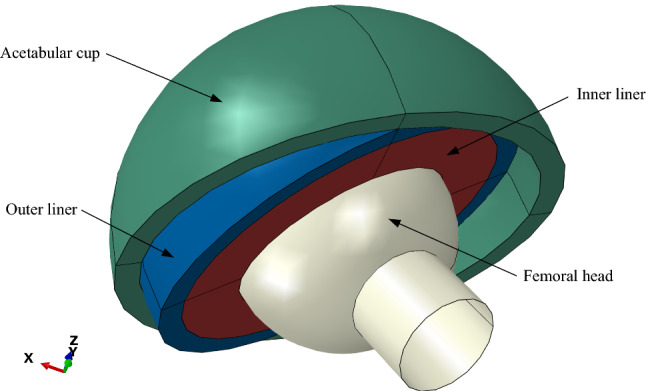
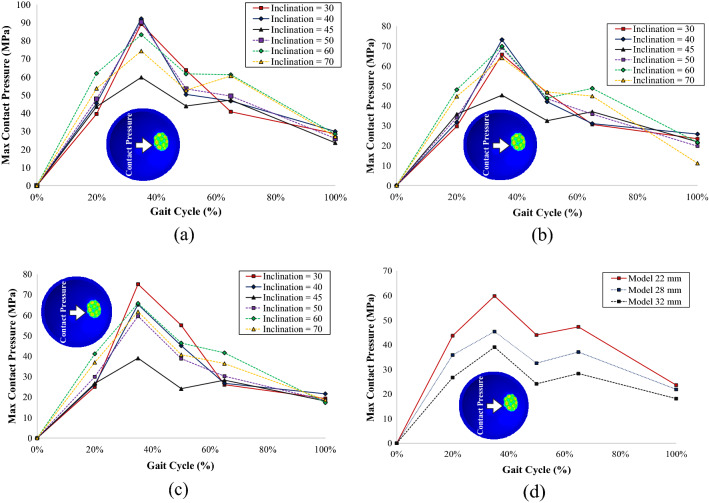
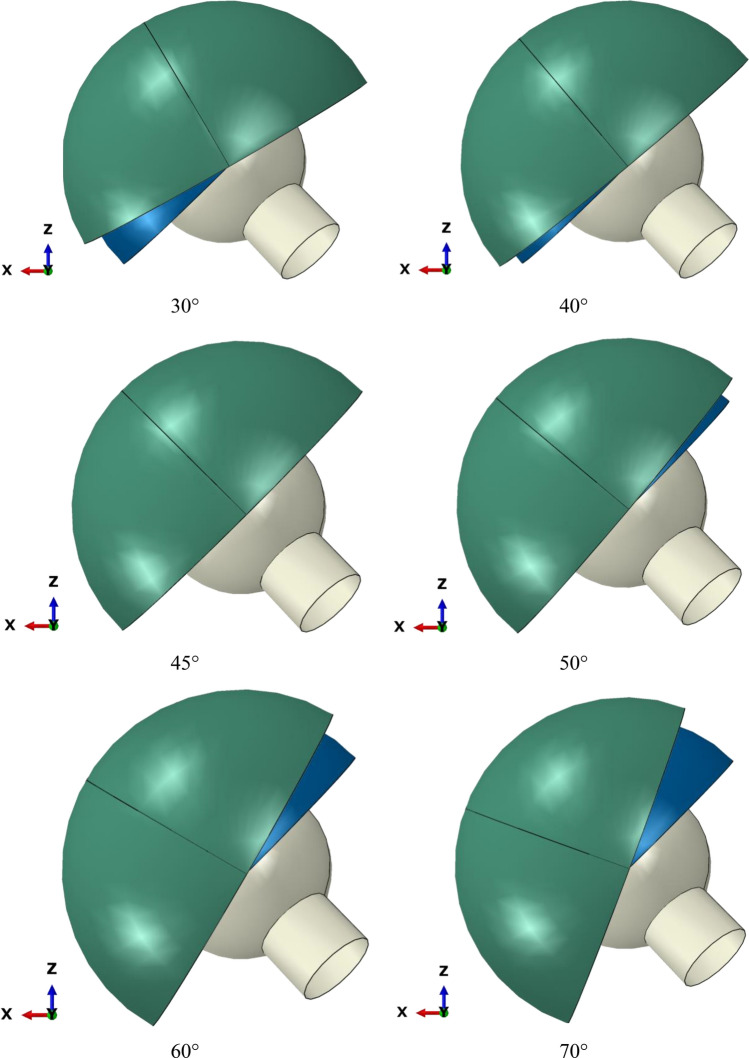
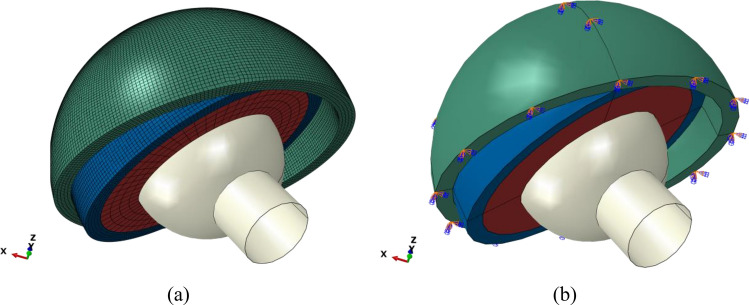
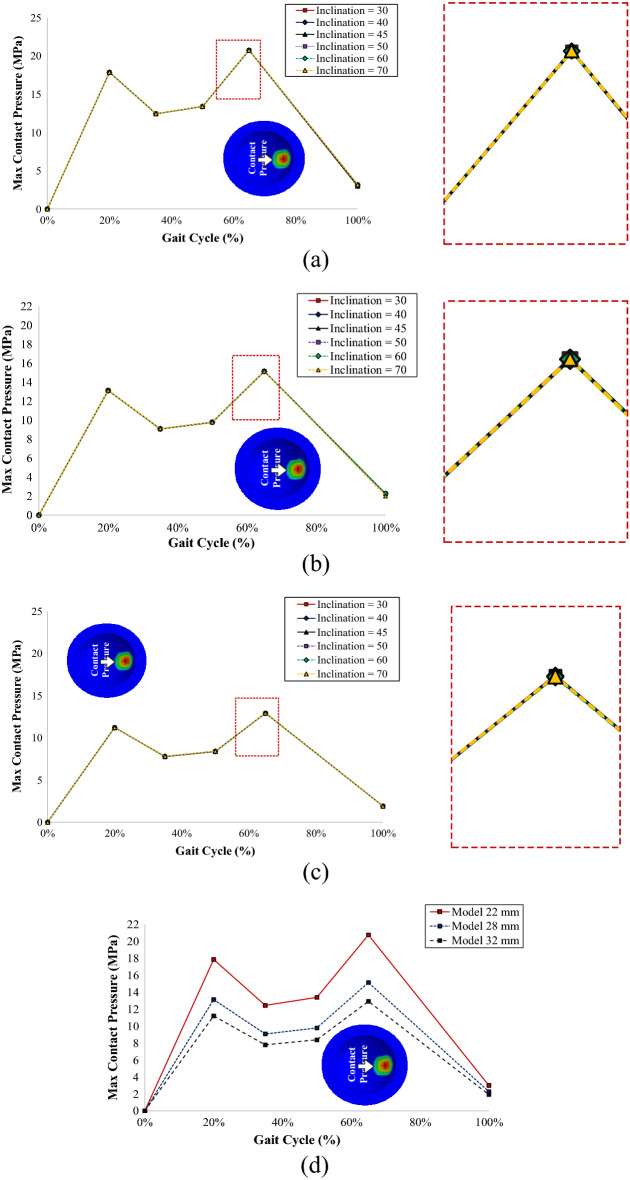
Hip joint prostheses are used to replace hip joint function in the human body. The latest dual-mobility hip joint prosthesis has an additional component of an outer liner that acts as a cover for the liner component. Research on the contact pressure generated on the latest model of a dual-mobility hip joint prosthesis under a gait cycle has never been done before. The model is made of ultrahigh molecular weight polyethylene (UHMWPE) on the inner liner and 316L stainless steel (SS 316L) on the outer liner and acetabular cup. Simulation modeling using the finite element method is considered static loading with an implicit solver for studying the geometric parameter design of dual-mobility hip joint prostheses. In this study, simulation modeling was carried out by applying varying inclination angles of 30°, 40°, 45°, 50°, 60°, and 70° to the acetabular cup component. Three-dimensional loads were placed on femoral head reference points with variations of femoral head diameter used at 22 mm, 28 mm, and 32 mm. The results in the inner surface of the inner liner, the outer surface of the outer liner, and the inner surface of the acetabular cup showed that the variations in inclination angle do not have a major effect on the maximum contact pressure value on the liner component, where the acetabular cup with an inclination angle of 45° can reduce contact pressure more than the other studied inclination angle variations. In addition, it was found that the 22 mm diameter of the femoral head increases the contact pressure. The use of a larger diameter femoral head with an acetabular cup configuration at a 45° inclination can minimize the risk of implant failure due to wear.
髋关节假体用于替代人体髋关节的功能。最新的双动髋关节假体有一个额外的组件,即外衬,作为衬里组件的覆盖物。以前从未对步态周期下最新款双动髋关节假体产生的接触压力进行过研究。该模型的内衬采用超高分子量聚乙烯(UHMWPE),外衬和髋臼杯采用 316L 不锈钢(SS 316L)。使用有限元法的模拟建模被认为是静态加载,采用隐式求解器来研究双动髋关节假体的几何参数设计。在这项研究中,通过将髋臼杯组件的倾斜角度分别设置为 30°、40°、45°、50°、60°和 70°,进行了模拟建模。在股骨头参考点上放置三维载荷,并使用 22mm、28mm 和 32mm 的股骨头直径进行变化。在内衬的内表面、外衬的外表面和髋臼杯的内表面的结果表明,倾斜角度的变化对衬里组件上最大接触压力值没有重大影响,其中倾斜角度为 45°的髋臼杯可以比其他研究的倾斜角度变化更有效地降低接触压力。此外,研究还发现,股骨头直径为 22mm 会增加接触压力。在 45°倾斜角的髋臼杯配置中使用更大直径的股骨头可以最大限度地降低因磨损导致植入物失效的风险。