Goel Muskan, Mackeyev Yuri, Krishnan Sunil
Amity School of Applied Sciences, Amity University, Gurugram, Haryana 122413 India.
Vivian L. Smith Department of Neurosurgery, University of Texas Health Science Center, Houston, TX 77030 USA.
Cancer Nanotechnol. 2023;14(1):15. doi: 10.1186/s12645-023-00165-y. Epub 2023 Feb 27.
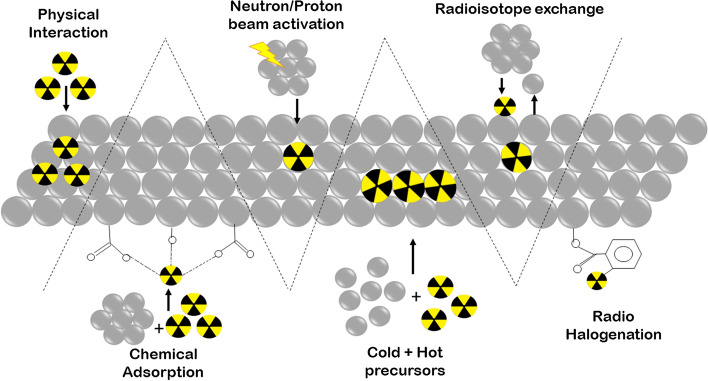
In the last three decades, radiopharmaceuticals have proven their effectiveness for cancer diagnosis and therapy. In parallel, the advances in nanotechnology have fueled a plethora of applications in biology and medicine. A convergence of these disciplines has emerged more recently with the advent of nanotechnology-aided radiopharmaceuticals. Capitalizing on the unique physical and functional properties of nanoparticles, radiolabeled nanomaterials or nano-radiopharmaceuticals have the potential to enhance imaging and therapy of human diseases. This article provides an overview of various radionuclides used in diagnostic, therapeutic, and theranostic applications, radionuclide production through different techniques, conventional radionuclide delivery systems, and advancements in the delivery systems for nanomaterials. The review also provides insights into fundamental concepts necessary to improve currently available radionuclide agents and formulate new nano-radiopharmaceuticals.
在过去三十年中,放射性药物已证明其在癌症诊断和治疗方面的有效性。与此同时,纳米技术的进步推动了其在生物学和医学领域的大量应用。随着纳米技术辅助放射性药物的出现,这些学科最近出现了融合。利用纳米颗粒独特的物理和功能特性,放射性标记的纳米材料或纳米放射性药物有潜力增强人类疾病的成像和治疗效果。本文概述了用于诊断、治疗和诊疗应用的各种放射性核素、通过不同技术生产放射性核素、传统放射性核素递送系统以及纳米材料递送系统的进展。该综述还深入探讨了改进现有放射性核素药物和研发新型纳米放射性药物所需的基本概念。