Zhao Yan-Jie, Zhang Cheng, Guo Tong, Sha Sha, Su Zhaohui, Cheung Teris, Jackson Todd, An Feng-Rong, Xiang Yu-Tao
Beijing Key Laboratory of Mental Disorders, Beijing Anding Hospital, The National Clinical Research Center for Mental Disorders, The Advanced Innovation Center for Human Brain Protection, School of Mental Health, Capital Medical University, Beijing, China.
Yong Ding Lu Outpatient Department, Jingnan Medical Area, Chinese PLA General Hospital, Beijing, China.
Front Psychiatry. 2023 Feb 15;14:975443. doi: 10.3389/fpsyt.2023.975443. eCollection 2023.
Post-traumatic stress symptoms (PTSS) are commonly reported by psychiatric healthcare personnel during the coronavirus disease 2019 (COVID-19) pandemic and negatively affect quality of life (QOL). However, associations between PTSS and QOL at symptom level are not clear. This study examined the network structure of PTSS and its connection with QOL in psychiatric healthcare personnel during the COVID-19 pandemic.
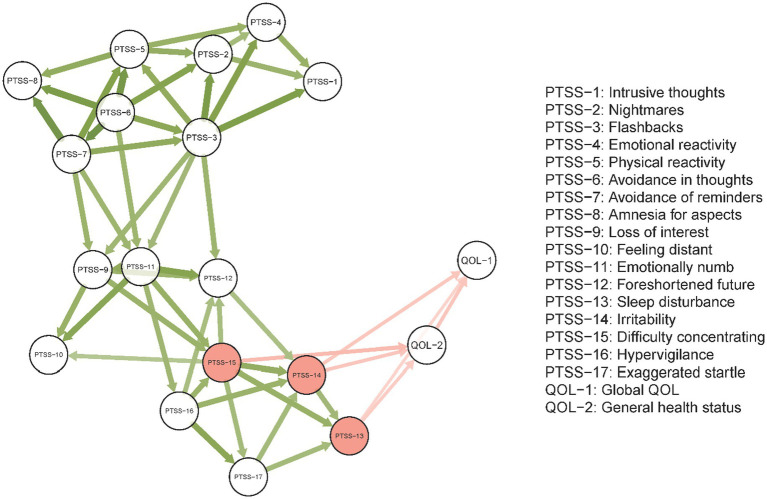
This cross-sectional study was carried out between March 15 and March 20, 2020 based on convenience sampling. Self-report measures including the 17-item Post-Traumatic Stress Disorder Checklist - Civilian version (PCL-C) and World Health Organization Quality of Life Questionnaire - Brief Version (WHOQOL-BREF) were used to measure PTSS and global QOL, respectively. Network analysis was used to investigate the central symptoms of PTSS and pattern of connections between PTSS and QOL. An undirected network was constructed using an extended Bayesian Information Criterion (EBIC) model, while a directed network was established based on the Triangulated Maximally Filtered Graph (TMFG) method.
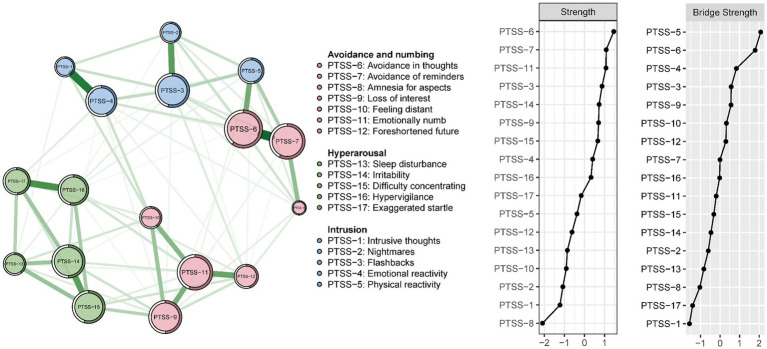
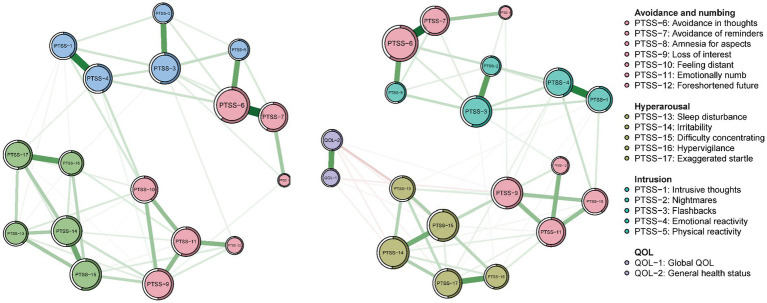
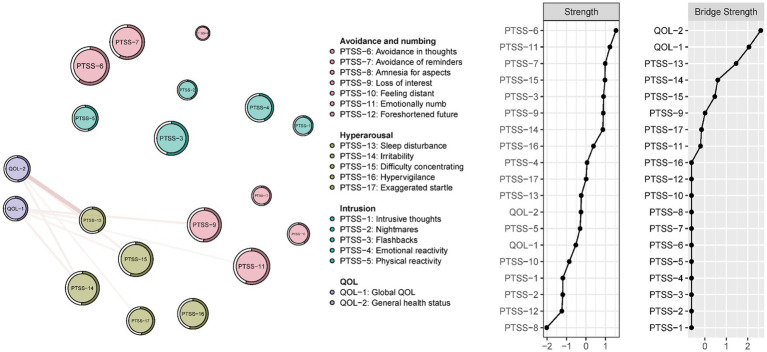
Altogether, 10,516 psychiatric healthcare personnel completed the assessment. "Avoidance of thoughts" (PTSS-6), "Avoidance of reminders" (PTSS-7), and "emotionally numb" (PTSS-11) were the most central symptoms in the PTSS community, all of which were in the domain. Key bridge symptoms connecting PTSS and QOL were "Sleep disturbances" (PTSS-13), "Irritability" (PTSS-14) and "Difficulty concentrating" (PTSS-15), all of which were within the domain.
In this sample, the most prominent PTSS symptoms reflected avoidance while symptoms of hyper-arousal had the strongest links with QOL. As such, these symptom clusters are potentially useful targets for interventions to improve PTSS and QOL among healthcare personnel at work under pandemic conditions.
在2019冠状病毒病(COVID-19)大流行期间,创伤后应激症状(PTSS)在精神科医护人员中普遍存在,并对生活质量(QOL)产生负面影响。然而,PTSS与症状层面的生活质量之间的关联尚不清楚。本研究探讨了COVID-19大流行期间精神科医护人员PTSS的网络结构及其与生活质量的联系。
本横断面研究于2020年3月15日至3月20日基于便利抽样进行。采用自我报告测量方法,分别使用17项创伤后应激障碍检查表-平民版(PCL-C)和世界卫生组织生活质量问卷-简版(WHOQOL-BREF)测量PTSS和总体生活质量。网络分析用于研究PTSS的核心症状以及PTSS与生活质量之间的联系模式。使用扩展贝叶斯信息准则(EBIC)模型构建无向网络,同时基于三角最大过滤图(TMFG)方法建立有向网络。
共有10516名精神科医护人员完成了评估。“回避想法”(PTSS-6)、“回避提示物”(PTSS-7)和“情感麻木”(PTSS-11)是PTSS群落中最核心的症状,均属于[具体领域]。连接PTSS和生活质量的关键桥梁症状是“睡眠障碍”(PTSS-13)、“易怒”(PTSS-14)和“注意力不集中”(PTSS-15),均属于[具体领域]。
在本样本中,最突出的PTSS症状反映了回避,而过度唤醒症状与生活质量的联系最为紧密。因此,这些症状群可能是在大流行条件下改善医护人员工作中PTSS和生活质量干预措施的潜在有用目标。