Kan Hong, Zhang Dongxue, Chen Weijia, Wang Shihan, He Zhongmei, Pang Shifeng, Qu Shuai, Wang Yingping
College of Chinese Medicinal Materials, Jilin Agricultural University, Changchun 130118, China.
Institute of Special Animal and Plant Sciences of Chinese Academy of Agricultural Sciences, Changchun 130112, China.
Chin Herb Med. 2022 Oct 17;15(1):123-131. doi: 10.1016/j.chmed.2022.04.003. eCollection 2023 Jan.
This study aimed to identify the main medicinal active components of () in the compatibility environment of clinical application. For this purpose, the anti-inflammatory ingredients of were investigated based on its therapeutic effect in Sijunzi Decoction (SJD) which is a widely used traditional Chinese formula.
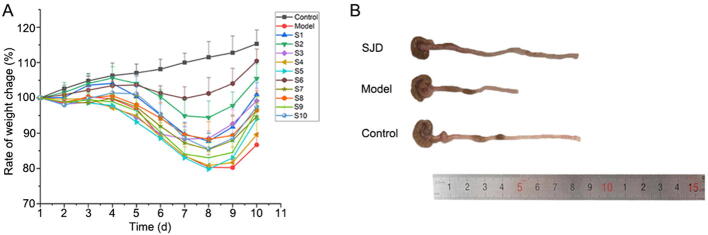
The fingerprints of 10 batches of SJD consisting of different sources of were established by UPLC technique to investigate the chemical components. At the same time, the anti-inflammatory effects of these components were evaluated by dextran sulfate sodium-induced ulcerative colitis mouse model. Grey relational analysis was applied to explore the correlation degree between fingerprints and anti-inflammatory effects in SJD. Lipopolysaccharide-stimulated RAW264.7 murine macrophages were established to evaluate the anti-inflammatory action of the screened effective substances of .
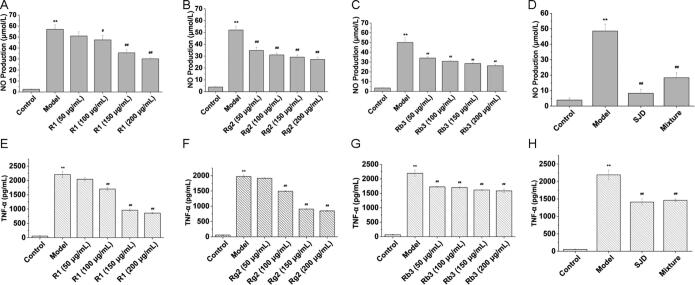
According to grey relational analysis, notoginsenoside R, ginsenoside Rg and ginsenoside Rb of were the major anti-inflammatory contributions in SJD. They had been proven to be closely associated with the anti-inflammatory process of SJD and displayed a close effect compared with SJD by LPS-stimulated RAW264.7 murine macrophages.
Our work provides a general strategy for exploring the pharmacological ingredients of in traditional Chinese formulas which is beneficial for establishing the quality standards of traditional herbs in traditional Chinese medicine prescription based on their clinical therapeutic effect.
本研究旨在确定()在临床应用配伍环境中的主要药用活性成分。为此,基于其在广泛应用的传统中药方剂四君子汤(SJD)中的治疗效果,对()的抗炎成分进行了研究。
采用超高效液相色谱(UPLC)技术建立了10批由不同来源()组成的SJD的指纹图谱,以研究其化学成分。同时,通过葡聚糖硫酸钠诱导的溃疡性结肠炎小鼠模型评估这些成分的抗炎作用。应用灰色关联分析探讨SJD指纹图谱与抗炎作用之间的相关程度。建立脂多糖刺激的RAW264.7小鼠巨噬细胞模型,以评估筛选出的()有效物质的抗炎作用。
根据灰色关联分析,()中的三七皂苷R、人参皂苷Rg和人参皂苷Rb是SJD中主要的抗炎成分。它们已被证明与SJD的抗炎过程密切相关,并且通过脂多糖刺激的RAW264.7小鼠巨噬细胞显示出与SJD相似的紧密作用。
我们的工作为探索传统中药方剂中()的药理成分提供了一种通用策略,这有助于基于传统中药方剂的临床治疗效果建立传统草药的质量标准。