
一种利用诱变和环状聚合酶延伸克隆快速生成传染性严重急性呼吸综合征冠状病毒2(SARS-CoV-2)及其变体的方法。
A Rapid Method for Generating Infectious SARS-CoV-2 and Variants Using Mutagenesis and Circular Polymerase Extension Cloning.
作者信息
Kim Beom Kyu, Choi Won-Suk, Jeong Ju Hwan, Oh Sol, Park Ji-Hyun, Yun Yu Soo, Min Seong Cheol, Kang Da Hyeon, Kim Eung-Gook, Ryu Hojin, Kim Hye Kwon, Baek Yun Hee, Choi Young Ki, Song Min-Suk
机构信息
Department of Microbiology, Chungbuk National University, College of Medicine and Medical Research Institute, Cheongju, Chungbuk, Republic of Korea.
Department of Biochemistry, Chungbuk National University, College of Medicine and Medical Research Institute, Cheongju, Chungbuk, Republic of Korea.
出版信息
Microbiol Spectr. 2023 Mar 6;11(2):e0338522. doi: 10.1128/spectrum.03385-22.
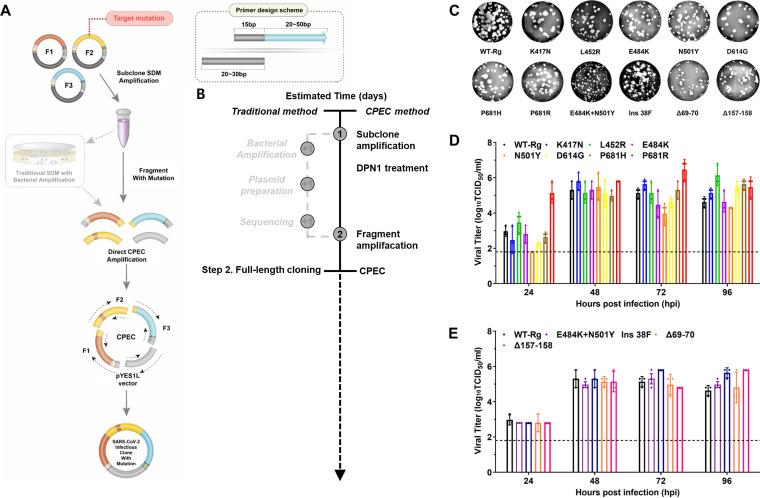
The appearance of SARS-CoV-2 variants in late 2020 raised alarming global public health concerns. Despite continued scientific progress, the genetic profiles of these variants bring changes in viral properties that threaten vaccine efficacy. Thus, it is critically important to investigate the biologic profiles and significance of these evolving variants. In this study, we demonstrate the application of circular polymerase extension cloning (CPEC) to the generation of full-length clones of SARS-CoV-2. We report that, combined with a specific primer design scheme, this yields a simpler, uncomplicated, and versatile approach for engineering SARS-CoV-2 variants with high viral recovery efficiency. This new strategy for genomic engineering of SARS-CoV-2 variants was implemented and evaluated for its efficiency in generating point mutations (K417N, L452R, E484K, N501Y, D614G, P681H, P681R, Δ69-70, Δ157-158, E484K+N501Y, and Ins-38F) and multiple mutations (N501Y/D614G and E484K/N501Y/D614G), as well as a large truncation (ΔORF7A) and insertion (GFP). The application of CPEC to mutagenesis also allows the inclusion of a confirmatory step prior to assembly and transfection. This method could be of value in the molecular characterization of emerging SARS-CoV-2 variants as well as the development and testing of vaccines, therapeutic antibodies, and antivirals. Since the first emergence of the SARS-CoV-2 variant in late 2020, novel variants have been continuously introduced to the human population, causing severe public health threats. In general, because these variants acquire new genetic mutation/s, it is critical to analyze the biological function of viruses that such mutations can confer. Therefore, we devised a method that can construct SARS-CoV-2 infectious clones and their variants rapidly and efficiently. The method was developed based on a PCR-based circular polymerase extension cloning (CPEC) combined with a specific primer design scheme. The efficiency of the newly designed method was evaluated by generating SARS-CoV-2 variants with single point mutations, multiple point mutations, and a large truncation and insertion. This method could be of value for the molecular characterization of emerging SARS-CoV-2 variants and the development and testing of vaccines and antiviral agents.
2020年末出现的严重急性呼吸综合征冠状病毒2(SARS-CoV-2)变体引发了全球公共卫生方面的高度关注。尽管科学仍在不断进步,但这些变体的基因特征带来了病毒特性的变化,对疫苗效力构成了威胁。因此,研究这些不断演变的变体的生物学特征及意义至关重要。在本研究中,我们展示了环状聚合酶延伸克隆(CPEC)在生成SARS-CoV-2全长克隆中的应用。我们报告称,结合特定的引物设计方案,这为构建具有高病毒回收效率的SARS-CoV-2变体提供了一种更简单、不复杂且通用的方法。实施并评估了这种针对SARS-CoV-2变体进行基因组工程的新策略在产生点突变(K417N、L452R、E484K、N501Y、D614G、P681H、P681R、Δ69 - 70、Δ157 - 158、E484K + N501Y和Ins - 38F)、多个突变(N501Y/D614G和E484K/N501Y/D614G)以及一个大的截短(ΔORF7A)和插入(绿色荧光蛋白,GFP)方面的效率。将CPEC应用于诱变还允许在组装和转染之前加入一个验证步骤。该方法对于新出现的SARS-CoV-2变体的分子特征分析以及疫苗、治疗性抗体和抗病毒药物的开发与测试可能具有价值。自2020年末首次出现SARS-CoV-2变体以来,新的变体不断出现在人群中,造成了严重公共卫生威胁。一般来说,由于这些变体获得了新的基因突变,分析此类突变可能赋予病毒的生物学功能至关重要。因此,我们设计了一种能够快速高效构建SARS-CoV-2感染性克隆及其变体的方法。该方法基于一种基于聚合酶链反应(PCR)的环状聚合酶延伸克隆(CPEC)并结合特定引物设计方案开发而成。通过产生具有单点突变、多点突变以及大截短和插入的SARS-CoV-2变体来评估新设计方法的效率。该方法对于新出现的SARS-CoV-2变体的分子特征分析以及疫苗和抗病毒药物的开发与测试可能具有价值。



 Zotero 插件