School of Nursing, Guangxi Medical University, Nanning, Guangxi, China.
Duke University School of Nursing, Durham, North Carolina, USA.
BMJ Glob Health. 2023 Feb;8(3). doi: 10.1136/bmjgh-2022-010556.
The number of children in sexual minority parent families has increased. This systematic review aims to synthesise the evidence of disparities in family outcomes between sexual minority and heterosexual families and to identify specific social risk factors of poor family outcomes.
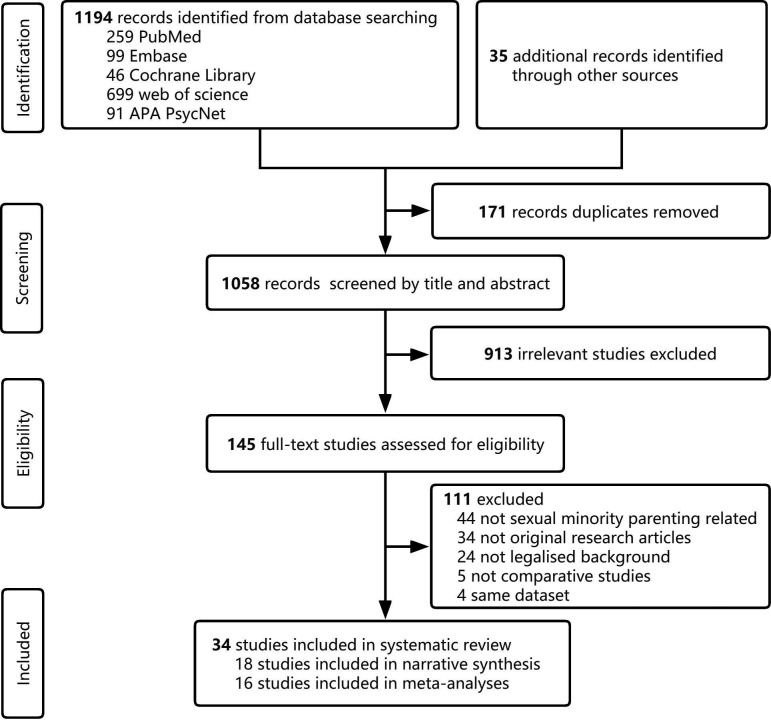
We systematically searched PubMed, the Web of Science, Embase, the Cochrane Library and APA PsycNet for original studies that compared family outcomes between sexual minority and heterosexual families. Two reviewers independently selected studies and assessed the risk of bias of included studies. Narrative synthesis and meta-analysis were conducted to synthesise evidence.
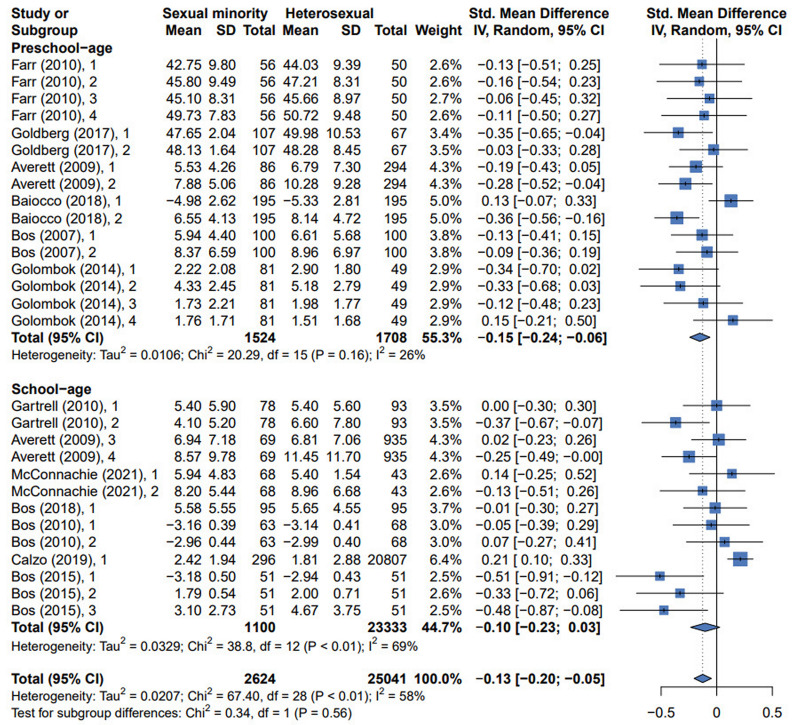
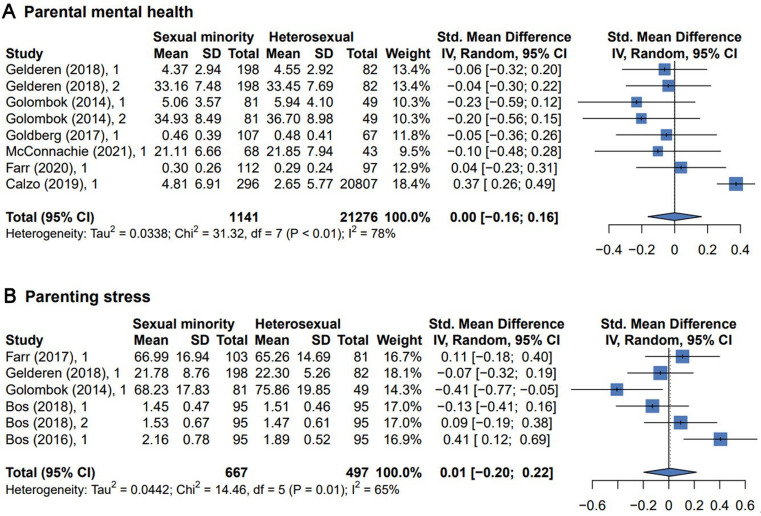
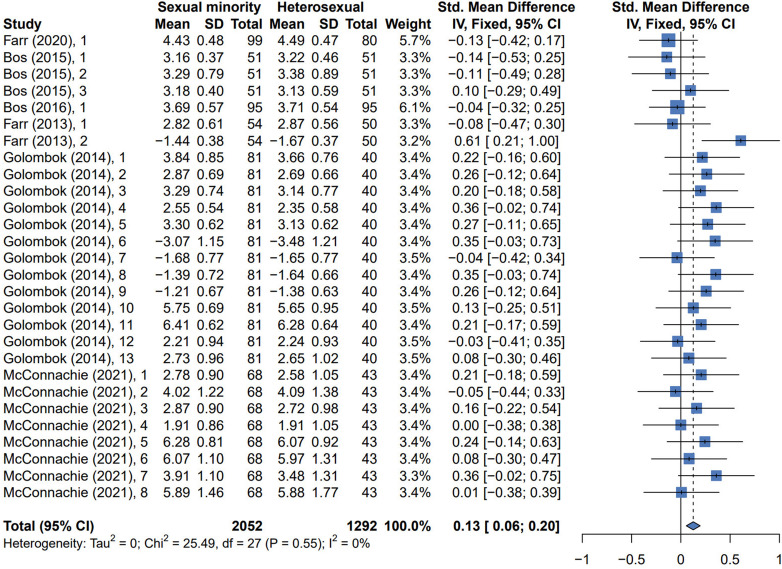
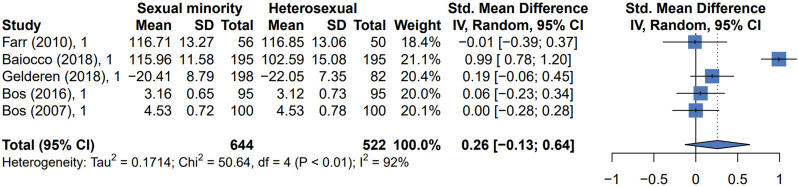
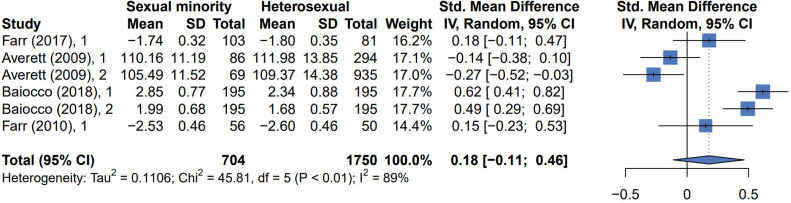
Thirty-four articles were included. The narrative synthesis results revealed several significant findings for children's gender role behaviour and gender identity/sexual orientation outcomes. Overall, 16 of 34 studies were included in the meta-analyses. The quantitative synthesis results suggested that sexual minority families may perform better in children's psychological adjustment and parent-child relationship than heterosexual families (standardised mean difference (SMD) -0.13, 95% CI -0.20 to -0.05; SMD 0.13, 95% CI 0.06 to 0.20), but not couple relationship satisfaction (SMD 0.26, 95% CI -0.13 to 0.64), parental mental health (SMD 0.00, 95% CI -0.16 to 0.16), parenting stress (SMD 0.01, 95% CI -0.20 to 0.22) or family functioning (SMD 0.18, 95% CI -0.11 to 0.46).
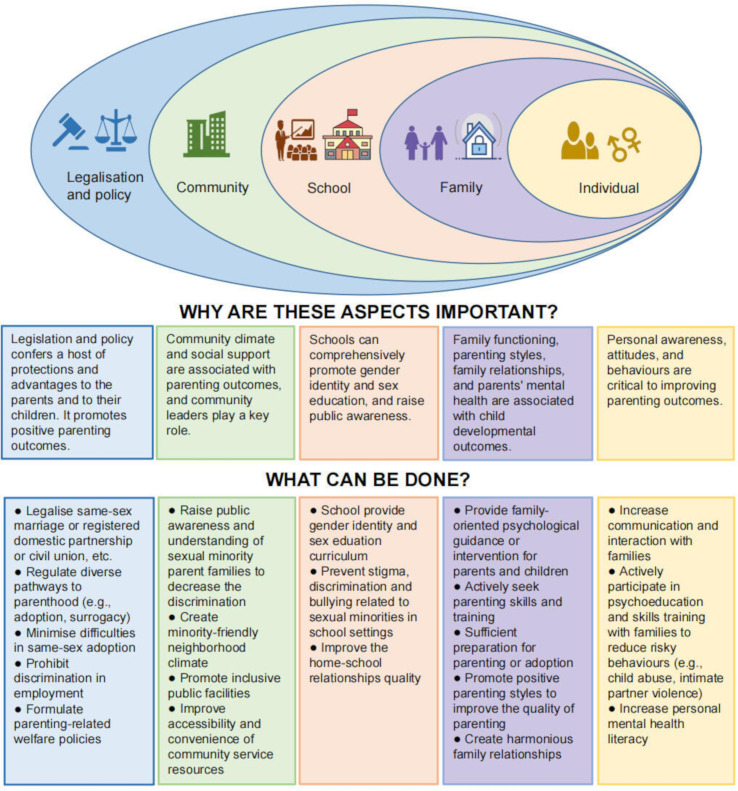
Most of the family outcomes are similar between sexual minority and heterosexual families, and sexual minority families have even better outcomes in some domains. Relevant social risk factors of poor family outcomes included stigma and discrimination, poor social support and marital status, etc. The next step is to integrate multiple aspects of support and multilevel interventions to reduce the adverse effects on family outcomes with a long-term goal of influencing policy and law making for better services to individuals, families, communities and schools.
有性少数群体父母的儿童数量有所增加。本系统综述旨在综合有性少数群体家庭与异性恋家庭在家庭结果方面存在差异的证据,并确定导致家庭结果不佳的具体社会风险因素。
我们系统地检索了 PubMed、Web of Science、Embase、Cochrane 图书馆和 APA PsycNet,以获取比较有性少数群体家庭与异性恋家庭家庭结果的原始研究。两位评审员独立筛选研究并评估纳入研究的偏倚风险。采用叙述性综合和荟萃分析来综合证据。
共纳入 34 篇文章。叙述性综合结果显示,在儿童的性别角色行为和性别认同/性取向结果方面有一些显著发现。总体而言,有 16 项研究纳入荟萃分析。定量综合结果表明,有性少数群体家庭在儿童的心理调整和亲子关系方面的表现可能优于异性恋家庭(标准化均数差(SMD)-0.13,95%置信区间(CI)-0.20 至 -0.05;SMD 0.13,95%CI 0.06 至 0.20),但在夫妻关系满意度(SMD 0.26,95%CI -0.13 至 0.64)、父母心理健康(SMD 0.00,95%CI -0.16 至 0.16)、育儿压力(SMD 0.01,95%CI -0.20 至 0.22)或家庭功能(SMD 0.18,95%CI -0.11 至 0.46)方面无差异。
大多数家庭结果在有性少数群体家庭与异性恋家庭之间相似,且有性少数群体家庭在某些领域的结果甚至更好。家庭结果不佳的相关社会风险因素包括污名和歧视、社会支持和婚姻状况不佳等。下一步是整合多方面的支持和多层次的干预措施,以减少对家庭结果的不利影响,长期目标是影响政策和法律制定,为个人、家庭、社区和学校提供更好的服务。