Mossakowski Medical Research Centre, Polish Academy of Sciences and Central Clinical Hospital MSWiA, Warsaw, Poland.
St John's Research Institute, Bangalore, India.
Cardiovasc Diabetol. 2023 Mar 10;22(1):52. doi: 10.1186/s12933-023-01757-z.
In clinical practice, anthropometric measures other than BMI are rarely assessed yet may be more predictive of cardiovascular (CV) risk. We analyzed the placebo group of the REWIND CV Outcomes Trial to compare several anthropometric measures as baseline risk factors for cardiovascular disease (CVD)-related outcomes in participants with type 2 diabetes (T2D).
Data from the REWIND trial placebo group (N = 4952) were analyzed. All participants had T2D, age ≥ 50 years, had either a previous CV event or CV risk factors, and a BMI of ≥ 23 kg/m. Cox proportional hazard models were used to investigate if BMI, waist-to-hip ratio (WHR), and waist circumference (WC) were significant risk factors for major adverse CV events (MACE)-3, CVD-related mortality, all-cause mortality, and heart failure (HF) requiring hospitalization. Models were adjusted for age, sex, and additional baseline factors selected by LASSO method. Results are presented for one standard deviation increase of the respective anthropometric factor.
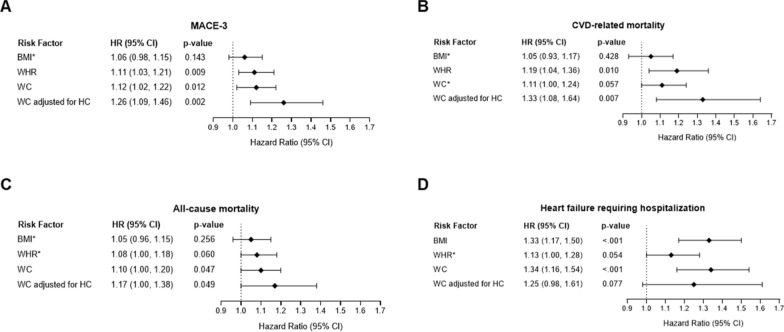
Participants in the placebo group experienced 663 MACE-3 events, 346 CVD-related deaths, 592 all-cause deaths, and 226 events of HF requiring hospitalization during the median follow-up of 5.4 years. WHR and WC, but not BMI, were identified as independent risk factors of MACE-3 (hazard ratio [HR] for WHR: 1.11 [95% CI 1.03 to 1.21]; p = 0.009; HR for WC: 1.12 [95% CI 1.02 to 1.22]; p = 0.012). WC adjusted for hip circumference (HC) showed the strongest association with MACE-3 compared to WHR, WC, or BMI unadjusted for each other (HR: 1.26 [95% CI 1.09 to 1.46]; p = 0.002). Results for CVD-related mortality and all-cause mortality were similar. WC and BMI were risk factors for HF requiring hospitalization, but not WHR or WC adjusted for HC (HR for WC: 1.34 [95% CI 1.16 to 1.54]; p < 0.001; HR for BMI: 1.33 [95% CI 1.17 to 1.50]; p < 0.001). No significant interaction with sex was observed.
In this post hoc analysis of the REWIND placebo group, WHR, WC and/or WC adjusted for HC were risk factors for MACE-3, CVD-related mortality, and all-cause mortality; while BMI was only a risk factor for HF requiring hospitalization. These findings indicate the need for anthropometric measures that consider body fat distribution when assessing CV risk.
在临床实践中,除了 BMI 之外,很少评估人体测量学指标,但这些指标可能更能预测心血管 (CV) 风险。我们分析了 REWIND CV 结局试验的安慰剂组,以比较几种人体测量学指标作为 2 型糖尿病 (T2D) 患者心血管疾病 (CVD) 相关结局的基线风险因素。
分析了 REWIND 试验安慰剂组 (N=4952) 的数据。所有参与者均患有 T2D,年龄≥50 岁,既往有 CV 事件或 CV 危险因素,且 BMI≥23kg/m2。使用 Cox 比例风险模型来研究 BMI、腰臀比 (WHR) 和腰围 (WC) 是否是主要不良 CV 事件 (MACE)-3、CVD 相关死亡率、全因死亡率和需要住院的心衰 (HF) 的显著风险因素。模型根据年龄、性别和 LASSO 方法选择的其他基线因素进行了调整。结果以各自人体测量因素的一个标准差增加表示。
在中位随访 5.4 年期间,安慰剂组的 663 名参与者发生了 MACE-3 事件,346 名参与者发生了 CVD 相关死亡,592 名参与者发生了全因死亡,226 名参与者发生了需要住院的 HF。WHR 和 WC,但不是 BMI,被确定为 MACE-3 的独立风险因素 (WHR 的 HR:1.11[95%CI 1.03 至 1.21];p=0.009;WC 的 HR:1.12[95%CI 1.02 至 1.22];p=0.012)。与未相互调整的 WHR、WC 或 BMI 相比,经髋围 (HC) 调整的 WC 与 MACE-3 相关性最强 (HR:1.26[95%CI 1.09 至 1.46];p=0.002)。CVD 相关死亡率和全因死亡率的结果相似。WC 和 BMI 是需要住院治疗 HF 的风险因素,但不是经 HC 调整的 WHR 或 WC (WC 的 HR:1.34[95%CI 1.16 至 1.54];p<0.001;BMI 的 HR:1.33[95%CI 1.17 至 1.50];p<0.001)。未观察到与性别存在显著交互作用。
在 REWIND 安慰剂组的这项事后分析中,WHR、WC 和/或经 HC 调整的 WC 是 MACE-3、CVD 相关死亡率和全因死亡率的风险因素;而 BMI 仅是需要住院治疗 HF 的风险因素。这些发现表明,在评估 CV 风险时,需要考虑身体脂肪分布的人体测量学指标。