
用于生物医学应用的CoFeO-BaTiO磁电纳米复合材料的合成与功能表征
Synthesis and Functional Characterization of CoFeO-BaTiO Magnetoelectric Nanocomposites for Biomedical Applications.
作者信息
Nizamov Timur R, Amirov Abdulkarim A, Kuznetsova Tatiana O, Dorofievich Irina V, Bordyuzhin Igor G, Zhukov Dmitry G, Ivanova Anna V, Gabashvili Anna N, Tabachkova Nataliya Yu, Tepanov Alexander A, Shchetinin Igor V, Abakumov Maxim A, Savchenko Alexander G, Majouga Alexander G
机构信息
Department of Physical Materials Science, National University of Science and Technology "MISiS", 119049 Moscow, Russia.
Amirkhanov Institute of Physics of Dagestan Federal Research Center, Russian Academy of Sciences, 367003 Makhachkala, Russia.
出版信息
Nanomaterials (Basel). 2023 Feb 22;13(5):811. doi: 10.3390/nano13050811.
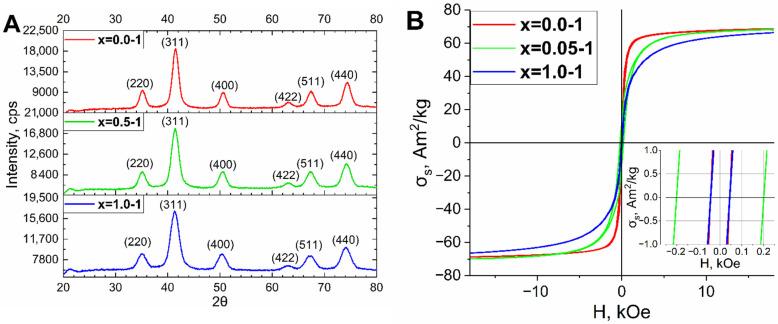
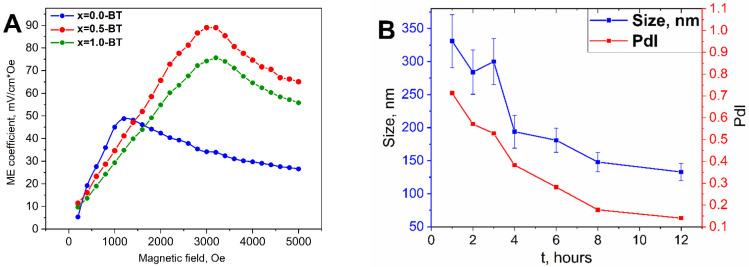
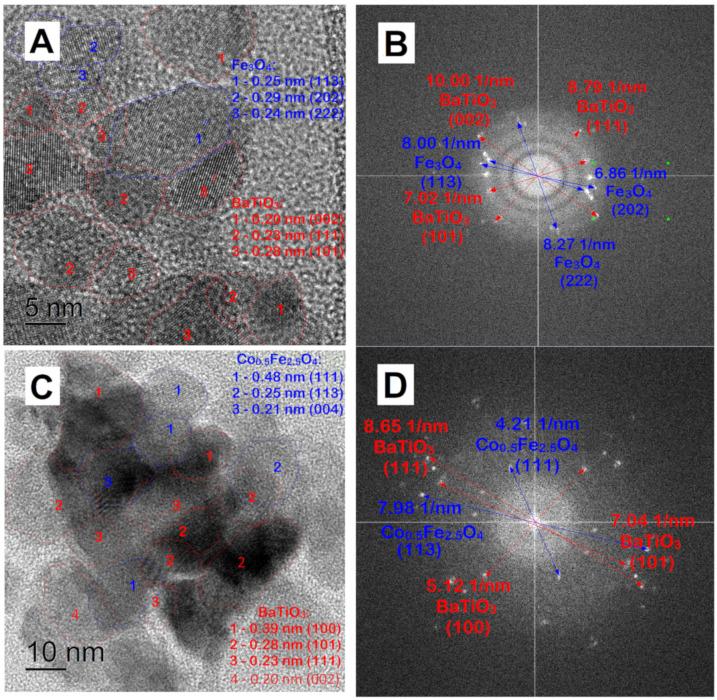
Nowadays, magnetoelectric nanomaterials are on their way to finding wide applications in biomedicine for various cancer and neurological disease treatment, which is mainly restricted by their relatively high toxicity and complex synthesis. This study for the first time reports novel magnetoelectric nanocomposites of CoFeO-BaTiO series with tuned magnetic phase structures, which were synthesized via a two-step chemical approach in polyol media. The magnetic CoFeO phases with x = 0.0, 0.5, and 1.0 were obtained by thermal decomposition in triethylene glycol media. The magnetoelectric nanocomposites were synthesized by the decomposition of barium titanate precursors in the presence of a magnetic phase under solvothermal conditions and subsequent annealing at 700 °C. X-ray diffraction revealed the presence of both spinel and perovskite phases after annealing with average crystallite sizes in the range of 9.0-14.5 nm. Transmission electron microscopy data showed two-phase composite nanostructures consisting of ferrites and barium titanate. The presence of interfacial connections between magnetic and ferroelectric phases was confirmed by high-resolution transmission electron microscopy. Magnetization data showed expected ferrimagnetic behavior and σ decrease after the nanocomposite formation. Magnetoelectric coefficient measurements after the annealing showed non-linear change with a maximum of 89 mV/cmOe with x = 0.5, 74 mV/cmOe with x = 0, and a minimum of 50 mV/cm*Oe with x = 0.0 core composition, that corresponds with the coercive force of the nanocomposites: 240 Oe, 89 Oe and 36 Oe, respectively. The obtained nanocomposites show low toxicity in the whole studied concentration range of 25-400 μg/mL on CT-26 cancer cells. The synthesized nanocomposites show low cytotoxicity and high magnetoelectric effects, therefore they can find wide applications in biomedicine.
如今,磁电纳米材料正逐渐在生物医学领域广泛应用于各种癌症和神经疾病的治疗,但其应用主要受限于相对较高的毒性和复杂的合成过程。本研究首次报道了具有可调磁相结构的新型CoFeO-BaTiO系列磁电纳米复合材料,该材料是通过在多元醇介质中采用两步化学法合成的。通过在三甘醇介质中热分解获得了x = 0.0、0.5和1.0的磁性CoFeO相。在溶剂热条件下,通过钛酸钡前驱体在磁性相存在下的分解以及随后在700°C退火,合成了磁电纳米复合材料。X射线衍射显示退火后同时存在尖晶石相和钙钛矿相,平均晶粒尺寸在9.0-14.5nm范围内。透射电子显微镜数据显示由铁氧体和钛酸钡组成的两相复合纳米结构。高分辨率透射电子显微镜证实了磁性相和铁电相之间存在界面连接。磁化数据显示出预期的亚铁磁性行为,并且在形成纳米复合材料后σ降低。退火后的磁电系数测量显示出非线性变化,x = 0.5时最大值为89mV/cmOe,x = 0时为74mV/cmOe,x = 0.0核心组成时最小值为50mV/cm*Oe,这与纳米复合材料的矫顽力相对应,分别为240Oe、89Oe和36Oe。在所研究的25-400μg/mL整个浓度范围内,所获得的纳米复合材料对CT-26癌细胞显示出低毒性。合成的纳米复合材料显示出低细胞毒性和高磁电效应,因此它们可在生物医学中得到广泛应用。




 Zotero 插件