Abou Hashish Ebtsam Aly, Ghanem Atalla Amal Diab
Faculty of Nursing, Alexandria University, Alexandria, Egypt.
College of Nursing, King Saud bin Abdulaziz University for Health Sciences, King Abdullah International Medical Research Center (KAIMRC), Jeddah, Saudi Arabia.
SAGE Open Nurs. 2023 Mar 8;9:23779608231160463. doi: 10.1177/23779608231160463. eCollection 2023 Jan-Dec.
The rapid spread of COVID-19 poses a significant threat to nurses' lives and health, resulting in varying degrees of mental distress. Nurses may experience compassion fatigue, and their professional quality of life and satisfaction may suffer as a result. Their coping mechanisms may vary as well, influencing their compassionate and safe care.
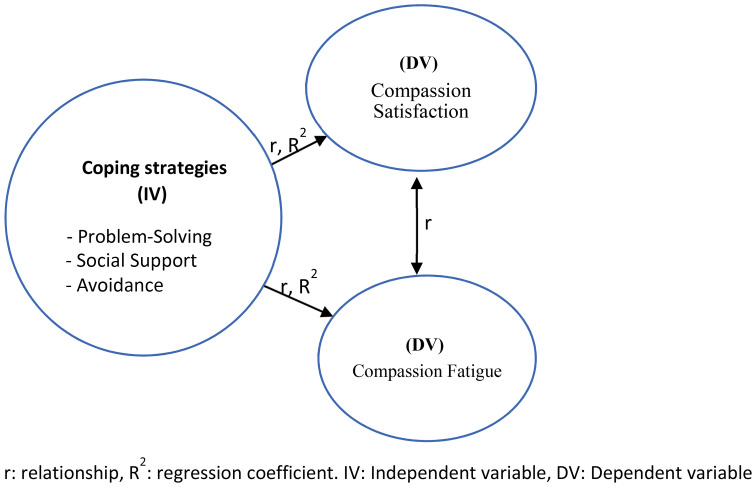
The study's objectives are to explore levels of compassion satisfaction and fatigue among nurses and identify their coping strategies. Further, to investigate the relationship between coping strategies, compassion satisfaction, and compassion fatigue during the COVID-19 pandemic.
Using a descriptive correlational design, this study was conducted with a convenience sample of 443 nurses working in an Egyptian university hospital. Nurses completed the coping strategy indicator scale and the professional quality of life (compassion satisfaction and compassion fatigue) scale. The data were analyzed using descriptive statistics, Pearson correlation, and regression analysis.
Nurses' professional quality of life was average in terms of compassion satisfaction (2.95 ± 0.92) and compassion fatigue (2.38 ± 0.35). Nurses have a moderate use of coping strategies (2.13 ± 0.35). Problem-solving was rated as the highest coping strategy, while avoidance was rated as the lowest. Coping strategies showed a positive correlation with compassion satisfaction ( = 0.503, < .001) and a negative correlation with compassion fatigue ( = -0.352, < .001). In addition, coping strategies could predict 25.4% and 12.4% of compassion satisfaction and compassion fatigue, respectively ( < .001).
Compassion satisfaction and fatigue are key determinants of nurses' quality of work life. Coping strategies, especially problem-solving and support systems, are vital to increase compassion satisfaction and mitigate burnout and secondary stress syndrome. Nurse managers should establish supportive work environments that promote nurses' well-being. Resilience-building programs and coping strategies' training are recommended to enhance the nurses' quality of work life and positive work attitudes.
新冠病毒病(COVID-19)的迅速传播对护士的生命和健康构成了重大威胁,导致了不同程度的精神困扰。护士可能会经历同情疲劳,其职业生活质量和满意度可能因此受到影响。他们的应对机制也可能各不相同,从而影响他们富有同情心和安全的护理工作。
本研究的目的是探讨护士的同情满意度和疲劳程度,并确定他们的应对策略。此外,调查在新冠疫情期间应对策略、同情满意度和同情疲劳之间的关系。
本研究采用描述性相关性设计,对埃及一所大学医院工作的443名护士进行便利抽样。护士们完成了应对策略指标量表和职业生活质量(同情满意度和同情疲劳)量表。使用描述性统计、Pearson相关性分析和回归分析对数据进行分析。
护士的职业生活质量在同情满意度(2.95±0.92)和同情疲劳(2.38±0.35)方面处于中等水平。护士对应对策略的使用程度中等(2.13±0.35)。解决问题被评为最高的应对策略,而回避则被评为最低。应对策略与同情满意度呈正相关(r = 0.503,p <.001),与同情疲劳呈负相关(r = -0.352,p <.001)。此外,应对策略分别可以预测同情满意度的25.4%和同情疲劳的12.4%(p <.001)。
同情满意度和疲劳是护士工作生活质量的关键决定因素。应对策略,尤其是解决问题和支持系统,对于提高同情满意度、减轻职业倦怠和继发性压力综合征至关重要。护士长应建立促进护士福祉的支持性工作环境。建议开展增强心理韧性的项目和应对策略培训,以提高护士的工作生活质量和积极的工作态度。