Orces Carlos H
Department of Medicine, Laredo Medical Center, Laredo Texas, United States.
Int J Prev Med. 2022 Nov 28;13:146. doi: 10.4103/ijpvm.IJPVM_625_20. eCollection 2022.
Although previous studies have described a positive correlation between physical activity and 25-hydroxyvitamin D levels (25(OH)D), the relationship between participation in school sports and 25(OH)D levels among children has not been well characterized.
The present study analyzed data from participants aged 5 to 15 years in the National Health and Nutrition Examination Survey cycle 2013-2014. General linear models adjusted for potential confounders were assembled to examine 25(OH)D levels according to participation in school sports.
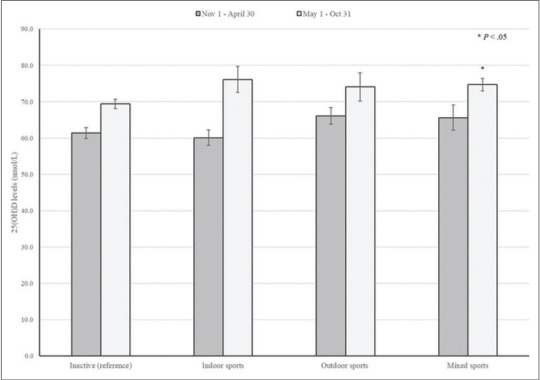
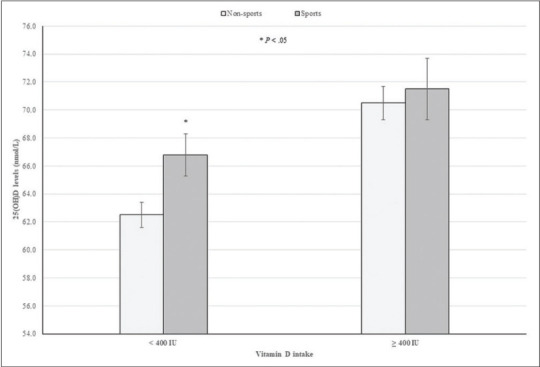
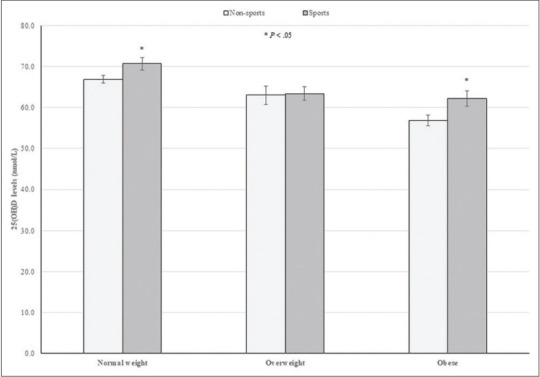
Of 1,670 children in the study sample, 17.9% were defined as having 25(OH)D inadequacy (< 50 nmol/L). Overall, 38% of children reported participation in school sports. In general, 25(OH)D levels were increased among children examined between May 1 and Oct 31 non-Hispanic whites, normal weight, higher income, and daily vitamin D intake ≥ 400 IU/d. After adjusting for potential confounders, 25(OH)D levels were 3.7 nmol/L higher among children who played in any school sports than those who did not. In general, higher 25(OH)D levels were seen among children examined during summer and fall seasons than those during winter and spring seasons, regardless the type of sport activities. Moreover, children who played mixed sports during summer and fall seasons had significantly higher 25(OH)D levels than their physically inactive counterparts.
25(OH)D concentrations were significantly higher in children playing school sports than those who did not. Thus, children's participation in school sports, particularly during summer and fall seasons should be considered as an effective public health intervention to reach optimal 25(OH)D levels.
尽管先前的研究已经描述了体育活动与25-羟基维生素D水平(25(OH)D)之间存在正相关,但儿童参与学校体育运动与25(OH)D水平之间的关系尚未得到充分描述。
本研究分析了2013 - 2014年国家健康与营养检查调查中5至15岁参与者的数据。构建了针对潜在混杂因素进行调整的一般线性模型,以根据参与学校体育运动的情况来检查25(OH)D水平。
在研究样本的1670名儿童中,17.9%被定义为25(OH)D不足(<50 nmol/L)。总体而言,38%的儿童报告参与了学校体育运动。一般来说,在5月1日至10月31日接受检查的非西班牙裔白人、体重正常、收入较高且每日维生素D摄入量≥400 IU/d的儿童中,25(OH)D水平有所升高。在调整潜在混杂因素后,参与任何学校体育运动的儿童的25(OH)D水平比未参与的儿童高3.7 nmol/L。一般来说,无论体育活动类型如何,夏季和秋季接受检查的儿童的25(OH)D水平高于冬季和春季接受检查的儿童。此外,在夏季和秋季进行混合体育运动的儿童的25(OH)D水平明显高于不进行体育活动的同龄人。
参与学校体育运动的儿童的25(OH)D浓度显著高于未参与的儿童。因此,应将儿童参与学校体育运动(尤其是在夏季和秋季)视为达到最佳25(OH)D水平的有效公共卫生干预措施。