Xu Yifei, Liu Ti, Li Yan, Wei Xuemin, Wang Zhaoguo, Fang Ming, Zhang Yuwei, Zhang Huaning, Zhang Lifang, Zhang Jinbo, Xu Jin, Tian Yunlong, He Nianzheng, Zhang Yuhan, Wang Yao, Yao Mingxiao, Pang Bo, Wang Shuang, Wen Hongling, Kou Zengqiang
Department of Microbiology, School of Public Health, Cheeloo College of Medicine, Shandong University, Jinan, Shandong, China.
Suzhou Research Institute of Shandong University, Suzhou, Jiangsu, China.
Microbiol Spectr. 2023 Mar 14;11(2):e0463222. doi: 10.1128/spectrum.04632-22.
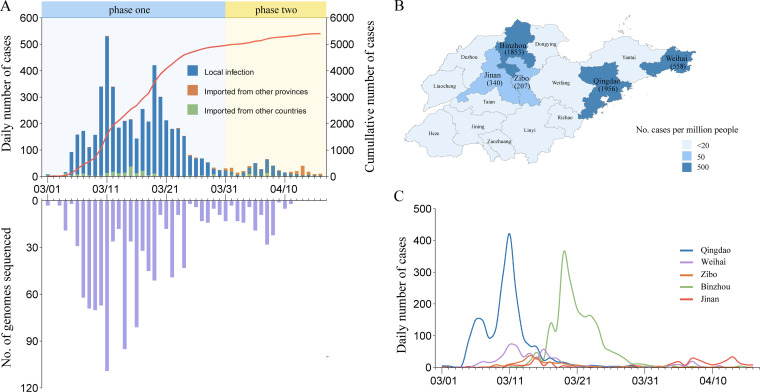
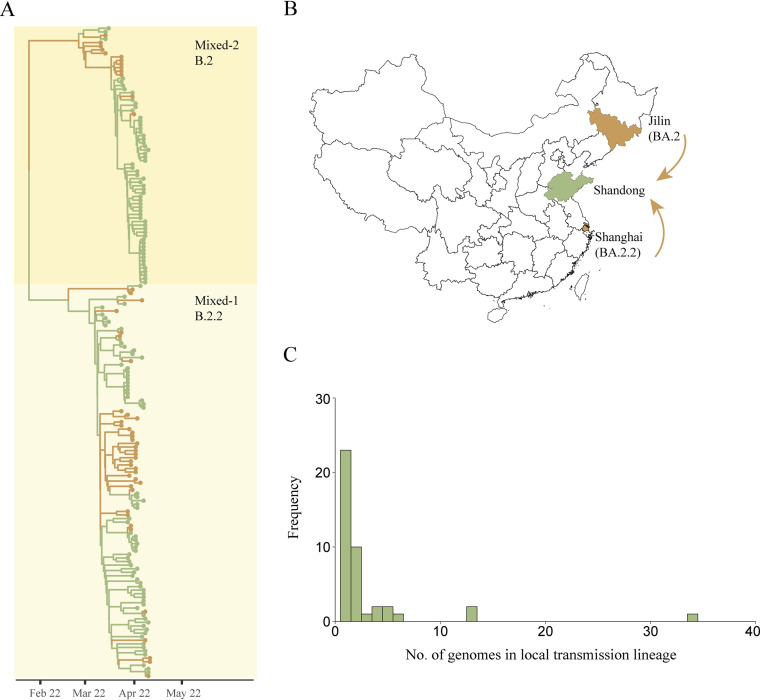
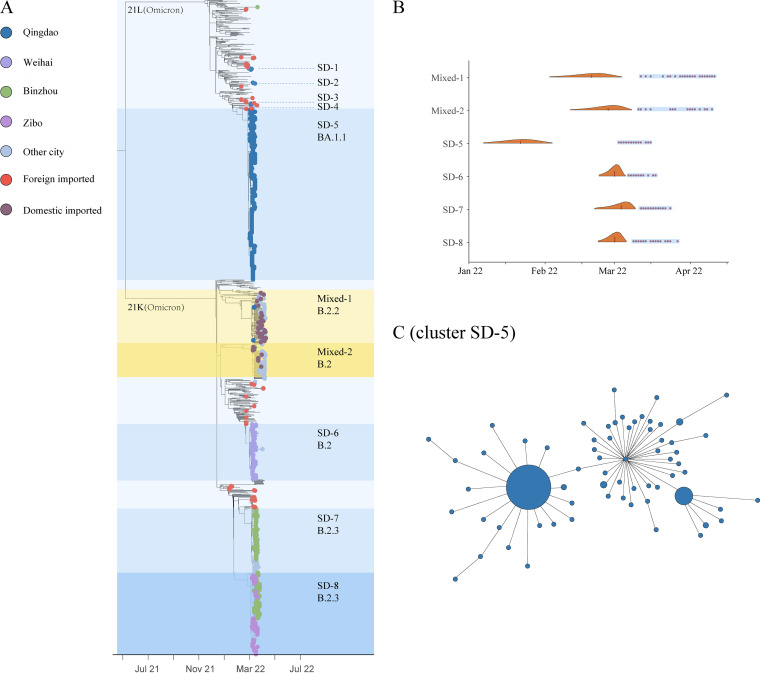
SARS-CoV-2 Omicron caused a large wave of COVID-19 cases in China in spring 2022. Shandong was one of the most affected regions during this epidemic yet was also among those areas that were able to quickly contain the transmission. We aimed to investigate the origin, genetic diversity, and transmission patterns of the Omicron epidemic in Shandong under a dynamic clearance strategy. We generated 1,149 Omicron sequences, performed phylogenetic analysis, and interpreted results in the context of available epidemiological information. We observed that there were multiple introductions of distinct Omicron sublineages into Shandong from foreign countries and other regions in China, while a small number of introductions led to majority of local cases. We found evidence suggesting that some local clusters were potentially associated with foreign imported cases. Superspreading events and cryptic transmissions contributed to the rapid spread of this epidemic. We identified a BA.1.1 genome with the R493Q reversion mutation in the spike receptor binding domain, potentially associated with an escape from vaccine and Omicron infection elicited neutralizing immunity. Our findings illustrated how the dynamic clearance strategy constrained this epidemic's size, duration, and geographical distribution. Starting in March 2022, the Omicron epidemic caused a large wave of COVID-19 cases in China. Shandong was one of the most affected regions during this epidemic but was also among those areas that were able to quickly contain the transmission. We investigated the origin, genetic diversity, and transmission patterns of Omicron epidemic in Shandong under a dynamic clearance strategy. We found that there were multiple introductions of distinct Omicron sublineages into Shandong from foreign countries and other regions in China, while a small number of introductions led to most local cases. We found evidence suggesting that some local clusters were associated with foreign imported cases. Superspreading events and cryptic transmissions contributed to the rapid spread of this epidemic. Our study illustrated the transmission patterns of Omicron epidemic in Shandong and provided a looking glass onto this epidemic in China.
2022年春季,新型冠状病毒奥密克戎变异株在中国引发了一波大规模的新冠疫情。山东是此次疫情中受影响最严重的地区之一,但也是能够迅速控制传播的地区之一。我们旨在研究在动态清零策略下山东奥密克戎疫情的起源、遗传多样性和传播模式。我们生成了1149条奥密克戎序列,进行了系统发育分析,并结合现有的流行病学信息解读结果。我们观察到,有多个不同的奥密克戎亚谱系从国外和中国其他地区传入山东,而少数几次传入导致了大多数本地病例。我们发现有证据表明,一些本地聚集性疫情可能与境外输入病例有关。超级传播事件和隐匿传播导致了此次疫情的快速传播。我们鉴定出一个在刺突受体结合域具有R493Q回复突变的BA.1.1基因组,这可能与逃避疫苗接种以及奥密克戎感染引发的中和免疫有关。我们的研究结果说明了动态清零策略是如何限制此次疫情的规模、持续时间和地理分布的。从2022年3月开始,奥密克戎疫情在中国引发了一波大规模的新冠病例。山东是此次疫情中受影响最严重的地区之一,但也是能够迅速控制传播的地区之一。我们研究了在动态清零策略下山东奥密克戎疫情的起源、遗传多样性和传播模式。我们发现,有多个不同的奥密克戎亚谱系从国外和中国其他地区传入山东,而少数几次传入导致了大多数本地病例。我们发现有证据表明,一些本地聚集性疫情与境外输入病例有关。超级传播事件和隐匿传播导致了此次疫情的快速传播。我们的研究阐明了山东奥密克戎疫情的传播模式,并为中国的这一疫情提供了一个观察窗口。