Department of Epidemiology Research, Statens Serum Institut, Copenhagen, Denmark
Department of Epidemiology Research, Statens Serum Institut, Copenhagen, Denmark.
BMJ. 2023 Jul 24;382:e074325. doi: 10.1136/bmj-2022-074325.
To investigate the comparative vaccine effectiveness of heterologous booster schedules (ie, three vaccine doses) compared with primary schedules (two vaccine doses) and with homologous mRNA vaccine booster schedules (three vaccine doses) during a period of omicron predominance.
Population based cohort analyses.
Denmark, Finland, Norway, and Sweden, 27 December 2020 to 31 December 2022.
All adults aged ≥18 years who had received at least a primary vaccination schedule of AZD1222 (Oxford-AstraZeneca) or monovalent SARS-CoV-2 wild type (ancestral) strain based mRNA vaccines BNT162b2 (Pfizer-BioNTech) or mRNA-1273 (Moderna), in any combination.
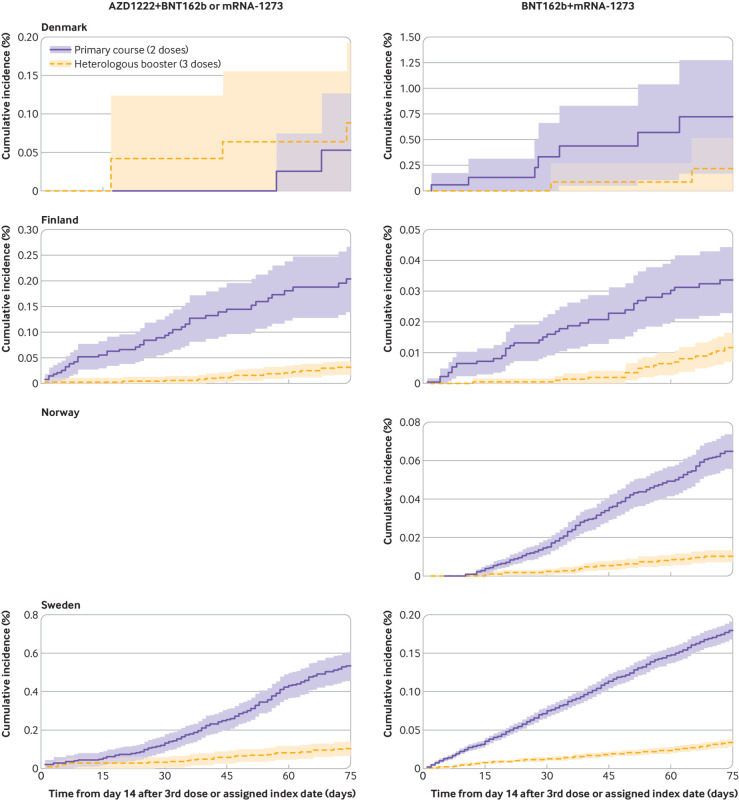
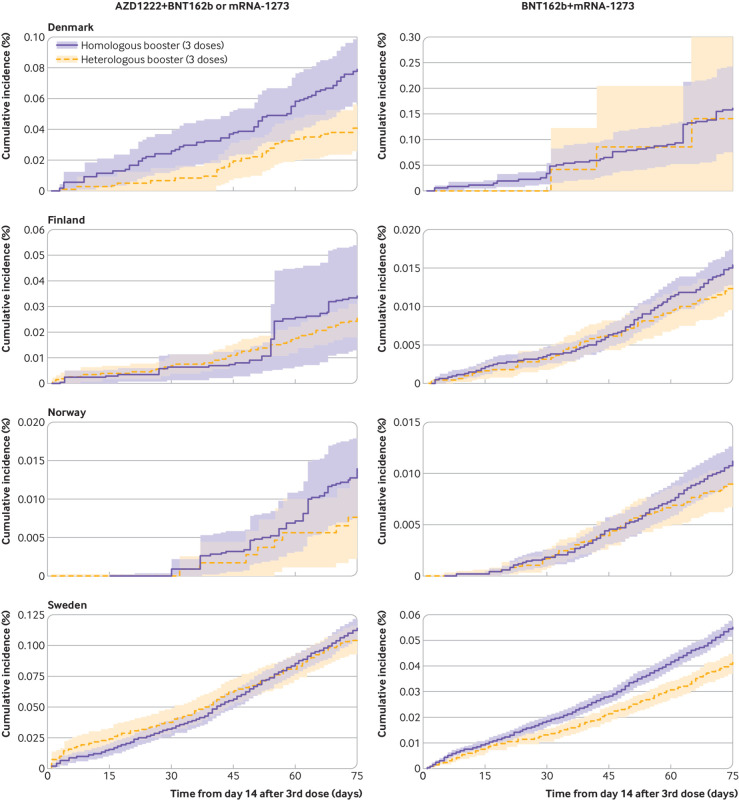
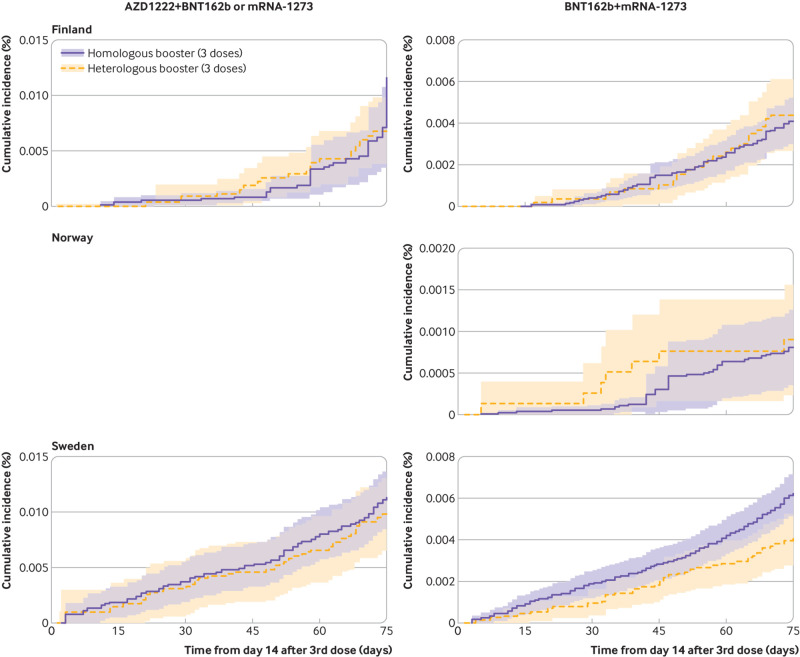
The main outcome measure was country combined risks of covid-19 related hospital admission and death with covid-19 and additional outcomes of covid-19 related admission to an intensive care unit and SARS-CoV-2 infection. During a period of omicron predominance, these outcomes were compared in those who received a heterologous booster versus primary schedule (matched analyses) and versus those who received a homologous mRNA vaccine booster (weighted analyses). Follow-up was for 75 days from day 14 after the booster dose; comparative vaccine effectiveness was calculated as 1-risk ratio.
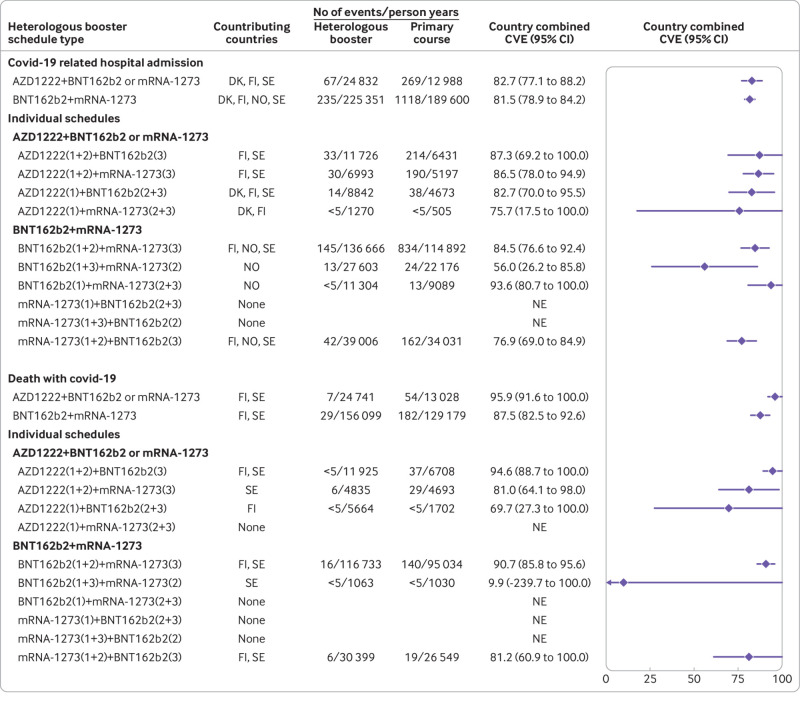
Across the four Nordic countries, 1 086 418 participants had received a heterologous booster schedule of AZD1222+BNT162b2 or mRNA-1273 and 2 505 093 had received a heterologous booster schedule of BNT162b2+mRNA-1273. Compared with the primary schedule only (two doses), the vaccine effectiveness of heterologous booster schedules comprising AZD1222+BNT162b2 or mRNA-1273 and BNT162b2+mRNA-1273 was 82.7% (95% confidence interval 77.1% to 88.2%) and 81.5% (78.9% to 84.2%) for covid-19 related hospital admission and 95.9% (91.6% to 100.0%) and 87.5% (82.5% to 92.6%) for death with covid-19, respectively. Homologous mRNA booster schedules were similarly associated with increased protection against covid-19 related hospital admission (≥76.5%) and death with covid-19 (≥84.1%) compared with previous primary course vaccination only. When a heterologous booster schedule was compared with the homologous booster schedule, vaccine effectiveness was 27.2% (3.7% to 50.6%) for AZD1222+BNT162b2 or mRNA-1273 and 23.3% (15.8% to 30.8%) for BNT162b2+mRNA-1273 schedules against covid-19 related hospital admission and 21.7% (-8.3% to 51.7%) and 18.4% (-15.7% to 52.5%) against death with covid-19, respectively.
Heterologous booster schedules are associated with increased protection against severe, omicron related covid-19 outcomes compared with primary course schedules and homologous booster schedules.
在奥密克戎为主的时期,研究异源加强接种方案(即三剂疫苗)与初级接种方案(两剂疫苗)以及同源 mRNA 疫苗加强接种方案(三剂疫苗)相比的疫苗相对有效性。
基于人群的队列分析。
丹麦、芬兰、挪威和瑞典,2020 年 12 月 27 日至 2022 年 12 月 31 日。
所有至少接受过 AZD1222(牛津-阿斯利康)或单价 SARS-CoV-2 野生型(祖先)株基于 mRNA 疫苗 BNT162b2(辉瑞-生物技术)或 mRNA-1273(Moderna)的初级接种方案的≥18 岁成年人,无论组合如何。
主要观察指标是与 COVID-19 相关的住院和死亡的国家合并风险,以及 COVID-19 相关的 ICU 住院和 SARS-CoV-2 感染的其他结果。在奥密克戎为主的时期,比较了接受异源加强接种与初级接种方案(匹配分析)和同源 mRNA 疫苗加强接种方案(加权分析)的患者的这些结果。随访时间为加强接种后第 14 天开始的 75 天;比较疫苗有效性为 1-风险比。
在四个北欧国家中,有 1086418 名参与者接受了 AZD1222+BNT162b2 或 mRNA-1273 的异源加强接种方案,2505093 名参与者接受了 BNT162b2+mRNA-1273 的异源加强接种方案。与仅接受初级接种方案(两剂)相比,AZD1222+BNT162b2 或 mRNA-1273 和 BNT162b2+mRNA-1273 组成的异源加强接种方案的疫苗有效性分别为 82.7%(95%置信区间 77.1%至 88.2%)和 81.5%(78.9%至 84.2%),COVID-19 相关住院的风险和 95.9%(91.6%至 100.0%)和 87.5%(82.5%至 92.6%),与 COVID-19 相关的死亡。同源 mRNA 加强接种方案与 COVID-19 相关住院(≥76.5%)和 COVID-19 相关死亡(≥84.1%)的保护作用相似,与之前的初级疗程接种相比。当比较异源加强接种方案与同源加强接种方案时,AZD1222+BNT162b2 或 mRNA-1273 方案的疫苗有效性为 27.2%(3.7%至 50.6%),BNT162b2+mRNA-1273 方案为 23.3%(15.8%至 30.8%),用于 COVID-19 相关住院,分别为 21.7%(-8.3%至 51.7%)和 18.4%(-15.7%至 52.5%)。
与初级疗程方案和同源加强接种方案相比,异源加强接种方案与严重的、与奥密克戎相关的 COVID-19 结果的保护作用增加。