Heblich Benedict, Terzidis Orestis, González M Marcos, Kuschel Katherina, Mukadam Mouzzam, Birkenbach Marius
Karlsruhe Institute of Technology, Karlsruhe, Germany.
Universidad Austral de Chile, Puerto Montt, Chile.
Int J Clin Health Psychol. 2023 Oct-Dec;23(4):100375. doi: 10.1016/j.ijchp.2023.100375. Epub 2023 Mar 5.
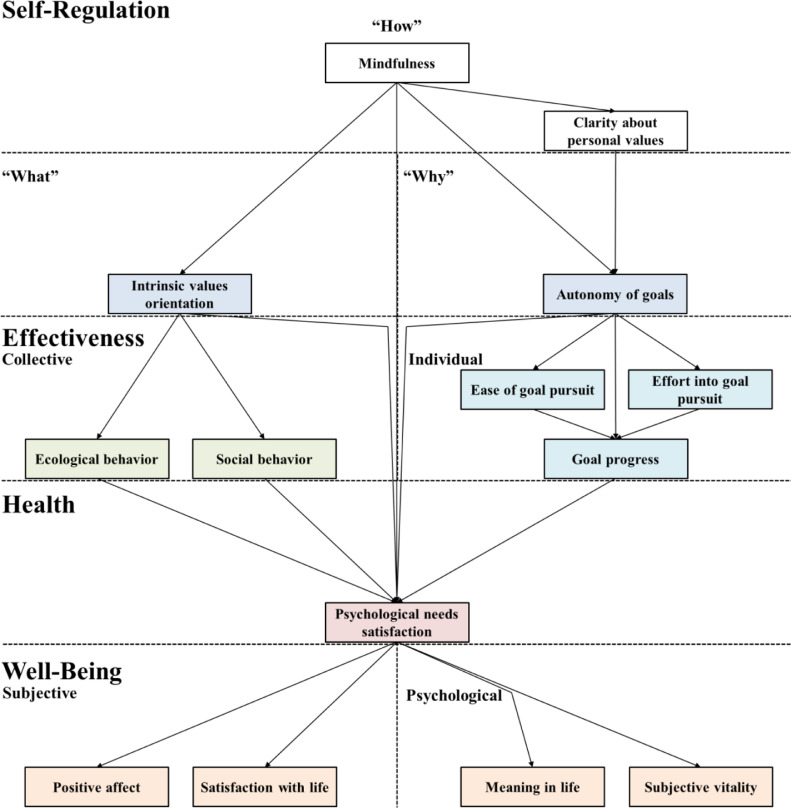
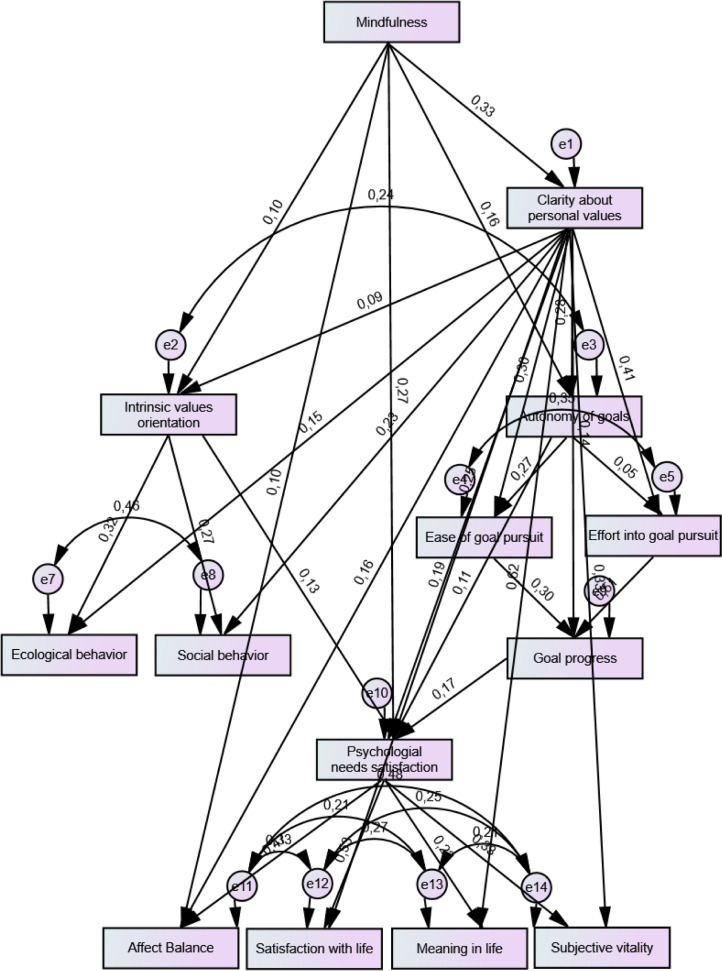
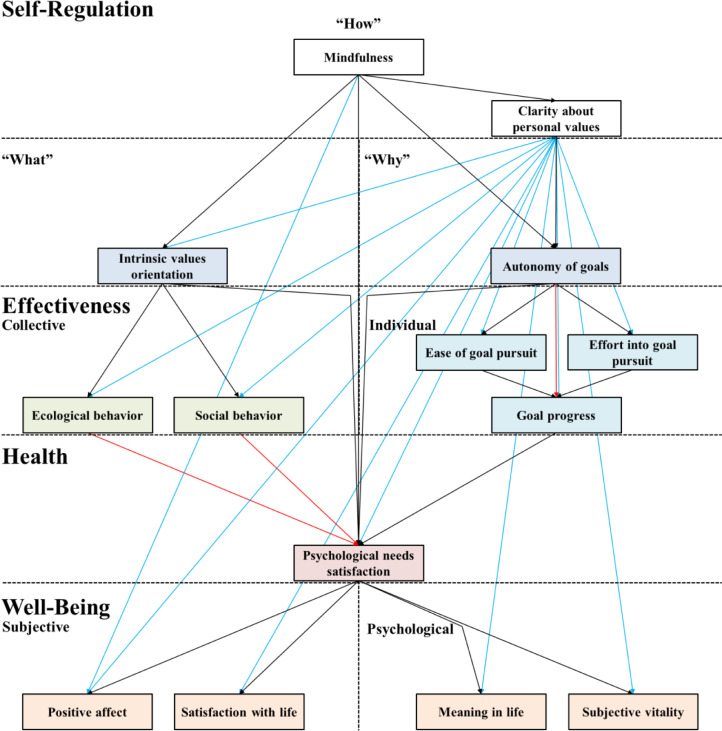
The purpose of this study is to develop and empirically test a structural equation model (SEM) for healthy and effective self-regulation based on the propositions of self-determination theory (SDT). A cross-sectional data sample ( = 6,705) is used to test the model. The results of the SEM demonstrate good to excellent global fit indices (RMSEA = 0.06, SRMR = 0.04 CFI = 0.97, TLI/NNFI = 0.95) and excellent local fit indices ( < 0.001). It is acknowledged that longitudinal and experimental research designs will be necessary to infer causal effects. However, based on the strong theoretical and empirical grounding of the model, indications for causal effects are discussed beyond correlational relations. The local fit indices imply that autonomy of goals, intrinsic values orientation, mindfulness, and the newly integrated construct clarity about personal values positively affect psychological needs satisfaction and facets of subjective and psychological well-being. Additionally, they indicate that mindfulness and clarity about personal values have the greatest benefits on individual health, well-being, and effectiveness. These results are crucial as they emphasize the significant role of mindfulness in healthy and effective self-regulation. Furthermore, they put the spotlight on a rather new construct; clarity about personal values. By having transferred the knowledge base of SDT into an empirically derived model of healthy and effective self-regulation, this study provides well-grounded indications of how health, well-being, and effectiveness in individuals may be fostered. These indications offer new insights for theory building and practical interventions in domains like psychotherapy, healthcare, organizations, sports, and education.
本研究的目的是基于自我决定理论(SDT)的命题,开发并实证检验一个关于健康有效的自我调节的结构方程模型(SEM)。使用一个横截面数据样本(n = 6705)来检验该模型。结构方程模型的结果显示出良好到优异的整体拟合指数(RMSEA = 0.06,SRMR = 0.04,CFI = 0.97,TLI/NNFI = 0.95)和优异的局部拟合指数(p < 0.001)。公认的是,纵向和实验研究设计对于推断因果效应是必要的。然而,基于该模型强大的理论和实证基础,除了相关关系之外,还讨论了因果效应的迹象。局部拟合指数表明,目标自主性、内在价值观取向、正念以及新整合的个人价值观清晰度结构对心理需求满足以及主观和心理幸福感的各个方面有积极影响。此外,它们表明正念和个人价值观清晰度对个体健康、幸福感和效能有最大的益处。这些结果至关重要,因为它们强调了正念在健康有效的自我调节中的重要作用。此外,它们还聚焦于一个相当新的结构;个人价值观清晰度。通过将自我决定理论的知识库转化为一个基于实证推导的健康有效的自我调节模型,本研究为如何促进个体的健康、幸福感和效能提供了有充分依据的迹象。这些迹象为心理治疗、医疗保健、组织、体育和教育等领域的理论构建和实践干预提供了新的见解。