Lu Yilun, Li Ding, Huang Yueyue, Sun Yuanyuan, Zhou Hongmin, Ye Fanrong, Yang Hongjing, Xu Tingting, Quan Shichao, Pan Jingye
Department of Intensive Care Unit, the First Affiliated Hospital of Wenzhou Medical University, Wenzhou, People's Republic of China.
Key Laboratory of Intelligent Treatment and Life Support for Critical Diseases of Zhejiang Province, Wenzhou, People's Republic of China.
J Inflamm Res. 2023 Mar 10;16:1027-1042. doi: 10.2147/JIR.S393850. eCollection 2023.
Sepsis is an aggressive and life-threatening organ dysfunction induced by infection. Excessive inflammation and coagulation contribute to the negative outcomes for sepsis, resulting in high morbidity and mortality. In this study, we explored whether Eupatilin could alleviate lung injury, reduce inflammation and coagulation during sepsis.
We constructed an in vitro sepsis model by stimulating RAW264.7 cells with 1 μg/mL lipopolysaccharide (LPS) for 6 hours. The cells were divided into control group, LPS group, LPS+ Eupatilin (Eup) group, and Eup group to detect their cell activity and inflammatory cytokines and coagulation factor levels. Cells in LPS+Eup and Eup group were pretreated with Eupatilin (10μM) for 2 hours. In vivo, mice were divided into sham operation group, cecal ligation and puncture (CLP) group and Eup group. Mice in the CLP and Eup groups were pretreated with Eupatilin (10mg/kg) for 2 hours by gavage. Lung tissue and plasma were collected and inflammatory cytokines, coagulation factors and signaling were measured.
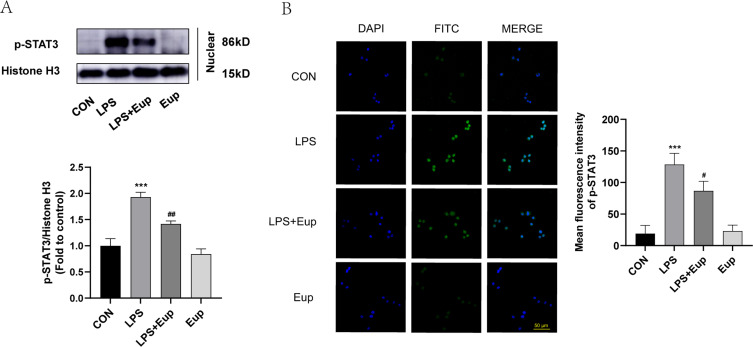
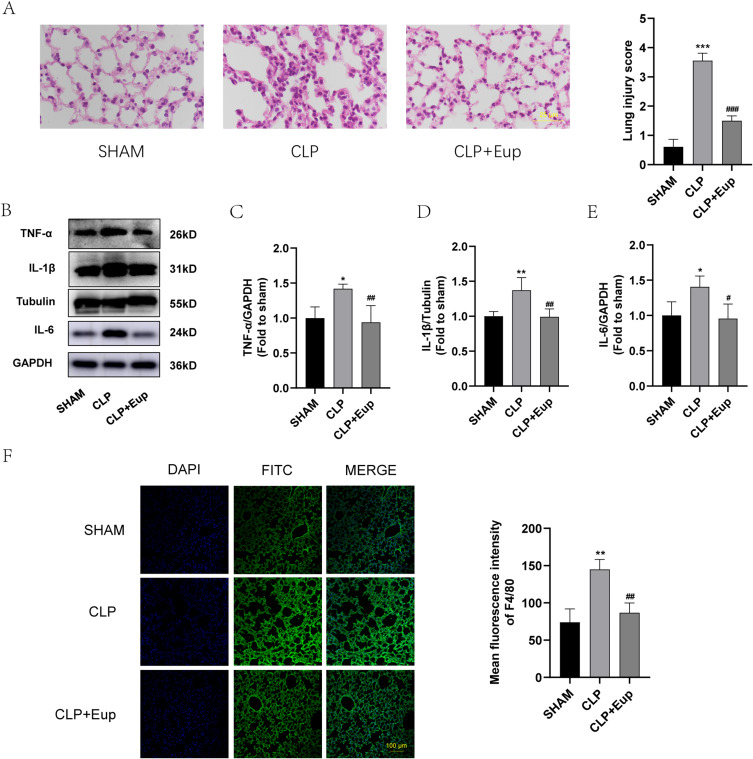
In vitro, tumor necrosis factor (TNF)-α, interleukin (IL)-1β, IL-6, and tissue factor (TF) expression in LPS-stimulated RAW264.7 cells was downregulated by Eupatilin (10μM). Furthermore, Eupatilin inhibited phosphorylation of the JAK2/STAT3 signaling pathway and suppressed p-STAT3 nuclear translocation. In vivo, Eupatilin increased the survival rate of the mice. In septic mice, plasma concentrations of TNF-α, IL-1β and IL-6, as well as TF, plasminogen activator inhibitor 1 (PAI-1), D-dimer, thrombin-antithrombin complex (TAT) and fibrinogen were improved by Eupatilin. Moreover, Eupatilin alleviated lung injury by improving the expression of inflammatory cytokines and TF, fibrin deposition and macrophage infiltration in lung tissue.
Our results revealed that Eupatilin may modulate inflammation and coagulation indicators as well as improve lung injury in sepsis via the JAK2/STAT3 signaling pathway.
脓毒症是一种由感染引起的具有侵袭性且危及生命的器官功能障碍。过度的炎症反应和凝血会导致脓毒症的不良后果,从而造成高发病率和高死亡率。在本研究中,我们探究了灯盏乙素是否能减轻脓毒症期间的肺损伤、减少炎症和凝血反应。
我们通过用1μg/mL脂多糖(LPS)刺激RAW264.7细胞6小时构建了体外脓毒症模型。将细胞分为对照组、LPS组、LPS + 灯盏乙素(Eup)组和Eup组,以检测它们的细胞活性、炎性细胞因子和凝血因子水平。LPS + Eup组和Eup组的细胞用灯盏乙素(10μM)预处理2小时。在体内实验中,将小鼠分为假手术组、盲肠结扎穿孔(CLP)组和Eup组。CLP组和Eup组的小鼠通过灌胃用灯盏乙素(10mg/kg)预处理2小时。收集肺组织和血浆并检测炎性细胞因子、凝血因子及信号通路。
在体外实验中,灯盏乙素(10μM)可下调LPS刺激的RAW264.7细胞中肿瘤坏死因子(TNF)-α、白细胞介素(IL)-1β、IL-6和组织因子(TF)的表达。此外,灯盏乙素抑制JAK2/STAT3信号通路的磷酸化并抑制p-STAT3核转位。在体内实验中,灯盏乙素提高了小鼠的存活率。在脓毒症小鼠中,灯盏乙素改善了血浆中TNF-α、IL-1β和IL-6以及TF、纤溶酶原激活物抑制剂1(PAI-1)、D-二聚体、凝血酶 - 抗凝血酶复合物(TAT)和纤维蛋白原的浓度。此外,灯盏乙素通过改善肺组织中炎性细胞因子和TF的表达、纤维蛋白沉积及巨噬细胞浸润减轻了肺损伤。
我们的研究结果表明,灯盏乙素可能通过JAK2/STAT3信号通路调节脓毒症中的炎症和凝血指标,并改善肺损伤。