Department of Health Sciences, University of York, York, UK
Better Start Bradford Innovation Hub, Born in Bradford, Bradford Institute for Health Research, Bradford, UK.
BMJ Paediatr Open. 2023 Mar;7(1). doi: 10.1136/bmjpo-2022-001764.
Preschool language skills and language delay predict academic and socioemotional outcomes. Children from deprived environments are at a higher risk of language delay, and both minority ethnic and bilingual children can experience a gap in language skills at school entry. However, research that examines late talking (preschool language delay) in an ethnically diverse, bilingual, deprived environment at age 2 is scarce.
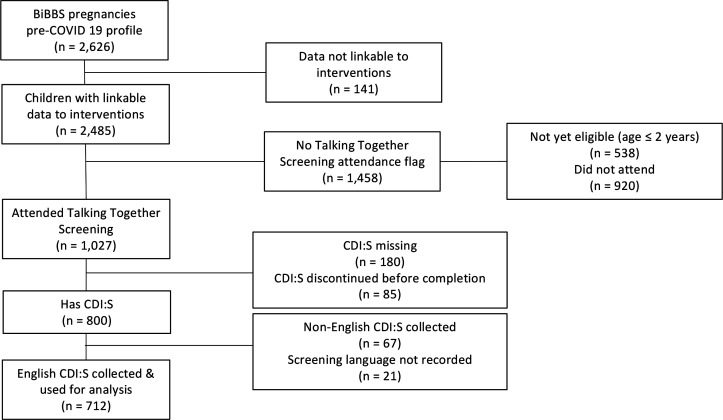
Data from Born in Bradford's Better Start birth cohort were used to identify rates of late talking (≤10th percentile on the Oxford-Communicative Development Inventory: Short) in 2-year-old children within an ethnically diverse, predominantly bilingual, deprived UK region (N=712). The relations between known demographic, maternal, distal and proximal child risk factors, and language skills and language delay were tested using hierarchical linear and logistic regression.
A total of 24.86% of children were classified as late talkers. Maternal demographic factors (ethnicity, born in UK, education, financial security, employment, household size, age) predicted 3.12% of the variance in children's expressive vocabulary. Adding maternal language factors (maternal native language, home languages) and perinatal factors (birth weight, gestation) to the model predicted 3.76% of the variance. Adding distal child factors (child sex, child age) predicted 11.06%, and adding proximal child factors (receptive vocabulary, hearing concerns) predicted 49.51%. Significant risk factors for late talking were male sex (OR 2.07, 95% CI 1.38 to 3.09), receptive vocabulary delay (OR 8.40, 95% CI 4.99 to 14.11) and parent-reported hearing concerns (OR 7.85, 95% CI 1.90 to 32.47). Protective factors were increased household size (OR 0.85, 95% CI 0.77 to 0.95) and age (OR 0.82, 95% CI 0.70 to 0.96).
Almost one in four children living in an ethnically diverse and deprived UK area have early language delay. Demographic factors explained little variance in early vocabulary, whereas proximal child factors held more predictive value. The results indicate further research on early language delay is warranted for vulnerable groups.
学前语言技能和语言延迟预测学业和社会情感结果。来自贫困环境的儿童语言延迟的风险更高,少数民族和双语儿童在入学时也可能存在语言技能差距。然而,在种族多样化、双语、贫困环境中研究 2 岁儿童的晚说话(学前语言延迟)的研究很少。
本研究使用伯明翰出生队列研究(Born in Bradford's Better Start birth cohort)的数据,在一个种族多样化、以双语为主、贫困的英国地区(N=712)确定 2 岁儿童中晚说话(在牛津交际发展量表:短版中≤第 10 百分位数)的发生率。使用分层线性和逻辑回归检验已知的人口统计学、产妇、远端和近端儿童风险因素与语言技能和语言延迟之间的关系。
共有 24.86%的儿童被归类为晚说话者。产妇人口统计学因素(种族、在英国出生、教育、经济保障、就业、家庭规模、年龄)预测了儿童表达词汇量的 3.12%的方差。将产妇语言因素(产妇母语、家庭语言)和围产期因素(出生体重、胎龄)加入模型后,预测了 3.76%的方差。添加远端儿童因素(儿童性别、年龄)预测了 11.06%,添加近端儿童因素(接受性词汇、听力问题)预测了 49.51%。晚说话的显著风险因素是男性(OR 2.07,95%置信区间 1.38 至 3.09)、接受性词汇延迟(OR 8.40,95%置信区间 4.99 至 14.11)和父母报告的听力问题(OR 7.85,95%置信区间 1.90 至 32.47)。保护因素是家庭规模增加(OR 0.85,95%置信区间 0.77 至 0.95)和年龄(OR 0.82,95%置信区间 0.70 至 0.96)。
生活在种族多样化和贫困的英国地区的近四分之一的儿童有早期语言延迟。人口统计学因素对早期词汇量的变化解释很少,而近端儿童因素具有更大的预测价值。结果表明,需要进一步研究弱势群体的早期语言延迟问题。