Narra Keerthi, Naik Santosh K, Ghatge Anjali S
Dermatology, Skintis Clinic, Hyderabad, IND.
Pharmacology, Kamineni Academy of Medical Sciences and Research Centre, Hyderabad, IND.
Cureus. 2023 Mar 15;15(3):e36168. doi: 10.7759/cureus.36168. eCollection 2023 Mar.
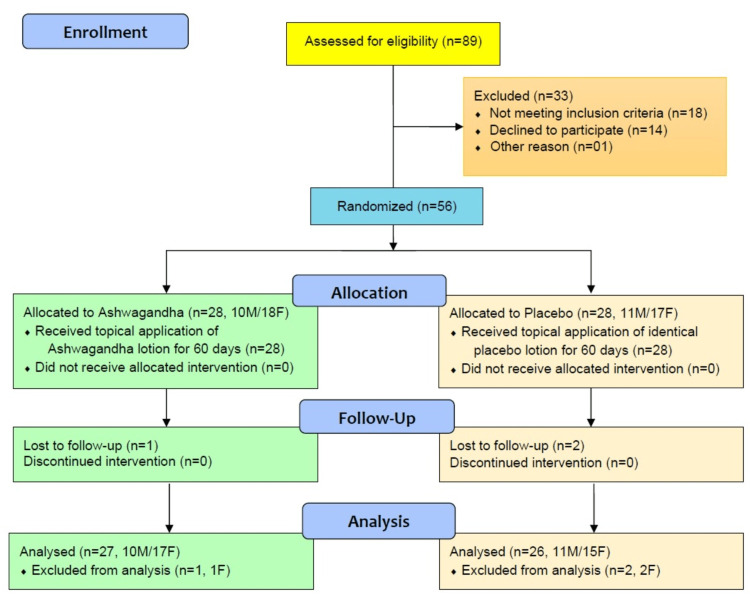
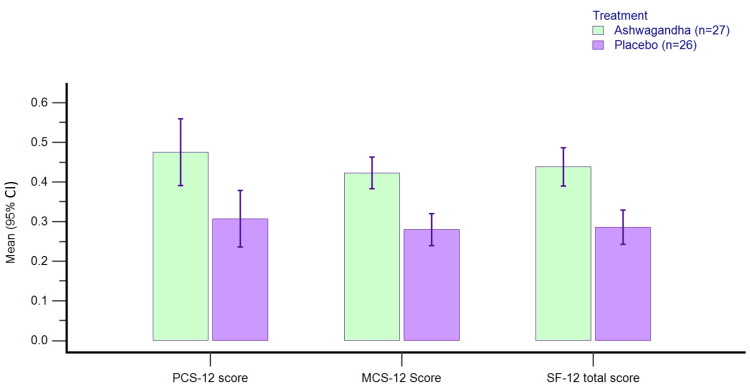
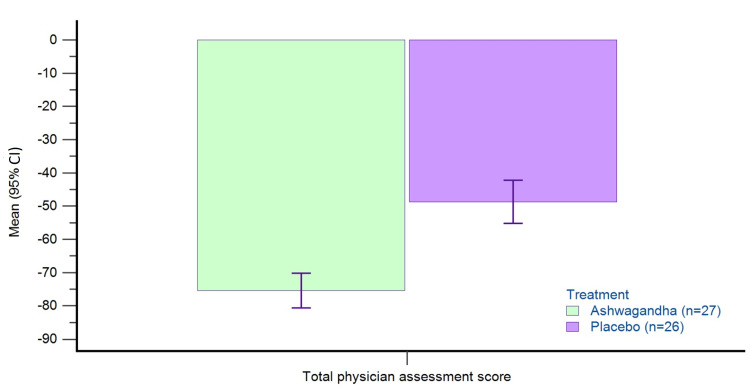
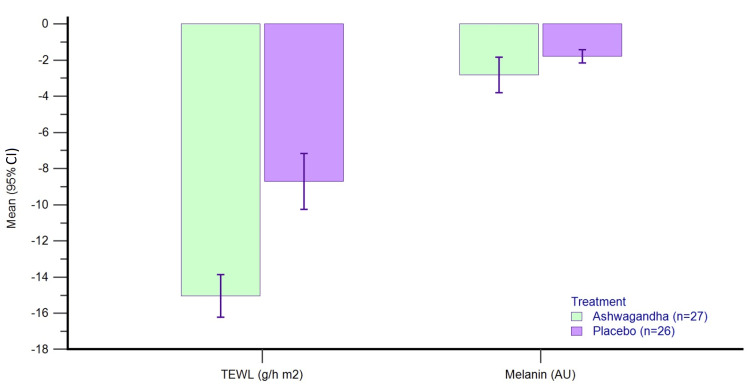
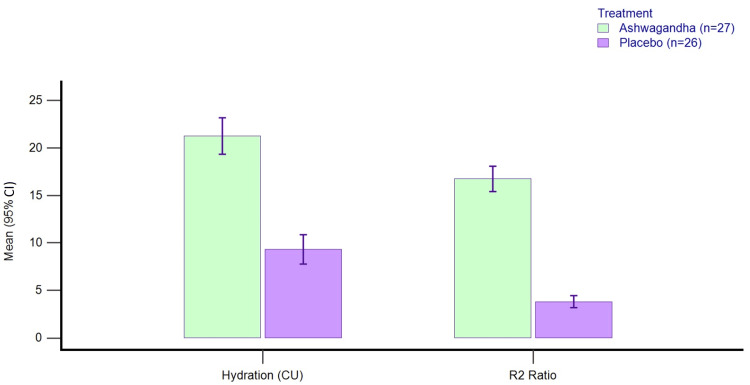
Background Facial skin has an essential cosmetic function in both men and women, and photoaged skin can affect the quality of life in healthy people. Ashwagandha () which is also called Indian ginseng has adaptogenic properties and is used in traditional Indian medicine to maintain balance, energize, and rejuvenate. Objective This randomized, double-blind, and placebo-controlled study assessed the efficacy and safety of topical application of lotion containing 8% standardized Ashwagandha root extract on improvement of skin parameters in the photoaged facial skin of healthy subjects. Methods Fifty-six healthy men and women aged between 18 and 60 years with Fitzpatrick phototype III-VI skin grade were randomized to receive the topical application (lotion on facial skin) of either Ashwagandha 8% (AG, n=28), or an identical placebo (PL, n=28) for 60 days. The primary outcome was the change from baseline on day 60 in the scores for global physician assessment scoring for the five dermatological signs (skin wrinkles, pores, hydration/moisture, skin brightness/tone, and pigmentation) on facial skin. Secondary outcomes were changes from baseline in the transepidermal water loss (TEWL), melanin index, hydration, and skin elasticity (R2 ratio). Another efficacy outcome was quality of life using the health-specific Short Form Health Survey-12 (SF-12). Safety was assessed using local reactions and adverse events. Three (1 AG, 2 PL) patients were lost to follow-up and per-protocol (PP) data included 53 patients (27 AG, 26 PL). For measurement data, repeated measures analysis of variance (ANOVA) was used to assess treatment effect at different time periods in the PP dataset (n=53). Two groups were compared for differences using a t-test for continuous data or a Mann-Whitney 'U' test for ordinal data. Adverse events were compared between two groups using the chi-square test. Results Greater reduction (p<0.0001) in total physician assessment scores from baseline to day 60 was observed with AG (-74.69%) compared to PL (-48.68%). There was a greater improvement in TEWL, skin hydration, and skin elasticity (R2 ratio) with AG as compared to placebo (p<0.0001). However, the change in melanin index was similar in the two groups at the end of day 60 (p=0.969). The percentage increase in melanin index from baseline to day 60 in the PP dataset was by -2.82% with AG and -1.78% with PL, whereas the percentage reduction in TEWL from baseline to day 60 in the PP dataset was by -15.12% with AG and -8.34% with PL. Similarly, greater percentage improvements were seen with AG as compared to PL for skin hydration (20.66% with AG and 9.5% with PL) and elasticity was assessed by the R2 ratio (16.34% with AG and 3.73% with PL). Adverse events were comparable in the two groups. Conclusions Topical application of a lotion containing Ashwagandha standardized root extract improves the skin condition and quality of life in photoaged healthy individuals. Further studies with different skin types and standard comparators are warranted to substantiate these claims of benefit.
背景 面部皮肤对男性和女性都具有重要的美容功能,光老化皮肤会影响健康人群的生活质量。南非醉茄()也被称为印度人参,具有适应原特性,在传统印度医学中用于维持平衡、增强活力和恢复青春。目的 本随机、双盲、安慰剂对照研究评估了局部应用含8%标准化南非醉茄根提取物的洗剂对改善健康受试者光老化面部皮肤参数的疗效和安全性。方法 将56名年龄在18至60岁之间、皮肤菲茨帕特里克分型为III - VI级的健康男性和女性随机分为两组,分别接受局部应用(面部皮肤涂抹洗剂)8%南非醉茄(AG,n = 28)或相同的安慰剂(PL,n = 28),为期60天。主要结局是第60天面部皮肤五项皮肤病学体征(皮肤皱纹、毛孔、水合/水分、皮肤亮度/色调和色素沉着)的全球医生评估评分相对于基线的变化。次要结局是经表皮水分流失(TEWL)、黑色素指数、水合作用和皮肤弹性(R2比值)相对于基线的变化。另一个疗效结局是使用健康专用简明健康调查问卷-12(SF - 12)评估的生活质量。通过局部反应和不良事件评估安全性。3名患者(1名AG组,2名PL组)失访,符合方案(PP)数据集包括53名患者(27名AG组,26名PL组)。对于测量数据,在PP数据集(n = 53)中使用重复测量方差分析(ANOVA)评估不同时间段的治疗效果。使用t检验比较两组连续数据的差异,使用曼 - 惠特尼“U”检验比较两组有序数据的差异。使用卡方检验比较两组之间的不良事件。结果 与PL组(-48.68%)相比,AG组从基线到第60天医生评估总分的降低幅度更大(p < 0.0001)(-74.69%)。与安慰剂相比,AG组在TEWL、皮肤水合作用和皮肤弹性(R2比值)方面有更大改善(p < 0.0001)。然而,两组在第60天结束时黑色素指数的变化相似(p = 0.969)。在PP数据集中,从基线到第60天,AG组黑色素指数的百分比增加为-2.82%,PL组为-1.78%,而从基线到第60天,PP数据集中AG组TEWL的百分比降低为-15.12%,PL组为-8.34%。同样,与PL组相比,AG组在皮肤水合作用方面的改善百分比更高(AG组为20.66%,PL组为9.5%),弹性通过R2比值评估(AG组为16.34%,PL组为3.73%)。两组的不良事件相当。结论 局部应用含标准化南非醉茄根提取物的洗剂可改善光老化健康个体的皮肤状况和生活质量。有必要进行针对不同皮肤类型和标准对照的进一步研究,以证实这些有益的说法。