Ang Chin Siang, Lee Kai Wei, Voon Siok Ping, Ho Meng Chuan, Tan Chai Eng, Ching Siew Mooi, Ooi Pei Boon
Centre for Population Health Sciences, Lee Kong Chian School of Medicine, Nanyang Technological University, Mandalay Rd, Singapore.
Department of Pre-Clinical Sciences, Faculty of Medicine and Health Sciences, Universiti Tunku Abdul Rahman, Kajang, Malaysia.
Oman Med J. 2023 Jan 31;38(1):e456. doi: 10.5001/omj.2023.20. eCollection 2023 Jan.
From early 2020, Malaysia had to implement nationwide lockdowns, quarantines, and other social distancing practices to contain the spread of COVID-19 virus, leading to symptoms of psychosocial burnout among the people. The aim of the present research is to develop and validate a Malay language version of the COVID-19 Burnout Scale (M-COVID-19-BS).
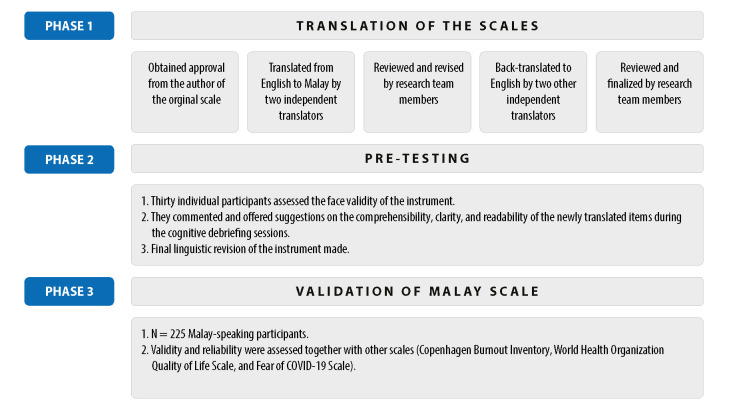
This three-phase study was conducted among Malaysian population. Phase 1 involved forward and backward translations of the Scale to Malay language by four professional bilingual translators. In Phase 2, the new M-COVID-19-BS instrument was piloted on 30 participants who suggested minor lexical modifications. Phase 3 consisted of online recruiting of Malaysian citizens to answer a composite questionnaire comprising the M-COVID-19-BS, Copenhagen Burnout Inventory (CBI), World Health Organization Quality of Life Scale Abbreviated Version (WHOQOL-BREF), and Fear of COVID-19 Scale (FCV-19S). Data were statistically analyzed.
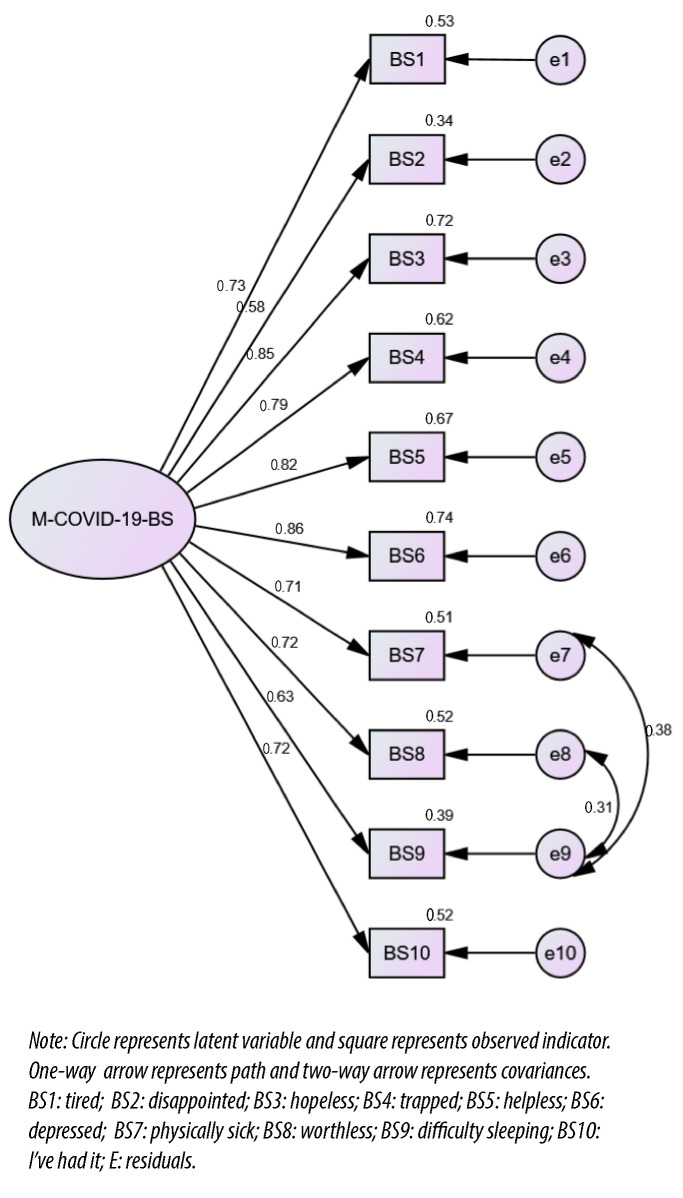
The composite four-part questionnaire in Malay was answered by N = 225 Malaysian citizens. The M-COVID-19-BS instrument demonstrated a good internal consistency (Cronbach's alpha = 0.926) and had a unidimensional factor structure. M-COVID-19-BS scores positively correlated with the three CBI subscales, showing evidence of convergent validity. Negative correlation was reported between M-COVID-19-BS and WHOQOL-BREF, achieving discriminant validity. M-COVID-19-BS also exhibited moderate positive correlations with the FCV-19S, thus supporting its concurrent validity.
Results demonstrate that M-COVID-19-BS is a valid and reliable instrument to assess burnout symptoms related to COVID-19 among Malay-speaking populations either collectively or as a self-care tool to detect burnout symptoms without needing to further burden the already overwhelmed Malaysian healthcare system.
从2020年初开始,马来西亚不得不实施全国范围的封锁、隔离及其他社交距离措施,以遏制新冠病毒的传播,这导致民众出现心理社会倦怠症状。本研究的目的是开发并验证新冠病毒倦怠量表(M-COVID-19-BS)的马来语版本。
这项分三个阶段的研究在马来西亚人群中开展。第一阶段由四名专业双语翻译人员将该量表进行正向和反向翻译为马来语。在第二阶段,新的M-COVID-19-BS工具在30名参与者中进行试用,他们提出了一些小的词汇修改建议。第三阶段包括在线招募马来西亚公民,以回答一份综合问卷,该问卷包括M-COVID-19-BS、哥本哈根倦怠量表(CBI)、世界卫生组织生活质量简表(WHOQOL-BREF)和新冠病毒恐惧量表(FCV-19S)。对数据进行了统计分析。
N = 225名马来西亚公民回答了马来语的综合四部分问卷。M-COVID-19-BS工具显示出良好的内部一致性(克朗巴哈系数= 0.926),并具有单维因子结构。M-COVID-19-BS得分与CBI的三个子量表呈正相关,显示出收敛效度的证据。M-COVID-19-BS与WHOQOL-BREF之间呈负相关,实现了区分效度。M-COVID-19-BS与FCV-19S也呈现出中度正相关,从而支持了其同时效度。
结果表明,M-COVID-19-BS是一种有效且可靠的工具,可用于评估马来语人群中与新冠病毒相关的倦怠症状,无论是集体评估还是作为一种自我护理工具来检测倦怠症状,而无需给本已不堪重负的马来西亚医疗系统增加额外负担。