Roy Poritosh, Mohanty Amar K, Dick Phil, Misra Manjusri
School of Engineering, Thornbrough Building, University of Guelph, 50 Stone Road East, Guelph, Ontario N1G 2W1, Canada.
Bioproducts Discovery and Development Centre, Department of Plant Agriculture, Crop Science Building, University of Guelph, 50 Stone Road East, Guelph, Ontario N1G 2W1, Canada.
ACS Environ Au. 2023 Jan 20;3(2):58-75. doi: 10.1021/acsenvironau.2c00050. eCollection 2023 Mar 15.
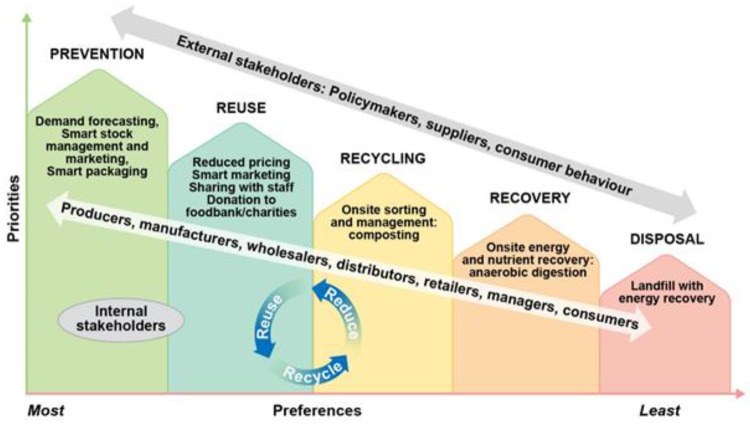
Valorization of food waste (FW) is instrumental for reducing the environmental and economic burden of FW and transitioning to a circular economy. The FW valorization process has widely been studied to produce various end-use products and summarize them; however, their economic, environmental, and social aspects are limited. This study synthesizes some of the valorization methods used for FW management and produces value-added products for various applications, and also discusses the technological advances and their environmental, economic, and social aspects. Globally, 1.3 billion tonnes of edible food is lost or wasted each year, during which about 3.3 billion tonnes of greenhouse gas is emitted. The environmental (-347 to 2969 kg CO equiv/tonne FW) and economic (-100 to $138/tonne FW) impacts of FW depend on the multiple parameters of food chains and waste management systems. Although enormous efforts are underway to reduce FW as well as valorize unavoidable FW to reduce environmental and economic loss, it seems the transdisciplinary approach/initiative would be essential to minimize FW as well as abate the environmental impacts of FW. A joint effort from stakeholders is the key to reducing FW and the efficient and effective valorization of FW to improve its sustainability. However, any initiative in reducing food waste should consider a broader sustainability check to avoid risks to investment and the environment.
食品废弃物(FW)的价值化对于减轻FW的环境和经济负担以及向循环经济转型至关重要。人们已经广泛研究了FW价值化过程以生产各种最终用途产品并对其进行总结;然而,它们在经济、环境和社会方面存在局限性。本研究综合了一些用于FW管理的价值化方法,并生产用于各种应用的增值产品,还讨论了技术进步及其环境、经济和社会方面。在全球范围内,每年有13亿吨可食用食物被损失或浪费,在此期间排放约33亿吨温室气体。FW的环境影响(-347至2969千克二氧化碳当量/吨FW)和经济影响(-100至138美元/吨FW)取决于食物链和废物管理系统的多个参数。尽管正在做出巨大努力来减少FW并将不可避免的FW进行价值化以减少环境和经济损失,但跨学科方法/举措对于尽量减少FW以及减轻FW的环境影响似乎至关重要。利益相关者的共同努力是减少FW以及对FW进行高效且有效的价值化以提高其可持续性的关键。然而,任何减少食物浪费的举措都应考虑更广泛的可持续性检查,以避免对投资和环境造成风险。