Wei Yulei, Zhang E, Yu Leqian, Ci Baiquan, Guo Lei, Sakurai Masahiro, Takii Shino, Liu Jian, Schmitz Daniel A, Ding Yi, Zhan Linfeng, Zheng Canbin, Sun Hai-Xi, Xu Lin, Okamura Daiji, Ji Weizhi, Tan Tao, Wu Jun
Department of Molecular Biology, University of Texas Southwestern Medical Center, Dallas, TX 75390, USA.
State Key Laboratory of Agrobiotechnology, College of Biological Sciences, China Agricultural University, Beijing 100193, China.
bioRxiv. 2023 Mar 8:2023.03.07.531525. doi: 10.1101/2023.03.07.531525.
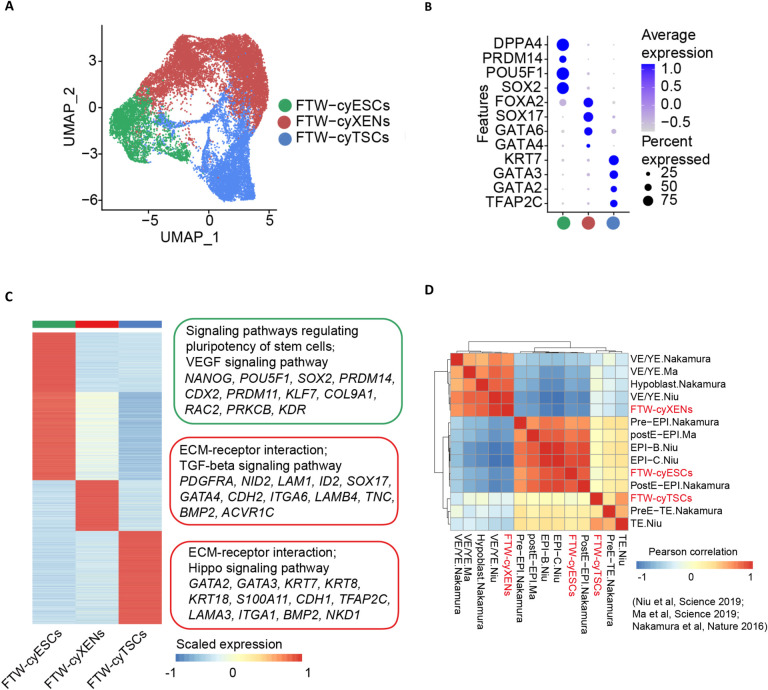
Faithful embryogenesis requires precise coordination between embryonic and extraembryonic tissues. Although stem cells from embryonic and extraembryonic origins have been generated for several mammalian species(Bogliotti et al., 2018; Choi et al., 2019; Cui et al., 2019; Evans and Kaufman, 1981; Kunath et al., 2005; Li et al., 2008; Martin, 1981; Okae et al., 2018; Tanaka et al., 1998; Thomson et al., 1998; Vandevoort et al., 2007; Vilarino et al., 2020; Yu et al., 2021b; Zhong et al., 2018), they are grown in different culture conditions with diverse media composition, which makes it difficult to study cross-lineage communication. Here, by using the same culture condition that activates FGF, TGF-β and WNT signaling pathways, we derived stable embryonic stem cells (ESCs), extraembryonic endoderm stem cells (XENs) and trophoblast stem cells (TSCs) from all three founding tissues of mouse and cynomolgus monkey blastocysts. This allowed us to establish embryonic and extraembryonic stem cell co-cultures to dissect lineage crosstalk during early mammalian development. Co-cultures of ESCs and XENs uncovered a conserved and previously unrecognized growth inhibition of pluripotent cells by extraembryonic endoderm cells, which is in part mediated through extracellular matrix signaling. Our study unveils a more universal state of stem cell self-renewal stabilized by activation, as opposed to inhibition, of developmental signaling pathways. The embryonic and extraembryonic stem cell co-culture strategy developed here will open new avenues for creating more faithful embryo models and developing more developmentally relevant differentiation protocols.
精确的胚胎发育需要胚胎组织和胚外组织之间的精确协调。尽管已经为几种哺乳动物生成了源自胚胎和胚外的干细胞(博廖蒂等人,2018年;崔等人,2019年;崔等人,2019年;埃文斯和考夫曼,1981年;库纳斯等人,2005年;李等人,2008年;马丁,1981年;冈江等人,2018年;田中等人,1998年;汤姆森等人,1998年;万德沃特等人,2007年;比利亚里诺等人,2020年;于等人,2021b;钟等人,2018年),但它们是在具有不同培养基成分的不同培养条件下生长的,这使得研究跨谱系通讯变得困难。在这里,通过使用激活FGF、TGF-β和WNT信号通路的相同培养条件,我们从小鼠和食蟹猴囊胚的所有三个基础组织中获得了稳定的胚胎干细胞(ESC)、胚外内胚层干细胞(XEN)和滋养层干细胞(TSC)。这使我们能够建立胚胎和胚外干细胞共培养体系,以剖析早期哺乳动物发育过程中的谱系串扰。ESC和XEN的共培养揭示了胚外内胚层细胞对多能细胞的一种保守且先前未被认识的生长抑制作用,这部分是通过细胞外基质信号介导的。我们的研究揭示了一种通过激活而非抑制发育信号通路来稳定干细胞自我更新的更普遍状态。这里开发的胚胎和胚外干细胞共培养策略将为创建更精确的胚胎模型和开发更与发育相关的分化方案开辟新途径。