Li Chao, Zhang Xumeng, Chen Pei, Zhou Keji, Yu Jie, Wu Guangjian, Xiang Du, Jiang Hao, Wang Ming, Liu Qi
State Key Laboratory of Integrated Chip and System, Frontier Institute of Chip and System, Fudan University, Shanghai 200433, China.
Key Laboratory of Microelectronics Device & Integrated Technology, Institute of Microelectronics of Chinese Academy of Sciences, Beijing 100029, China.
iScience. 2023 Mar 2;26(4):106315. doi: 10.1016/j.isci.2023.106315. eCollection 2023 Apr 21.
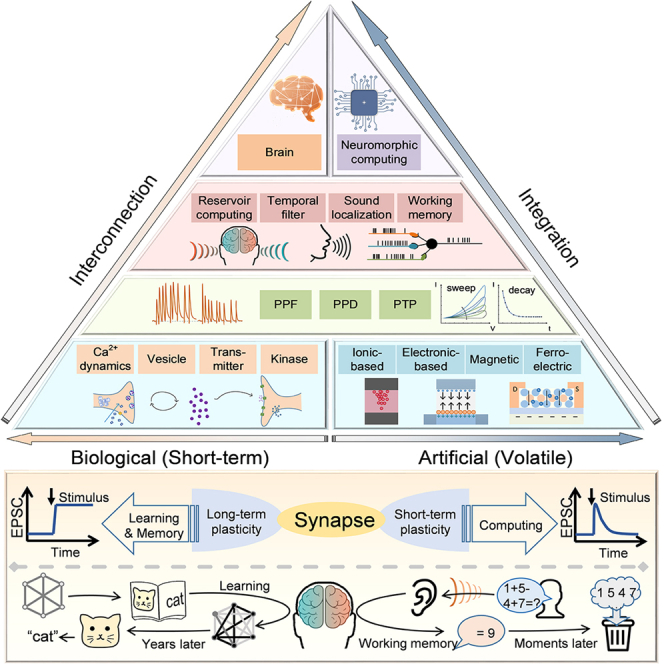
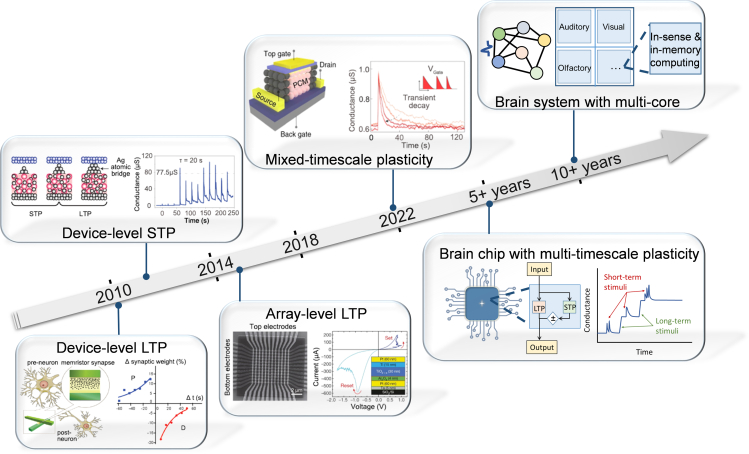
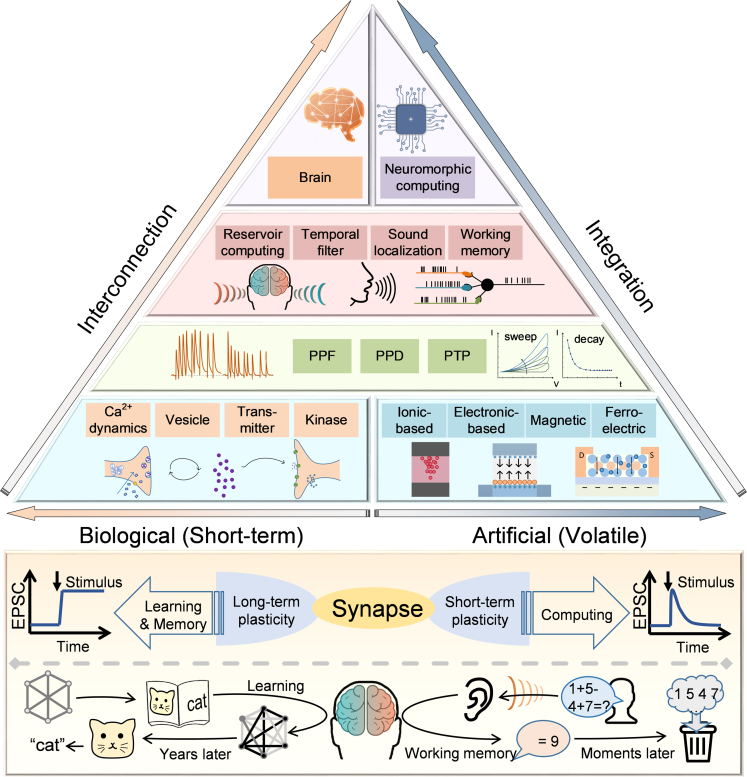
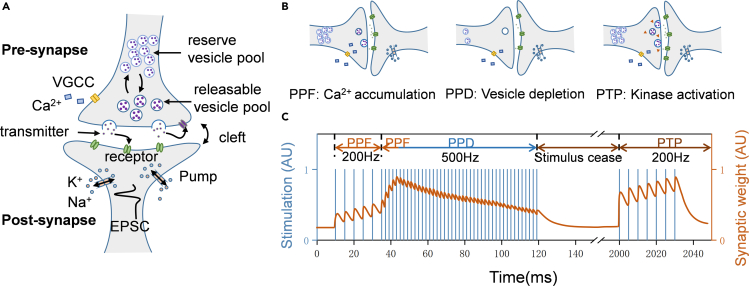
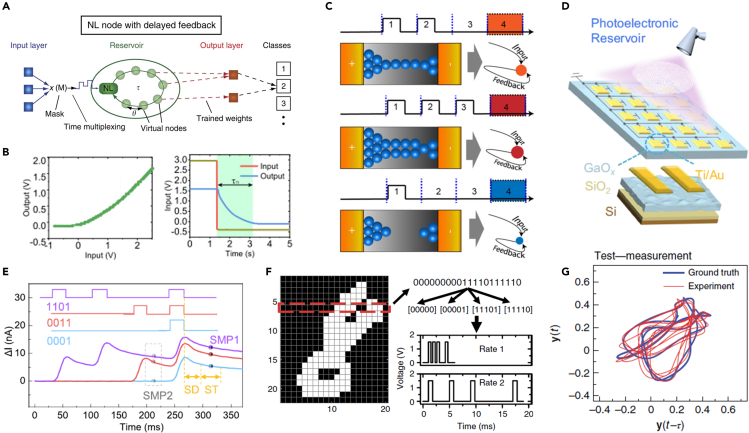
Neuromorphic computing is a promising computing paradigm toward building next-generation artificial intelligence machines, in which diverse types of synaptic plasticity play an active role in information processing. Compared to long-term plasticity (LTP) forming the foundation of learning and memory, short-term plasticity (STP) is essential for critical computational functions. So far, the practical applications of LTP have been widely investigated, whereas the implementation of STP in hardware is still elusive. Here, we review the development of STP by bridging the physics in emerging devices and biological behaviors. We explore the computational functions of various STP in biology and review their recent progress. Finally, we discuss the main challenges of introducing STP into synaptic devices and offer the potential approaches to utilize STP to enrich systems' capabilities. This review is expected to provide prospective ideas for implementing STP in emerging devices and may promote the construction of high-level neuromorphic machines.
神经形态计算是构建下一代人工智能机器的一种很有前景的计算范式,其中不同类型的突触可塑性在信息处理中发挥着积极作用。与构成学习和记忆基础的长期可塑性(LTP)相比,短期可塑性(STP)对于关键的计算功能至关重要。到目前为止,LTP的实际应用已经得到了广泛研究,而STP在硬件中的实现仍然难以捉摸。在这里,我们通过将新兴器件中的物理原理与生物行为联系起来,回顾了STP的发展。我们探索了各种STP在生物学中的计算功能,并回顾了它们最近的进展。最后,我们讨论了将STP引入突触器件的主要挑战,并提供了利用STP来增强系统能力的潜在方法。这篇综述有望为在新兴器件中实现STP提供前瞻性思路,并可能促进高级神经形态机器的构建。