Zhang Ying, Li Jing, Yang Min, Wang Qin
Department of Endocrinology, West China Hospital of Sichuan University, Chengdu, Sichuan, China.
Front Nutr. 2023 Mar 7;10:1131103. doi: 10.3389/fnut.2023.1131103. eCollection 2023.
To systematically evaluate the impact of vitamin D supplementation on mortality, ICU admission, and the rates of mechanical ventilation or intubation among COVID-19 patients.
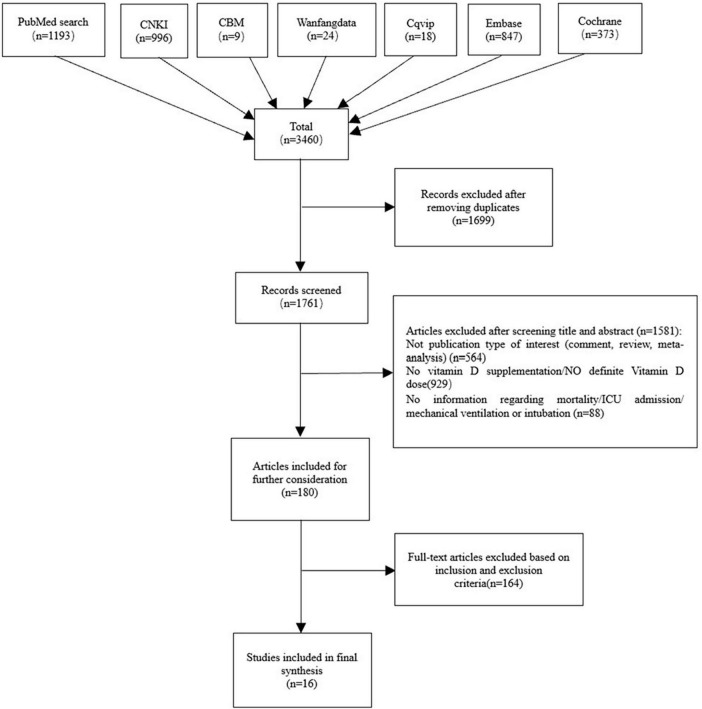
The PubMed, Embase, Cochrane Library, CBM, CNKI, VIP, and WanFang databases were searched from 1 December 2019 to 31 December 2022. The authors sought to identify randomized controlled trials and cohort studies that examined the relationship between vitamin D supplementation and mortality, ICU admission, and mechanical ventilation or intubation rates among COVID-19 patients.
Two investigators independently searched the literature, extracted the data, and assessed the quality of the included studies. The Grading of Recommendation, Assessment, Development, and Evaluation approach was used to evaluate the quality of the evidence. Meta-analysis was conducted using RevMan 5.3, STATA 15.1, and R 4.1.3 software.
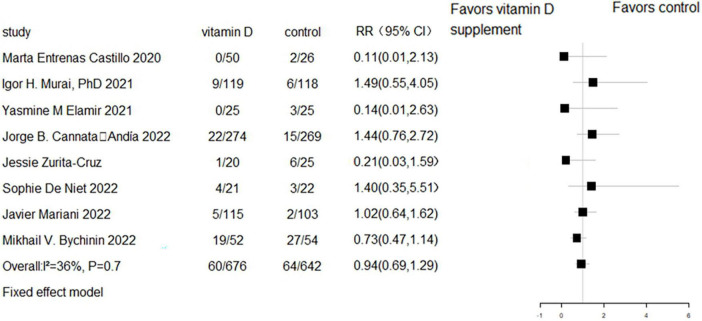
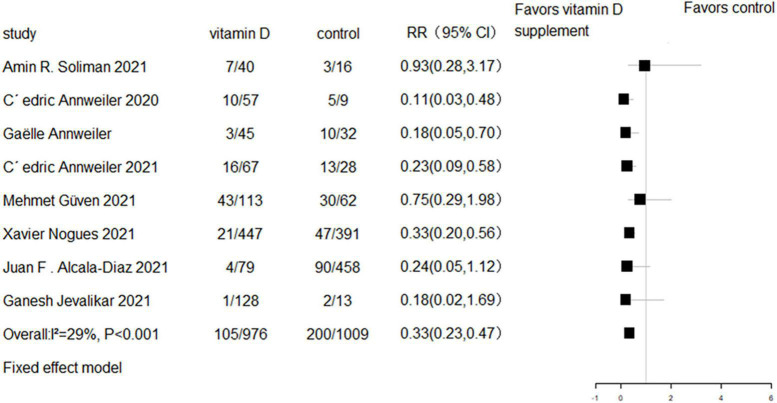
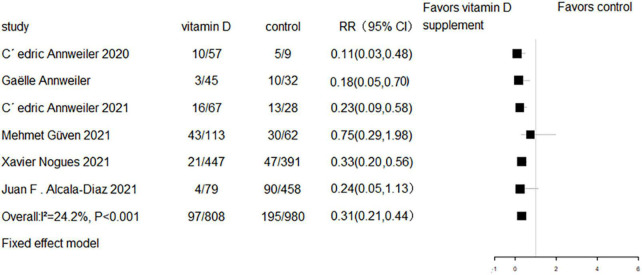
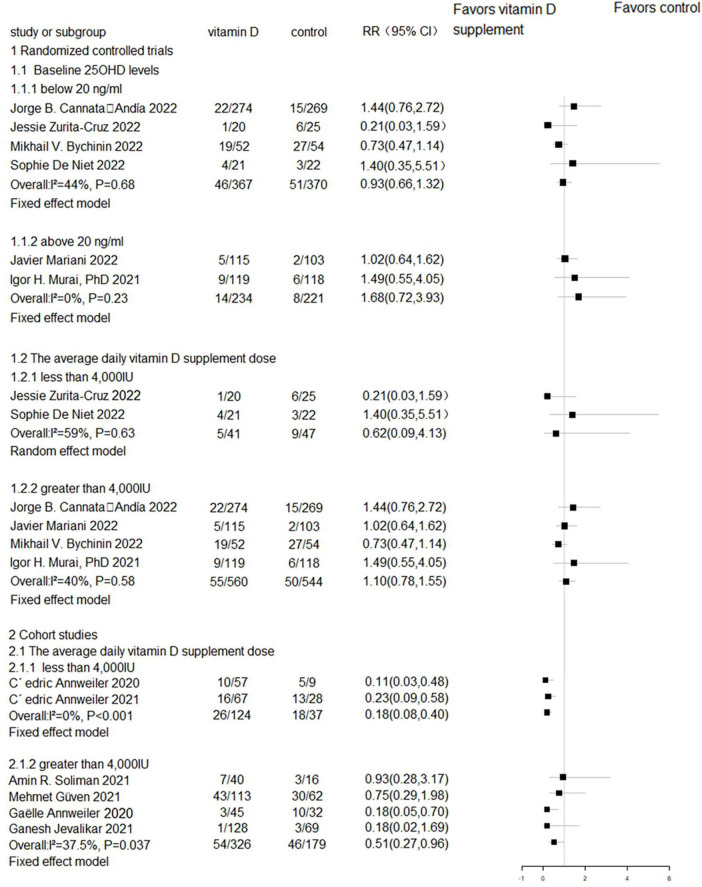
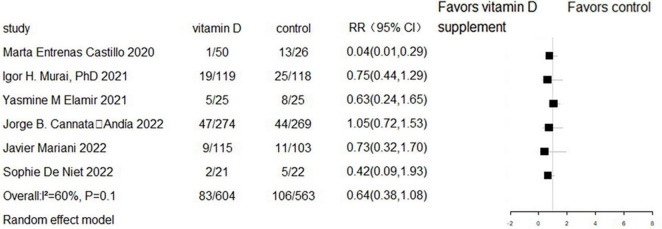
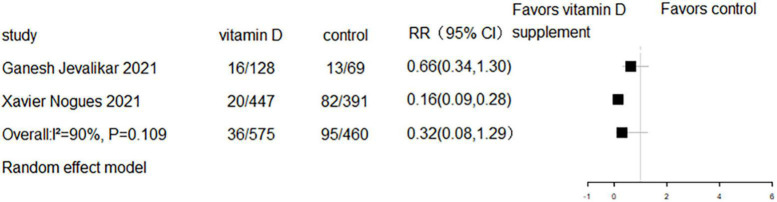
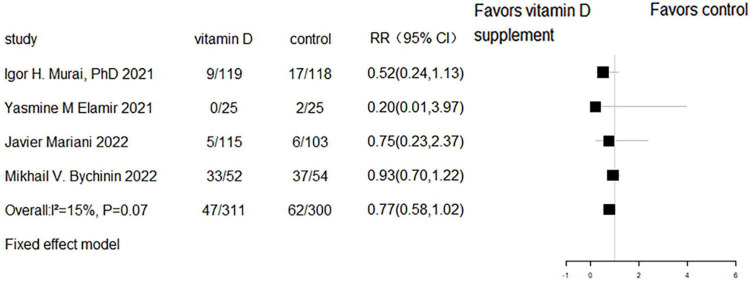
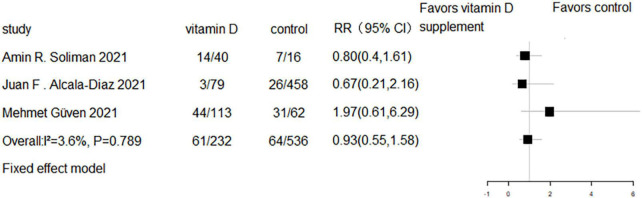
Eight randomized controlled trials (RCTs) and eight cohort studies were included, involving 3359 COVID-19 patients. The pooled analysis of randomized controlled trials showed that vitamin D supplementation did not have a significant effect on reducing mortality (Relative Risk, RR = 0.94, 95% CI 0.69-1.29, = 0.7), while the results of cohort studies indicated that vitamin D supplementation had a positive impact on reducing mortality among COVID-19 patients (RR = 0.33, 95% CI 0.23-0.47, < 0.001). There was no statistically significant difference in the rates of ICU admission (RCTs: RR = 0.64, 95%CI 0.38-1.08, = 0.10; cohort studies: RR = 0.32, 95% CI 0.08-1.29, = 0.109) or rates of mechanical ventilation or intubation (RCTs: RR = 0.77, 95% CI 0.58-1.02, = 0.07; cohort studies: RR = 0.93, 95% CI 0.55-1.58, = 0.789).
The results of this systematic review and meta-analysis suggest that vitamin D supplementation does not have a significant impact on reducing mortality, ICU admission, and the rates of mechanical ventilation or intubation among COVID-19 patients. However, due to the limited number and quality of the studies included, further high-quality studies are needed to confirm these findings.
www.crd.york.ac.uk, identifier CRD42021299521.
系统评价补充维生素D对新型冠状病毒肺炎(COVID-19)患者死亡率、入住重症监护病房(ICU)以及机械通气或插管率的影响。
检索2019年12月1日至2022年12月31日期间的PubMed、Embase、Cochrane图书馆、中国生物医学文献数据库(CBM)、中国知网(CNKI)、维普资讯(VIP)和万方数据库。作者试图识别随机对照试验和队列研究,以检验补充维生素D与COVID-19患者死亡率、入住ICU以及机械通气或插管率之间的关系。
两名研究者独立检索文献、提取数据并评估纳入研究的质量。采用推荐分级、评估、制定与评价方法来评估证据质量。使用RevMan 5.3、STATA 15.1和R 4.1.3软件进行荟萃分析。
纳入8项随机对照试验(RCT)和8项队列研究,涉及3359例COVID-19患者。随机对照试验的汇总分析表明,补充维生素D对降低死亡率无显著影响(相对危险度,RR = 0.94,95%可信区间[CI] 0.69 - 1.29,P = 0.7),而队列研究结果表明,补充维生素D对降低COVID-19患者死亡率有积极影响(RR = 0.33,95% CI 0.23 - 0.47,P < 0.001)。在入住ICU率(随机对照试验:RR = 0.64,95% CI 0.38 - 1.08,P = 0.10;队列研究:RR = 0.32,95% CI 0.08 - 1.29,P = 0.109)或机械通气或插管率方面(随机对照试验:RR = 0.77,95% CI 0.58 - 1.02,P = 0.07;队列研究:RR = 0.93,95% CI 0.55 - 1.58,P = 0.789),均无统计学显著差异。
本系统评价和荟萃分析结果表明,补充维生素D对降低COVID-19患者死亡率、入住ICU以及机械通气或插管率无显著影响。然而,由于纳入研究的数量和质量有限,需要进一步的高质量研究来证实这些发现。