School of Pharmacy and Life Sciences, Robert Gordon University, Aberdeen, AB10 7GJ, UK.
University of Aberdeen, Rowett Institute, Foresterhill Campus, Ashgrove Road West, Scotland, AB25 2ZD, UK.
BMC Plant Biol. 2023 Mar 25;23(1):162. doi: 10.1186/s12870-023-04144-8.
Terminalia ivorensis (TI) is used in West African ethnomedicine for the treatment of conditions including ulcers, malaria and wounds. Despite its widespread use, the phytochemical profile of TI remains largely undetermined. This research investigated the effects of extraction method, season, and storage conditions on the phytochemical composition of TI to contribute towards understanding the potential benefits.
TI bark was collected in September 2014, September 2018 and February 2018 during the rainy or dry seasons in Eastern Region, Ghana. Samples were extracted sequentially with organic solvents (petroleum ether, chloroform, ethyl acetate and ethanol) or using water (traditional). Metabolites were identified by liquid chromatography-mass spectrometry/mass spectrometry and compared statistically by ANOVA.
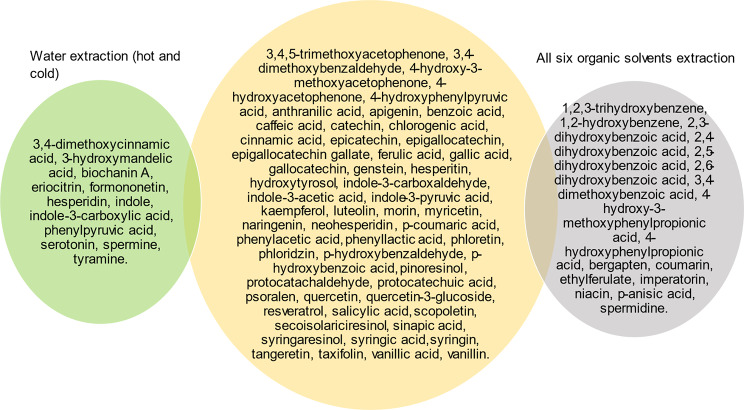
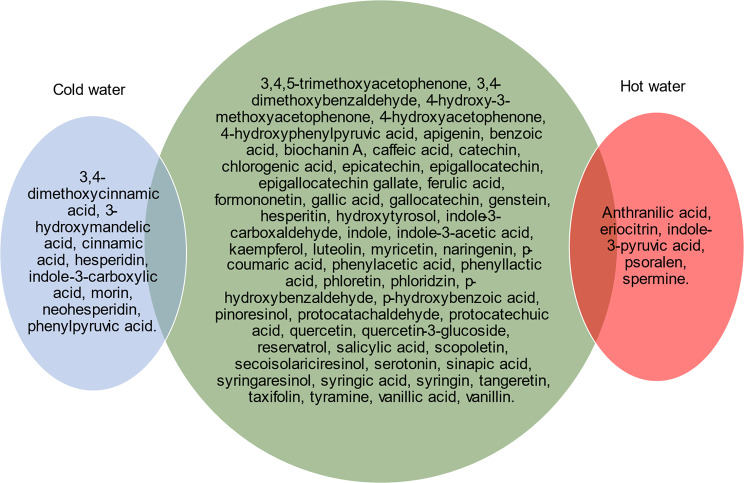
A total of 82 different phytochemicals were identified across all samples. A greater yield of the major phytochemicals (44%, p < 0.05) was obtained by water as compared with organic extraction. There was also a higher concentration of metabolites present in cold (63%, p < 0.05) compared with hot water extraction. A significantly (p < 0.05) higher number of phytochemicals were identified from TI collected in the dry (85%) compared to the rainy season (69%). TI bark stored for four years retained 84% of the major phytochemicals.
This work provides important information on composition and how this is modified by growing conditions, storage and method of extraction informing progress on the development of TI as a prophylactic formulation or medicine.
Terminalia ivorensis(TI)在西非传统医学中用于治疗溃疡、疟疾和伤口等疾病。尽管它被广泛使用,但 TI 的植物化学成分仍在很大程度上未被确定。本研究调查了提取方法、季节和储存条件对 TI 植物化学成分的影响,以期了解其潜在益处。
2014 年 9 月、2018 年 9 月和 2018 年 2 月在加纳东部地区的雨季和旱季采集 TI 树皮。使用有机溶剂(石油醚、氯仿、乙酸乙酯和乙醇)或水(传统)依次提取样品。通过液相色谱-质谱/质谱法鉴定代谢物,并通过 ANOVA 进行统计比较。
在所有样品中总共鉴定出 82 种不同的植物化学物质。与有机溶剂提取相比,水提取可获得主要植物化学物质的更高产量(44%,p<0.05)。冷水中(63%,p<0.05)存在的代谢物浓度也更高。与雨季(69%)相比,旱季(85%)采集的 TI 中鉴定出的植物化学物质数量明显更高(p<0.05)。储存四年的 TI 树皮保留了 84%的主要植物化学物质。
这项工作提供了有关成分的重要信息,以及这些成分如何受到生长条件、储存和提取方法的影响,为 TI 作为预防性制剂或药物的开发提供了信息。