László Török
Department of Engineering Management and Enterprise, Industrial Process Management Institute, Faculty of Engineering, University of Debrecen, Ótemető u.2-4, 4032, Debrecen, Hungary.
Heliyon. 2023 Mar 13;9(3):e14550. doi: 10.1016/j.heliyon.2023.e14550. eCollection 2023 Mar.
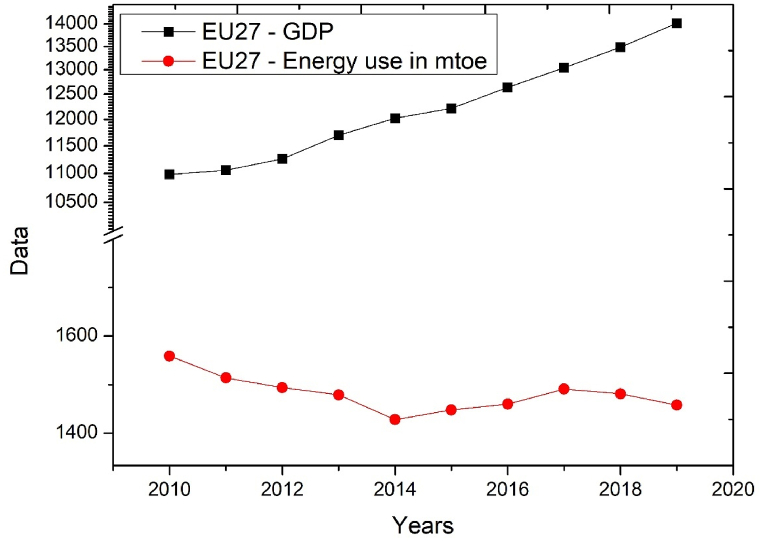
Energy consumption efficiency will be of paramount importance in 2023 due to the first global energy crisis experienced worldwide. The central question of this paper is how energy consumption and economic growth have been related to each other and how they have interacted in time and space in the European Union. Correlation calculations are used to show the relationship between the two indicators per Member State, and hierarchical cluster analysis is applied to the results. The analysis is based on data regarding the European Union Member States for the period of 2010-2019. The results show that there was no robust, strong correlation between the GDP and the energy consumption of the member countries. Another result shows that in the Member States where energy consumption fell significantly, the reduction did not have a negative impact on the economic growth. Finally, the study highlights the methodological shortcomings of studies on the correlation between energy consumption and economic growth.
由于全球首次经历能源危机,2023年能源消耗效率将至关重要。本文的核心问题是,在欧盟,能源消耗与经济增长如何相互关联,以及它们在时空上如何相互作用。相关性计算用于展示每个成员国这两个指标之间的关系,并对结果应用层次聚类分析。该分析基于2010年至2019年期间欧盟成员国的数据。结果表明,成员国的国内生产总值(GDP)与能源消耗之间不存在稳健、强烈的相关性。另一个结果表明,在能源消耗大幅下降的成员国,这种下降并未对经济增长产生负面影响。最后,该研究突出了能源消耗与经济增长相关性研究的方法缺陷。