Zeng Suqi, Liu Chuan, Zhang Jixiang, An Ping, Liu Zhongchun, Jiang Changqing, Shi Jie, Wu Kaichun, Dong Weiguo
Department of Gastroenterology, Renmin Hospital of Wuhan University, Wuhan, China.
Department of Psychiatry, Renmin Hospital of Wuhan University, Wuhan, China.
Front Psychiatry. 2023 Mar 9;14:1130396. doi: 10.3389/fpsyt.2023.1130396. eCollection 2023.
This study aimed to determine the prevalence and risk factors for poor sleep quality in inflammatory bowel disease (IBD) patients.
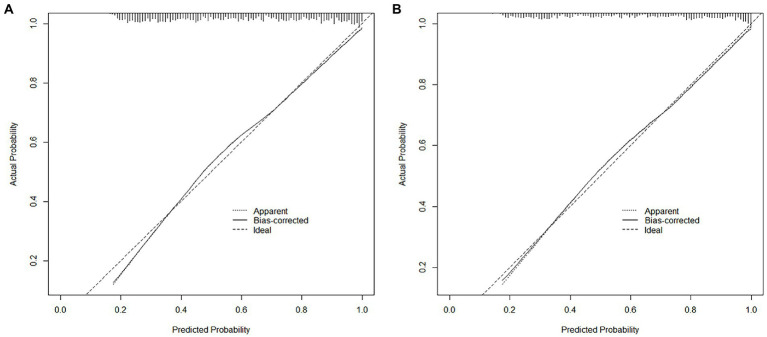
2,478 IBD patients were enrolled to investigate their sleep quality using the Pittsburgh sleep quality index (PSQI). Clinical and psychological characteristics were collected to explore the risk factors for poor sleep quality. A hurdle model was conducted to predict poor sleep quality based on the risk factors. Among this hurdle model, the logistic regression model was used to determine risk factors of the presence of poor sleep quality, and the zero-inflated negative binomial model was employed to identify risk factors of the severity of poor sleep quality.
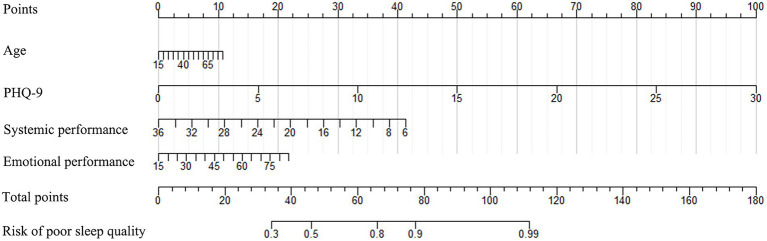
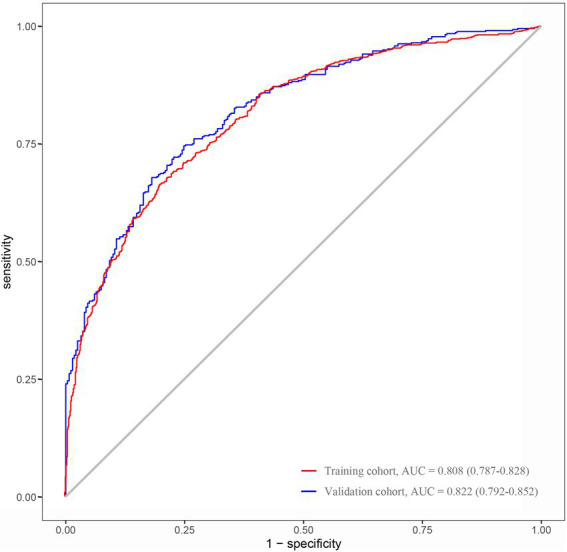
In this study, 1,491 (60.17%) IBD patients had poor sleep quality, and the proportion in the older group was higher than younger group (64.89% vs. 58.27%, = 0.003). According to multivariable logistic regression, age (OR, 1.011; 95% CI [1.002,1.020]; = 0.014), Patient Health Questionnaire-9 (PHQ-9) score (OR, 1.263; 95% CI [1.228,1.300]; < 0.001), systemic (OR, 0.906; 95% CI [0.867,0.946]; < 0.001) and emotional performance (OR, 1.023; 95% CI [1.005,1.043]; = 0.015) were risk factors of the presence of poor sleep quality. The area under the curve (AUC) of the prediction model was 0.808. According to zero-truncated negative binomial regression, age (RR, 1.004; 95% CI [1.002,1.005]; < 0.001) and PHQ-9 score (RR, 1.027; 95% CI [1.021,1.032]; < 0.001) were risk factors of the severity of poor sleep quality.
The prevalence of poor sleep quality among the older group in IBD patients was relatively high. Old age and depressive mood are risk factors for both the presence and severity of poor sleep quality.
本研究旨在确定炎症性肠病(IBD)患者睡眠质量差的患病率及危险因素。
纳入2478例IBD患者,采用匹兹堡睡眠质量指数(PSQI)调查其睡眠质量。收集临床和心理特征以探索睡眠质量差的危险因素。基于危险因素构建障碍模型以预测睡眠质量差。在该障碍模型中,使用逻辑回归模型确定存在睡眠质量差的危险因素,使用零膨胀负二项模型识别睡眠质量差严重程度的危险因素。
本研究中,1491例(60.17%)IBD患者睡眠质量差,老年组的比例高于年轻组(64.89%对58.27%,P = 0.003)。根据多变量逻辑回归分析,年龄(比值比[OR],1.011;95%置信区间[CI][1.002,1.020];P = 0.014)、患者健康问卷-9(PHQ-9)评分(OR,1.263;95% CI[1.228,1.300];P < 0.001)、全身表现(OR,0.906;95% CI[0.867,0.946];P < 0.001)和情绪表现(OR,1.023;95% CI[1.005,1.043];P = 0.015)是存在睡眠质量差的危险因素。预测模型的曲线下面积(AUC)为0.808。根据零截断负二项回归分析,年龄(风险比[RR],1.004;95% CI[1.002,1.005];P < 0.001)和PHQ-9评分(RR,1.027;95% CI[1.021,1.032];P < 0.001)是睡眠质量差严重程度的危险因素。
IBD患者中老年组睡眠质量差的患病率相对较高。年龄大和抑郁情绪是睡眠质量差的存在及严重程度的危险因素。