Permafrost Research Section, Alfred Wegener Institute Helmholtz Centre for Polar and Marine Research, Potsdam, Germany.
Department of Earth Sciences, Vrije Universiteit Amsterdam, Amsterdam, The Netherlands.
Nat Commun. 2023 Mar 28;14(1):1721. doi: 10.1038/s41467-023-37276-4.
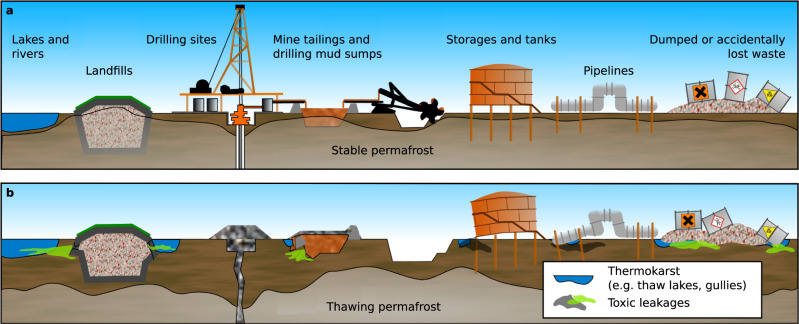
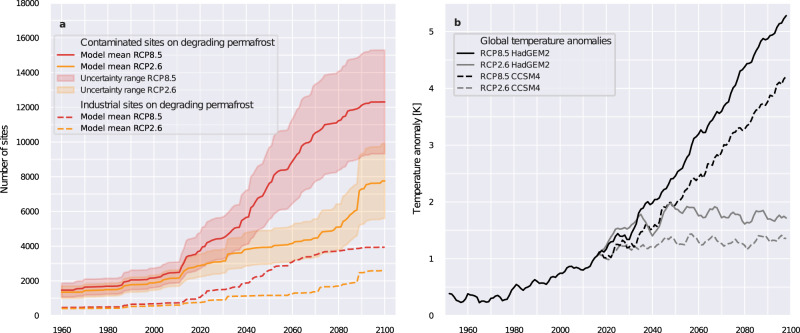
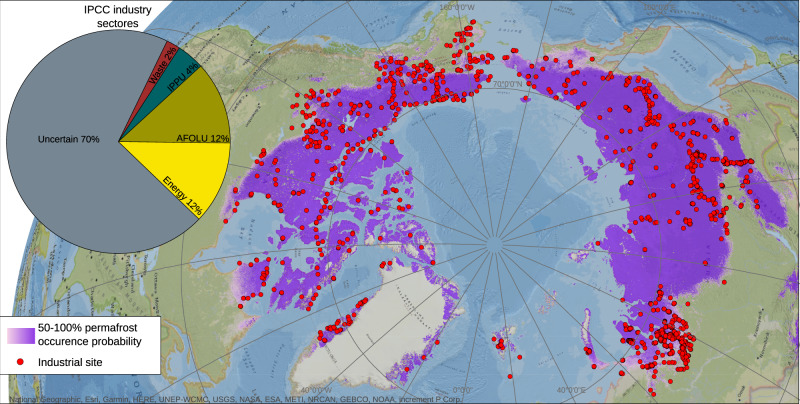
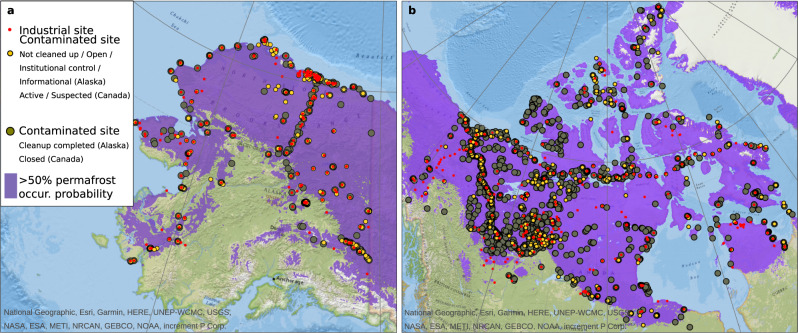
Industrial contaminants accumulated in Arctic permafrost regions have been largely neglected in existing climate impact analyses. Here we identify about 4500 industrial sites where potentially hazardous substances are actively handled or stored in the permafrost-dominated regions of the Arctic. Furthermore, we estimate that between 13,000 and 20,000 contaminated sites are related to these industrial sites. Ongoing climate warming will increase the risk of contamination and mobilization of toxic substances since about 1100 industrial sites and 3500 to 5200 contaminated sites located in regions of stable permafrost will start to thaw before the end of this century. This poses a serious environmental threat, which is exacerbated by climate change in the near future. To avoid future environmental hazards, reliable long-term planning strategies for industrial and contaminated sites are needed that take into account the impacts of cimate change.
在现有的气候影响分析中,北极永久冻土地区积累的工业污染物在很大程度上被忽视了。在这里,我们确定了大约 4500 个工业场地,这些场地在北极的永久冻土地区积极处理或储存潜在危险物质。此外,我们估计,与这些工业场地相关的污染场地约有 13000 到 20000 个。由于大约 1100 个工业场地以及位于稳定永久冻土地区的 3500 到 5200 个污染场地将在本世纪末之前开始融化,因此持续的气候变暖将增加污染和有毒物质迁移的风险。这构成了严重的环境威胁,而在不久的将来气候变化将使这种威胁更加恶化。为了避免未来的环境危害,需要制定可靠的工业和污染场地的长期规划策略,考虑到气候变化的影响。