Wang Xiaoming, Tong Shilu, Wang Yu, Ma Lijuan, Shi Xiaoming
Northwest Institute of Eco-environment and Resources, Chinese Academy of Sciences, Lanzhou City, Gansu Province, China.
China CDC Key Laboratory of Environment and Population Health, National Institute of Environmental Health, Chinese Center for Disease Control and Prevention, Beijing, China.
China CDC Wkly. 2025 Mar 21;7(12):379-384. doi: 10.46234/ccdcw2025.062.
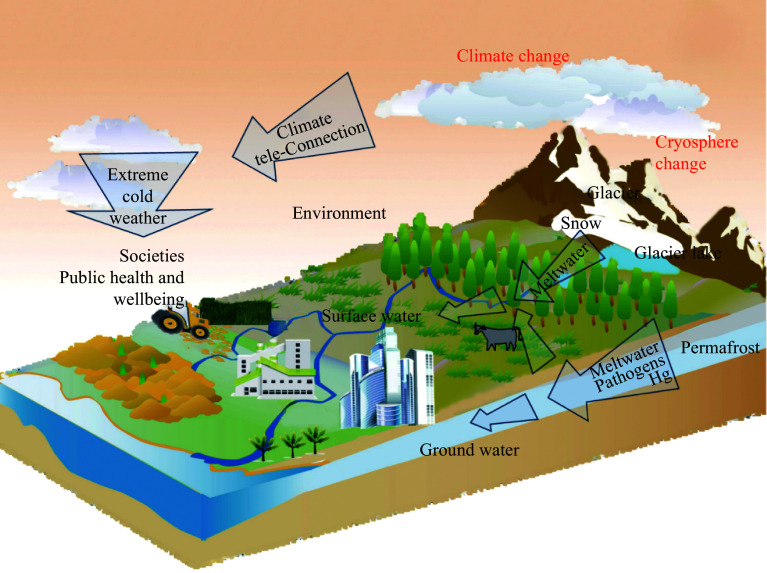
The cryosphere, encompassing glaciers, ice sheets, permafrost, and snow, plays a critical role in regulating climate and sustaining human wellbeing. However, climate change is driving widespread cryosphere degradation, intensifying geophysical and climate-related hazards that pose escalating risks to the public health and safety. The resulting decline in both the quantity and quality of cryosphere services also has severe consequences, particularly for populations in polar regions, high-altitude mountains, and their downstream areas. Furthermore, teleconnected climate systems can even extend cryosphere change impacts beyond these regions. It has been seen that increasing cryosphere-related hazards, such as glacial lake outburst floods and extreme winter events, heighten public health risks. Disrupted meltwater supply and ecosystem shifts inflict water and food insecurity in arid and semiarid regions, exacerbating malnutrition and disease burdens. Additionally, thawing permafrost may release ancient pathogens and toxic substances, increasing the risks of infectious disease outbreaks and severe environmental contamination. Addressing these cascading risks requires urgent interdisciplinary research, public awareness, and investment in adaptive strategies to strengthen societal resilience amid a rapidly changing cryosphere and safeguard public well-being.
冰冻圈包括冰川、冰盖、永久冻土和积雪,在调节气候和维持人类福祉方面发挥着关键作用。然而,气候变化正在导致冰冻圈广泛退化,加剧与地球物理和气候相关的灾害,对公众健康和安全构成不断升级的风险。冰冻圈服务的数量和质量下降也会产生严重后果,特别是对极地地区、高海拔山区及其下游地区的人口而言。此外,遥相关气候系统甚至会使冰冻圈变化的影响扩展到这些地区之外。人们已经看到,与冰冻圈相关的灾害不断增加,如冰川湖溃决洪水和极端冬季事件,会增加公共健康风险。融水供应中断和生态系统变化在干旱和半干旱地区造成水和粮食不安全,加剧营养不良和疾病负担。此外,永久冻土融化可能释放出古老的病原体和有毒物质,增加传染病爆发和严重环境污染的风险。应对这些连锁风险需要开展紧急的跨学科研究、提高公众意识,并投资于适应性战略,以便在快速变化的冰冻圈中增强社会复原力,保障公众福祉。