Hah Young-Sool, Lee Won Keong, Lee Seung-Jun, Lee Sang Yeob, Seo Jin-Hee, Kim Eun Ji, Choe Yeong-In, Kim Sang Gon, Yoo Jun-Il
Department of Orthopedics, Institute of Health Sciences, Gyeongsang National University School of Medicine and Hospital, Jinju 52727, Republic of Korea.
Biomedical Research Institute, Gyeongsang National University Hospital, Jinju 52727, Republic of Korea.
Antioxidants (Basel). 2023 Mar 3;12(3):639. doi: 10.3390/antiox12030639.
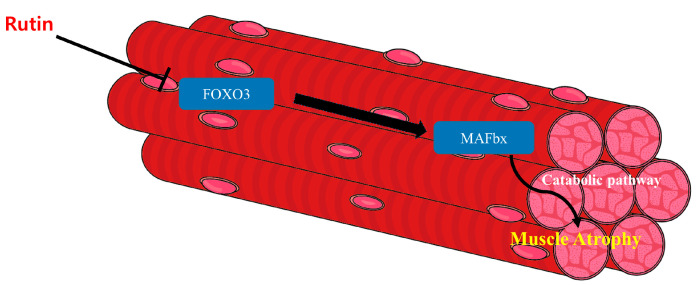
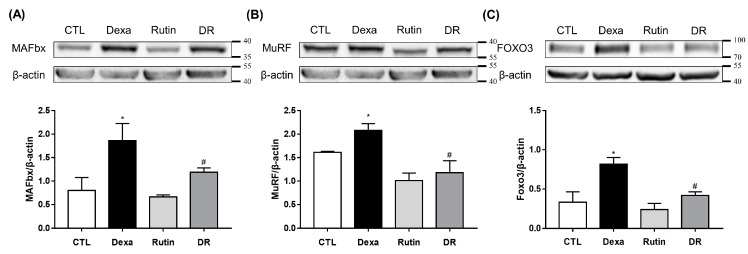
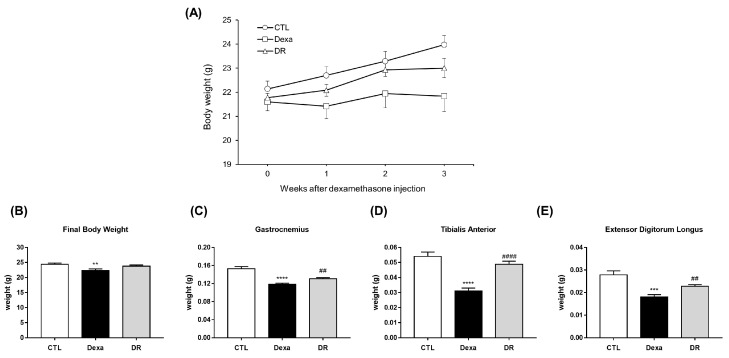
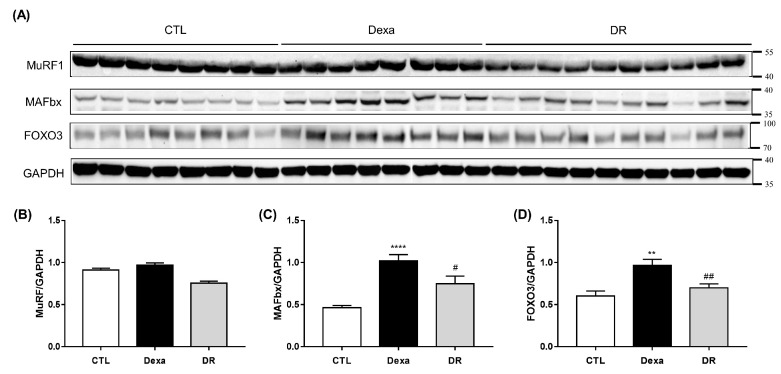
One of the causes of sarcopenia is that homeostasis between anabolism and catabolism breaks down due to muscle metabolism changes. Rutin has shown antioxidant and anti-inflammatory effects in various diseases, but there are few studies on the effect on muscle loss with aging. The effect of rutin on muscle loss was evaluated using dexamethasone-induced muscle loss C2C12 myoblast and mouse model. In the group treated with dexamethasone, the muscle weight of gastrocnemius (GA), tibialis anterior (TA), and extensor digitorum longus (EDL) in the mouse model were significantly decreased ( < 0.0001 in GA, < 0.0001 in TA, and < 0.001 in EDL) but recovered ( < 0.01 in GA, < 0.0001 in TA, and < 0.01 in EDL) when treated with rutin. MAFbx, MuRF1, and FOXO3 protein expression of C2C12 myoblast were significantly increased ( < 0.01 in MAFbx, < 0.01 in MuRF1, and < 0.01 in FOXO3) when treated with dexamethasone, but it was recovered ( < 0.01 in MAFbx, < 0.01 in MuRF1, and < 0.01 in FOXO3) when rutin was treated. In addition, MAFbx and FOXO3 protein expression in GA of mouse model was significantly increased ( < 0.0001 in MAFbx and < 0.001 in FOXO3) when treated with dexamethasone, but it was also recovered ( < 0.01 in MAFbx and < 0.001 in FOXO3) when rutin was treated. The present study shows that rutin blocks the FOXO3/MAFbx and FOXO3/MuRf1 pathways to prevent protein catabolism. Therefore, rutin could be a potential agent for muscle loss such as sarcopenia through the blocking ubiquitin-proteasome pathway associated with catabolic protein degradation.
肌肉减少症的原因之一是肌肉代谢变化导致合成代谢与分解代谢之间的稳态被打破。芦丁在多种疾病中已显示出抗氧化和抗炎作用,但关于其对衰老引起的肌肉流失影响的研究较少。使用地塞米松诱导的肌肉流失C2C12成肌细胞和小鼠模型评估了芦丁对肌肉流失的影响。在地塞米松治疗组中,小鼠模型的腓肠肌(GA)、胫前肌(TA)和趾长伸肌(EDL)的肌肉重量显著降低(GA中P<0.0001,TA中P<0.0001,EDL中P<0.001),但在接受芦丁治疗后恢复(GA中P<0.01,TA中P<0.0001,EDL中P<0.01)。用 地塞米松处理时,C2C12成肌细胞的MAFbx、MuRF1和FOXO3蛋白表达显著增加(MAFbx中P<0.01,MuRF1中P<0.01,FOXO3中P<0.01),但在使用芦丁处理后恢复(MAFbx中P<0.01,MuRF1中P<0.01,FOXO3中P<0.01)。此外,在小鼠模型的GA中,用地塞米松处理时MAFbx和FOXO3蛋白表达显著增加(MAFbx中P<0.0001,FOXO3中P<0.001),但在使用芦丁处理后也恢复(MAFbx中P<0.01,FOXO3中P<0.001)。本研究表明,芦丁可阻断FOXO3/MAFbx和FOXO3/MuRf1途径以防止蛋白质分解代谢。因此,芦丁可能是一种通过阻断与分解代谢性蛋白质降解相关的泛素 - 蛋白酶体途径来治疗肌肉减少症等肌肉流失的潜在药物。