Azzony Sumayya, Moria Kawthar, Alghamdi Jamaan
Department of Computer Sciences, Faculty of Computing and Information Technology, King Abdulaziz University, Jeddah 21589, Saudi Arabia.
Diagnostic Radiology Department, Faculty of Applied Medical Sciences, King Abdulaziz University, Jeddah 21589, Saudi Arabia.
Brain Sci. 2023 Mar 14;13(3):487. doi: 10.3390/brainsci13030487.
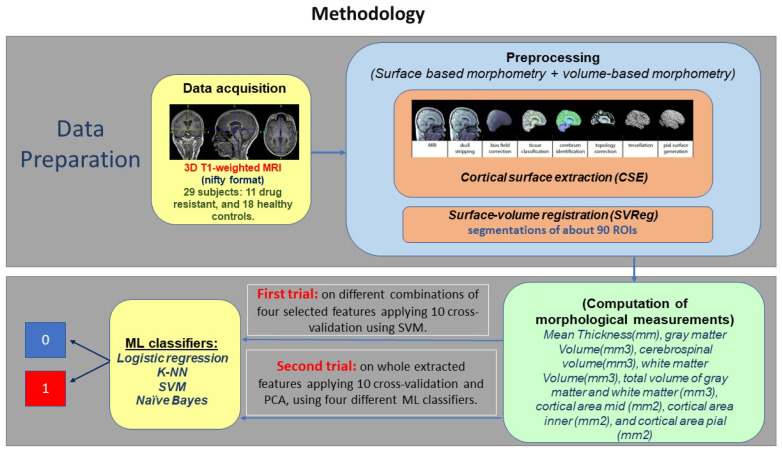
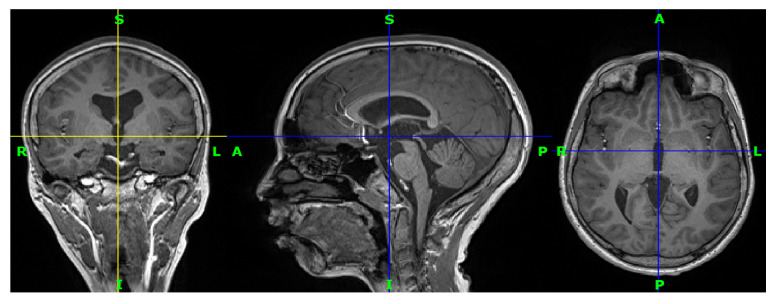
Epilepsy is a neurological disorder characterized by abnormal brain activity. Epileptic patients suffer from unpredictable seizures, which may cause a loss of awareness. Seizures are considered drug resistant if treatment does not affect success. This leads practitioners to calculate the cortical thickness to measure the distance between the brain's white and grey matter surfaces at various locations to perform a surgical intervention. In this study, we introduce using machine learning as an approach to classify extracted measurements from T1-weighted magnetic resonance imaging. Data were collected from the epilepsy unit at King Abdulaziz University Hospital. We applied two trials to classify the extracted measurements from T1-weighted MRI for drug-resistant epilepsy and healthy control subjects. The preprocessing sequence on T1-weighted MRI images was performed using C++ through BrainSuite's pipeline. The first trial was performed on seven different combinations of four commonly selected measurements. The best performance was achieved in Exp6 and Exp7, with 80.00% accuracy, 83.00% recall score, and 83.88% precision. It is noticeable that grey matter volume and white matter volume measurements are more significant than the cortical thickness measurement. The second trial applied four different machine learning classifiers after applying 10-fold cross-validation and principal component analysis on all extracted measurements as in the first trial based on the mentioned previous works. The K-nearest neighbours model outperformed the other machine learning classifiers with 97.11% accuracy, 75.00% recall score, and 75.00% precision.
癫痫是一种以大脑异常活动为特征的神经系统疾病。癫痫患者会遭受不可预测的发作,这可能导致意识丧失。如果治疗无效,发作则被认为是耐药性的。这使得从业者计算皮质厚度,以测量大脑不同位置白质和灰质表面之间的距离,从而进行手术干预。在本研究中,我们引入使用机器学习作为一种方法,对从T1加权磁共振成像中提取的测量数据进行分类。数据是从阿卜杜勒阿齐兹国王大学医院的癫痫科收集的。我们应用两种试验,对从T1加权MRI中提取的测量数据进行分类,以区分耐药性癫痫患者和健康对照者。使用C++通过BrainSuite的管道对T1加权MRI图像执行预处理序列。第一次试验在四个常用测量值的七种不同组合上进行。在Exp6和Exp7中取得了最佳性能,准确率为80.00%,召回率为83.00%,精确率为83.88%。值得注意的是,灰质体积和白质体积测量比皮质厚度测量更显著。第二次试验在如第一次试验那样对所有提取的测量数据应用10倍交叉验证和主成分分析之后,应用了四种不同的机器学习分类器。K近邻模型的表现优于其他机器学习分类器,准确率为97.11%,召回率为75.00%,精确率为75.00%。