Departamento de Ciencias de la Tierra y Fisica de la Materia Condensada, Universidad de Cantabria, 39005 Santander, Spain.
Catalan Institute of Nanoscience and Nanotechnology (ICN2), CSIC and The Barcelona Institute of Science and Technology, Campus UAB, Bellaterra, 08193 Barcelona, Spain.
J Am Chem Soc. 2023 Apr 26;145(16):8988-8995. doi: 10.1021/jacs.3c00173. Epub 2023 Mar 29.
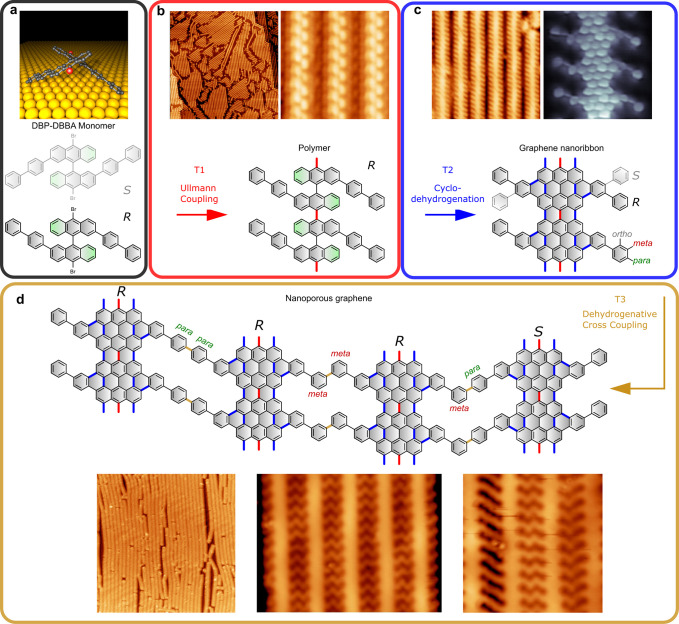
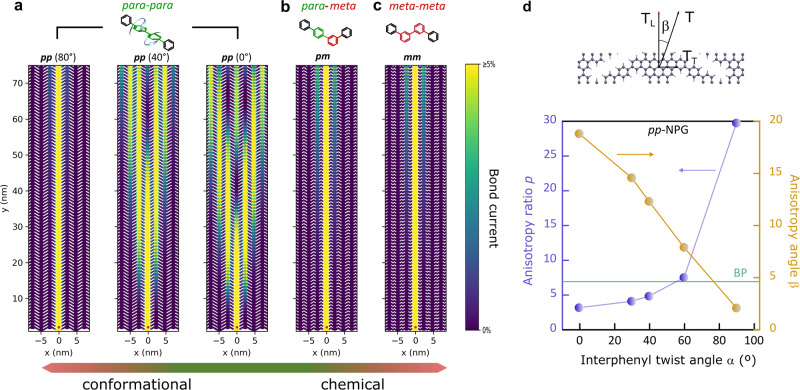
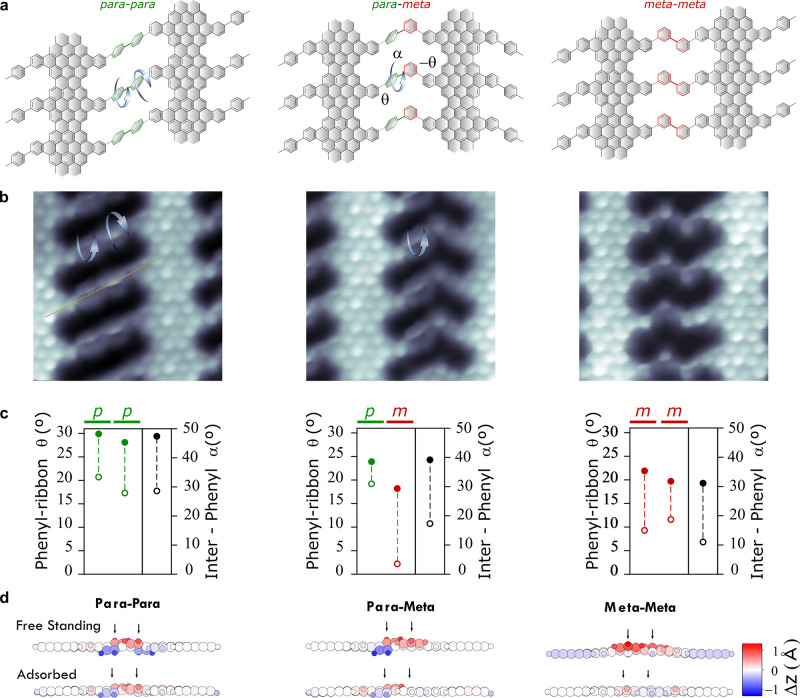
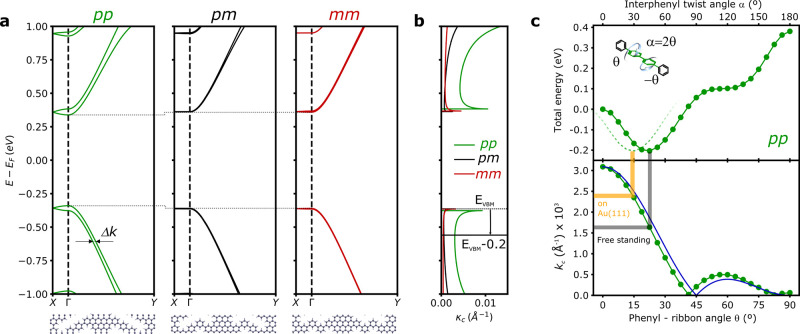
Recent advances on surface-assisted synthesis have demonstrated that arrays of nanometer wide graphene nanoribbons can be laterally coupled with atomic precision to give rise to a highly anisotropic nanoporous graphene structure. Electronically, this graphene nanoarchitecture can be conceived as a set of weakly coupled semiconducting 1D nanochannels with electron propagation characterized by substantial interchannel quantum interferences. Here, we report the synthesis of a new nanoporous graphene structure where the interribbon electronic coupling can be controlled by the different degrees of freedom provided by phenylene bridges that couple the conducting channels. This versatility arises from the multiplicity of phenylene cross-coupling configurations, which provides a robust chemical knob, and from the interphenyl twist angle that acts as a fine-tunable knob. The twist angle is significantly altered by the interaction with the substrate, as confirmed by a combined bond-resolved scanning tunneling microscopy (STM) and ab initio analysis, and should accordingly be addressable by other external stimuli. Electron propagation simulations demonstrate the capability of either switching on/off or modulating the interribbon coupling by the corresponding use of the chemical or the conformational knob. Molecular bridges therefore emerge as efficient tools to engineer quantum transport and anisotropy in carbon-based 2D nanoarchitectures.
最近在表面辅助合成方面的进展表明,可以以原子精度将纳米宽的石墨烯纳米带阵列横向耦合在一起,从而产生高度各向异性的纳米多孔石墨烯结构。从电子学角度来看,这种石墨烯纳米结构可以被设想为一组弱耦合的半导体 1D 纳米通道,其电子输运具有显著的通道间量子干涉。在这里,我们报告了一种新的纳米多孔石墨烯结构的合成,其中通过连接导电通道的亚苯基桥提供的不同自由度可以控制 ribbon 间的电子耦合。这种多功能性源于亚苯基交叉偶联构型的多样性,它提供了一个强大的化学旋钮,以及作为精细可调旋钮的间苯基扭转角。扭转角通过与基底的相互作用而显著改变,这一点通过结合键分辨扫描隧道显微镜(STM)和从头算分析得到了证实,并且应该可以通过其他外部刺激来调节。电子输运模拟表明,通过相应地使用化学或构象旋钮,可以打开/关闭或调制 ribbon 间的耦合。因此,分子桥成为了在基于碳的二维纳米结构中工程量子输运和各向异性的有效工具。