MRC Cognition and Brain Sciences Unit, University of Cambridge, Cambridge, UK.
Department of Psychology, University of Nigeria, Nsukka, Nigeria.
J Child Psychol Psychiatry. 2023 Aug;64(8):1159-1175. doi: 10.1111/jcpp.13793. Epub 2023 Mar 29.
Stress exposure in childhood and adolescence has been linked to reductions in cortical structures and cognitive functioning. However, to date, most of these studies have been cross-sectional, limiting the ability to make long-term inferences, given that most cortical structures continue to develop through adolescence.
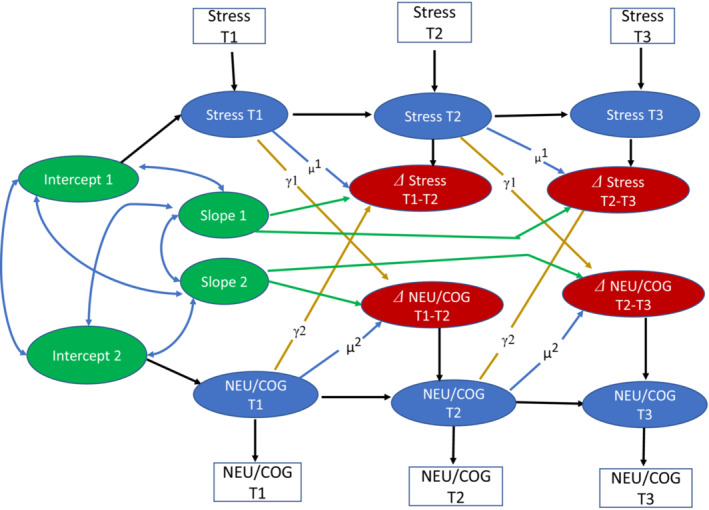
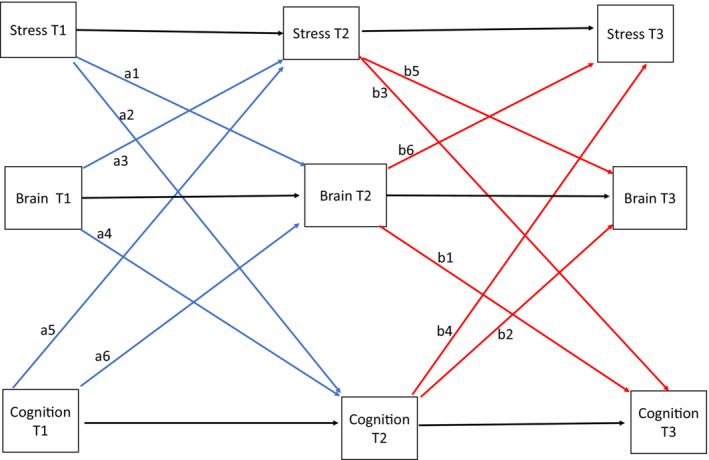
Here, we used a subset of the IMAGEN population cohort sample (N = 502; assessment ages: 14, 19, and 22 years; mean age: 21.945 years; SD = 0.610) to understand longitudinally the long-term interrelations between stress, cortical development, and cognitive functioning. To these ends, we first used a latent change score model to examine four bivariate relations - assessing individual differences in change in the relations between adolescent stress exposure and volume, surface area, and cortical thickness of cortical structures, as well as cognitive outcomes. Second, we probed for indirect neurocognitive effects linking stress to cortical brain structures and cognitive functions using rich longitudinal mediation modeling.
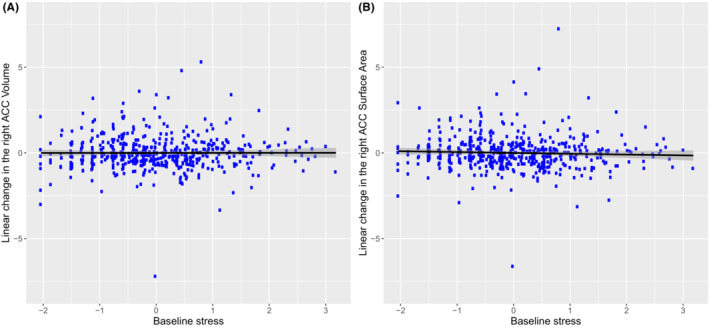
Latent change score modeling showed that greater baseline adolescence stress at age 14 predicted a small reduction in the right anterior cingulate volume (Std. β = -.327, p = .042, 95% CI [-0.643, -0.012]) and right anterior cingulate surface area (Std. β = -.274, p = .038, 95% CI [-0.533, -0.015]) across ages 14-22. These effects were very modest in nature and became nonsignificant after correcting for multiple comparisons. Our longitudinal analyses found no evidence of indirect effects in the two neurocognitive pathways linking adolescent stress to brain and cognitive outcomes.
Findings shed light on the impact of stress on brain reductions, particularly in the prefrontal cortex that have consistently been implicated in the previous cross-sectional studies. However, the magnitude of effects observed in our study is smaller than that has been reported in past cross-sectional work. This suggests that the potential impact of stress during adolescence on brain structures may likely be more modest than previously noted.
儿童和青少年时期的压力暴露与皮质结构和认知功能的降低有关。然而,迄今为止,这些研究大多是横断面研究,由于大多数皮质结构在青春期仍在继续发育,因此限制了进行长期推断的能力。
在这里,我们使用了 IMAGEN 人群队列样本的一个子集(N=502;评估年龄:14、19 和 22 岁;平均年龄:21.945 岁;SD=0.610)来了解青少年时期的压力、皮质发育和认知功能之间的长期相互关系。为此,我们首先使用潜在变化分数模型来检查四个双变量关系-评估青少年时期压力暴露与皮质结构的体积、表面积和皮质厚度以及认知结果之间关系变化的个体差异。其次,我们使用丰富的纵向中介模型来探究将压力与皮质脑结构和认知功能联系起来的间接神经认知效应。
潜在变化分数模型显示,14 岁时更大的青少年时期压力基线预测右侧前扣带回体积(Std.β=-.327,p=0.042,95%CI[-0.643,-0.012])和右侧前扣带回表面积(Std.β=-.274,p=0.038,95%CI[-0.533,-0.015])在 14-22 岁之间的小幅度减少。这些影响的性质非常温和,在进行多次比较校正后变得不显著。我们的纵向分析在连接青少年压力与大脑和认知结果的两个神经认知途径中没有发现间接效应的证据。
研究结果揭示了压力对大脑减少的影响,特别是在前额叶皮层,这在前瞻性研究中一直被认为是与压力相关的。然而,我们研究中观察到的效应幅度小于过去横断面研究中报道的。这表明,青春期压力对大脑结构的潜在影响可能比以前注意到的要小。