Department of Biomedical Engineering, Boston University, Boston, Massachusetts, United States of America.
Department of Psychological and Brain Sciences, Boston University, Boston, Massachusetts, United States of America.
PLoS Biol. 2023 Mar 30;21(3):e3002035. doi: 10.1371/journal.pbio.3002035. eCollection 2023 Mar.
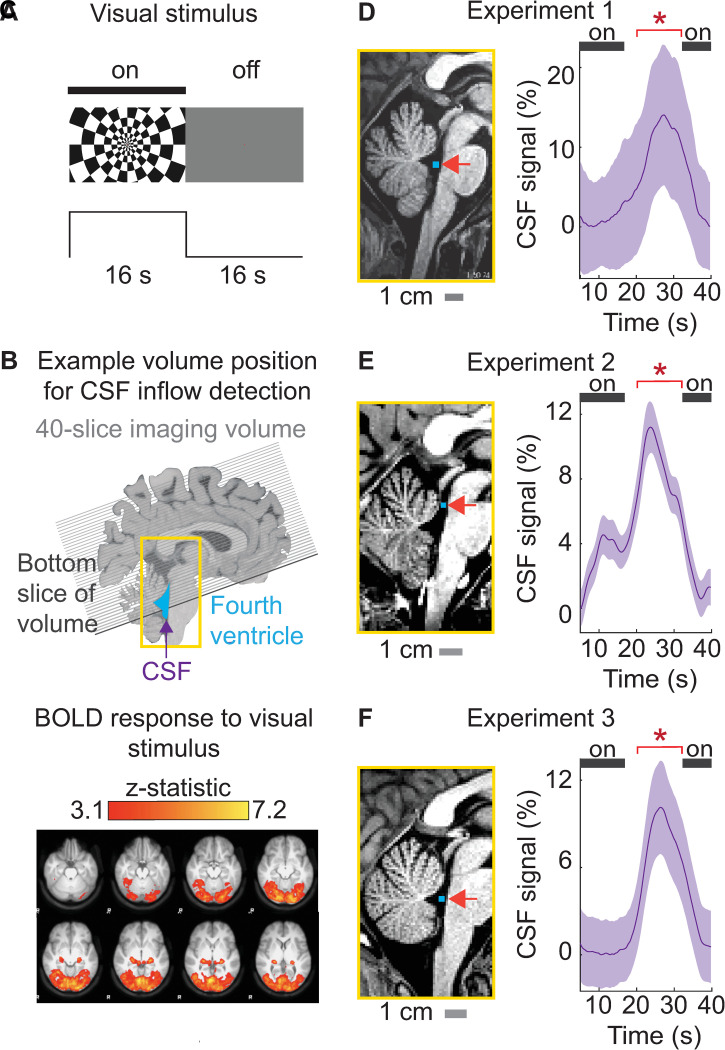
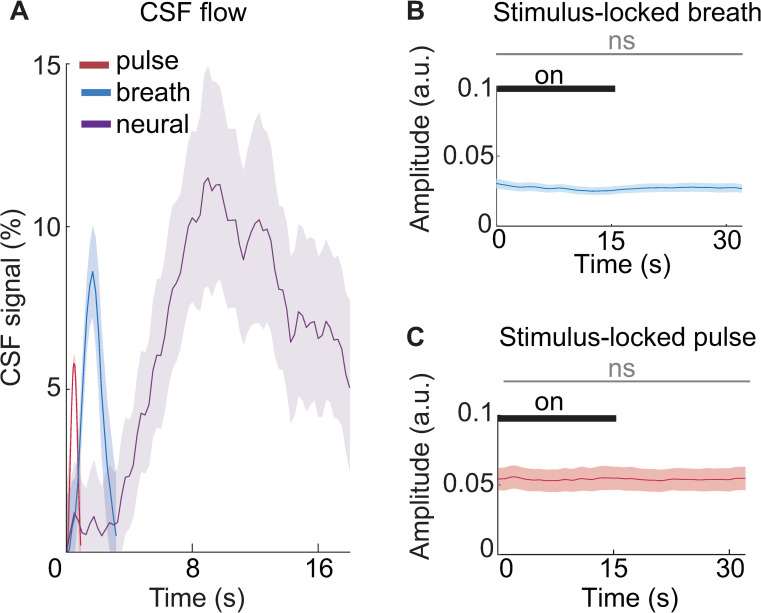
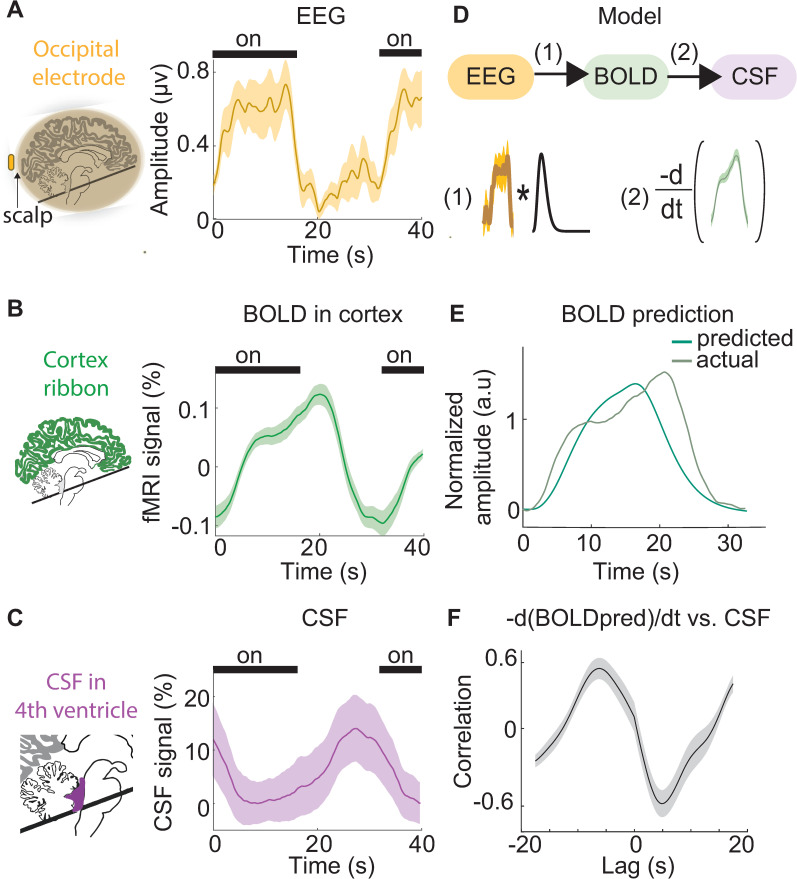
Cerebrospinal fluid (CSF) flow maintains healthy brain homeostasis, facilitating solute transport and the exchange of brain waste products. CSF flow is thus important for brain health, but the mechanisms that control its large-scale movement through the ventricles are not well understood. While it is well established that CSF flow is modulated by respiratory and cardiovascular dynamics, recent work has also demonstrated that neural activity is coupled to large waves of CSF flow in the ventricles during sleep. To test whether the temporal coupling between neural activity and CSF flow is in part due to a causal relationship, we investigated whether CSF flow could be induced by driving neural activity with intense visual stimulation. We manipulated neural activity with a flickering checkerboard visual stimulus and found that we could drive macroscopic CSF flow in the human brain. The timing and amplitude of CSF flow was matched to the visually evoked hemodynamic responses, suggesting neural activity can modulate CSF flow via neurovascular coupling. These results demonstrate that neural activity can contribute to driving CSF flow in the human brain and that the temporal dynamics of neurovascular coupling can explain this effect.
脑脊液(CSF)流动维持着健康的大脑内环境稳定,促进溶质运输和脑内废物的交换。因此,CSF 流动对大脑健康很重要,但控制其在脑室中大规模运动的机制还不是很清楚。虽然人们已经充分认识到 CSF 流动受到呼吸和心血管动力学的调节,但最近的研究也表明,在睡眠期间,神经活动与脑室中 CSF 流动的大波相关联。为了测试神经活动和 CSF 流动之间的时间耦合是否部分归因于因果关系,我们研究了是否可以通过强烈的视觉刺激驱动神经活动来诱导 CSF 流动。我们用闪烁的棋盘视觉刺激来操纵神经活动,发现我们可以在人脑内驱动宏观 CSF 流动。CSF 流动的时间和幅度与视觉诱发的血液动力学反应相匹配,这表明神经活动可以通过神经血管耦合来调节 CSF 流动。这些结果表明,神经活动可以有助于在人脑内驱动 CSF 流动,并且神经血管耦合的时间动态可以解释这种效应。