Rossi Maria Francesca, Gualano Maria Rosaria, Magnavita Nicola, Moscato Umberto, Santoro Paolo Emilio, Borrelli Ivan
Section of Occupational Health, Department of Life Sciences and Public Health, Università Cattolica del Sacro Cuore, Rome, Italy.
School of Medicine, UniCamillus-Saint Camillus International University of Health Sciences, Rome, Italy.
Front Psychiatry. 2023 Mar 16;14:1139260. doi: 10.3389/fpsyt.2023.1139260. eCollection 2023.
The COVID-19 pandemic had a negative impact on the psychological wellbeing of workers worldwide. Certain coping styles may increase burnout risk. To investigate the relationship between burnout and coping styles, a systematic review was performed.
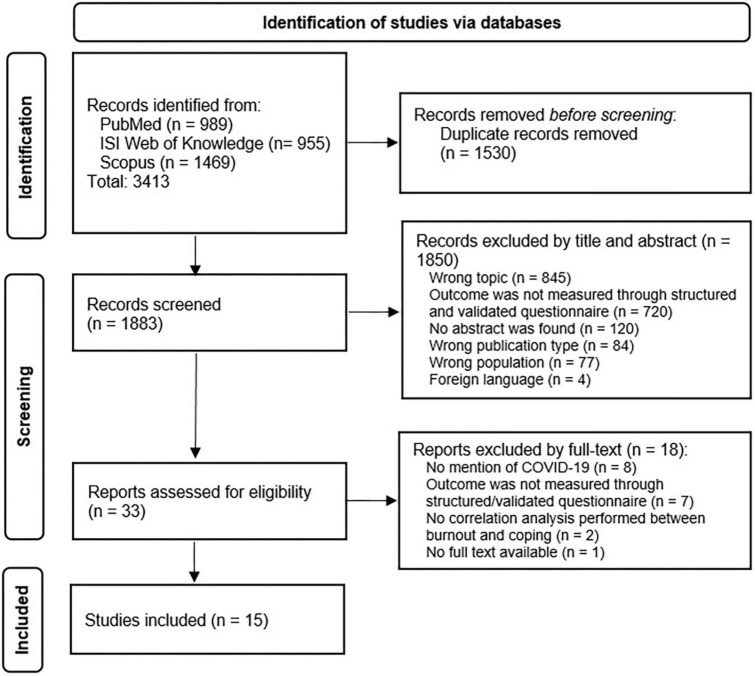
Following the PRISMA statements, three databases were screened up until October 2022, including research articles written in English language and investigating the relationship between burnout and coping strategies in workers. The quality of articles was assessed by the Newcastle-Ottawa Scale.
The initial search resulted in 3,413 records, 15 of which were included in this review. Most studies were performed on healthcare workers ( = 13, 86.6%) and included a majority of female workers ( = 13, 86.7%). The most used burnout assessment questionnaire was the Maslach Burnout Inventory ( = 8, 53.3%), and the most used coping assessment tool was the Brief-COPE ( = 6, 40.0%). Task-related coping was a protective factor for burnout in all four studies investigating its correlation with burnout dimensions. Two of the four studies investigating emotion-oriented coping found that it was protective while the other two found that it was predictive of burnout. All five studies investigating avoidance-oriented coping and burnout dimensions found that this coping style was predictive of burnout.
Task-oriented and adaptive coping were protective for burnout, avoidance-oriented, and maladaptive coping were predictive factors of burnout. Mixed results were highlighted concerning emotion-oriented coping, suggesting that different outcomes of this coping style may depend on gender, with women relying more on it than men. In conclusion, further research is needed to investigate the effect of coping styles in individuals, and how these correlates with their unique characteristics. Training workers about appropriate coping styles to adopt may be essential to enact prevention strategies to reduce burnout incidence in workers.
新冠疫情对全球劳动者的心理健康产生了负面影响。某些应对方式可能会增加职业倦怠风险。为了研究职业倦怠与应对方式之间的关系,我们进行了一项系统综述。
按照PRISMA声明,截至2022年10月,我们筛选了三个数据库,包括用英文撰写的、研究劳动者职业倦怠与应对策略之间关系的研究文章。文章质量通过纽卡斯尔-渥太华量表进行评估。
初步检索得到3413条记录,其中15条被纳入本综述。大多数研究是针对医护人员开展的(n = 13,86.6%),且大部分研究对象为女性劳动者(n = 13,86.7%)。使用最多的职业倦怠评估问卷是马氏职业倦怠量表(n = 8,53.3%),使用最多的应对评估工具是简易应对方式问卷(n = 6,40.0%)。在四项研究其与职业倦怠维度相关性的研究中,任务相关应对是职业倦怠的一个保护因素。在四项研究以情绪为导向应对的研究中,两项研究发现它具有保护作用,而另外两项研究发现它可预测职业倦怠。在五项研究回避导向应对与职业倦怠维度的研究中,所有研究均发现这种应对方式可预测职业倦怠。
任务导向和适应性应对对职业倦怠具有保护作用,回避导向和适应不良应对是职业倦怠的预测因素。关于以情绪为导向应对的结果不一,这表明这种应对方式的不同结果可能取决于性别,女性比男性更依赖这种方式。总之,需要进一步研究以调查应对方式在个体中的作用,以及这些方式如何与其独特特征相关联。培训劳动者采用适当的应对方式对于制定预防策略以降低劳动者职业倦怠发生率可能至关重要。