Soda Takafumi, Ahmadi Ahmadreza, Tani Jun, Honda Manabu, Hanakawa Takashi, Yamashita Yuichi
Department of Information Medicine, National Institute of Neuroscience, National Center of Neurology and Psychiatry, Kodaira, Japan.
Department of NCNP Brain Physiology and Pathology, Graduate School of Medical and Dental Sciences, Tokyo Medical and Dental University, Tokyo, Japan.
Front Psychiatry. 2023 Mar 15;14:1080668. doi: 10.3389/fpsyt.2023.1080668. eCollection 2023.
Investigating the pathological mechanisms of developmental disorders is a challenge because the symptoms are a result of complex and dynamic factors such as neural networks, cognitive behavior, environment, and developmental learning. Recently, computational methods have started to provide a unified framework for understanding developmental disorders, enabling us to describe the interactions among those multiple factors underlying symptoms. However, this approach is still limited because most studies to date have focused on cross-sectional task performance and lacked the perspectives of developmental learning. Here, we proposed a new research method for understanding the mechanisms of the acquisition and its failures in hierarchical Bayesian representations using a state-of-the-art computational model, referred to as in silico neurodevelopment framework for atypical representation learning.
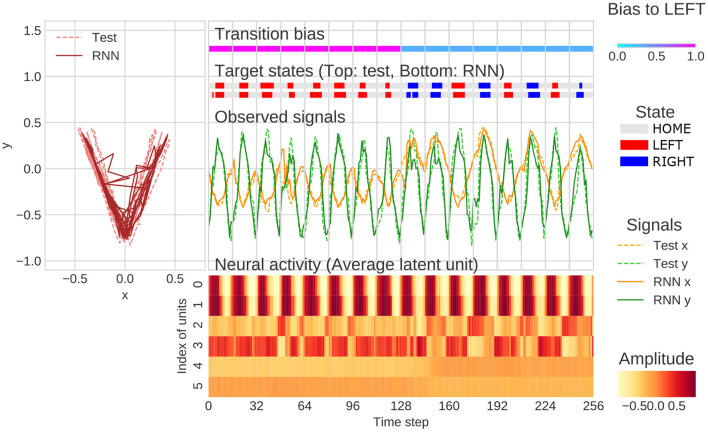
Simple simulation experiments were conducted using the proposed framework to examine whether manipulating the neural stochasticity and noise levels in external environments during the learning process can lead to the altered acquisition of hierarchical Bayesian representation and reduced flexibility.
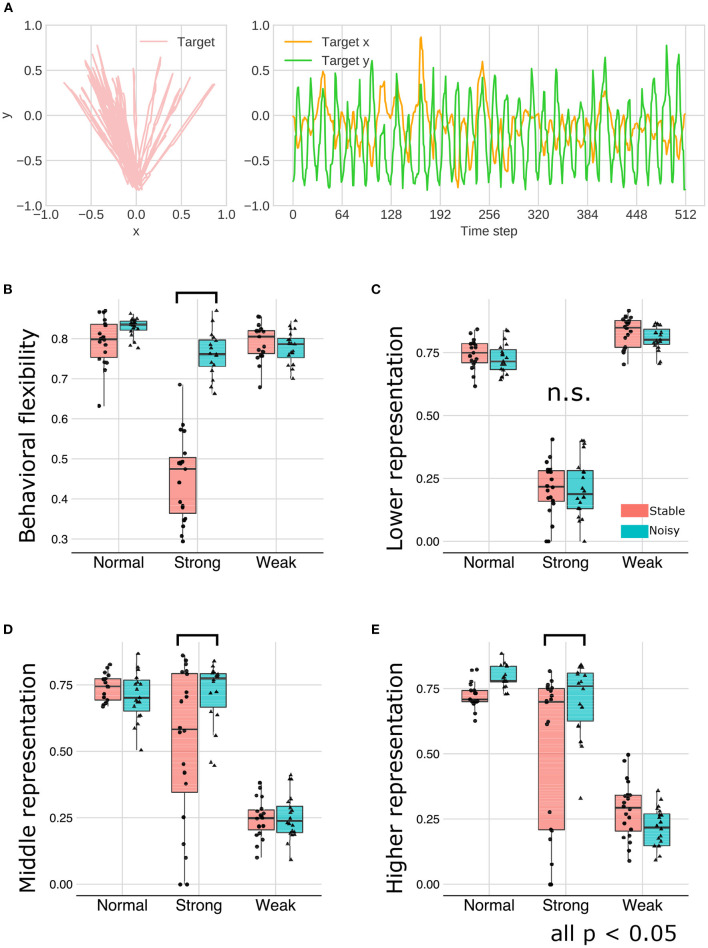
Networks with normal neural stochasticity acquired hierarchical representations that reflected the underlying probabilistic structures in the environment, including higher-order representation, and exhibited good behavioral and cognitive flexibility. When the neural stochasticity was high during learning, top-down generation using higher-order representation became atypical, although the flexibility did not differ from that of the normal stochasticity settings. However, when the neural stochasticity was low in the learning process, the networks demonstrated reduced flexibility and altered hierarchical representation. Notably, this altered acquisition of higher-order representation and flexibility was ameliorated by increasing the level of noises in external stimuli.
These results demonstrated that the proposed method assists in modeling developmental disorders by bridging between multiple factors, such as the inherent characteristics of neural dynamics, acquisitions of hierarchical representation, flexible behavior, and external environment.
研究发育障碍的病理机制是一项挑战,因为症状是神经网络、认知行为、环境和发育学习等复杂动态因素的结果。最近,计算方法已开始为理解发育障碍提供一个统一框架,使我们能够描述症状背后那些多因素之间的相互作用。然而,这种方法仍然有限,因为迄今为止大多数研究都集中在横断面任务表现上,缺乏发育学习的视角。在此,我们提出了一种新的研究方法,使用一种先进的计算模型(即非典型表征学习的计算机模拟神经发育框架)来理解分层贝叶斯表征中习得及其失败的机制。
使用所提出的框架进行了简单的模拟实验,以检验在学习过程中操纵外部环境中的神经随机性和噪声水平是否会导致分层贝叶斯表征的习得改变以及灵活性降低。
具有正常神经随机性的网络获得了反映环境中潜在概率结构(包括高阶表征)的分层表征,并表现出良好的行为和认知灵活性。当学习期间神经随机性较高时,尽管灵活性与正常随机性设置没有差异,但使用高阶表征的自上而下生成变得不典型。然而,当学习过程中神经随机性较低时,网络表现出灵活性降低和分层表征改变。值得注意的是,通过增加外部刺激中的噪声水平,这种高阶表征和灵活性的习得改变得到了改善。
这些结果表明,所提出的方法通过在神经动力学的固有特征、分层表征的习得、灵活行为和外部环境等多因素之间架起桥梁,有助于对发育障碍进行建模。