Pandemic Sciences Institute, University of Oxford, Oxford, United Kingdom.
Nuffield Department of Medicine, University of Oxford, Oxford, United Kingdom.
Front Cell Infect Microbiol. 2023 Mar 15;13:1107884. doi: 10.3389/fcimb.2023.1107884. eCollection 2023.
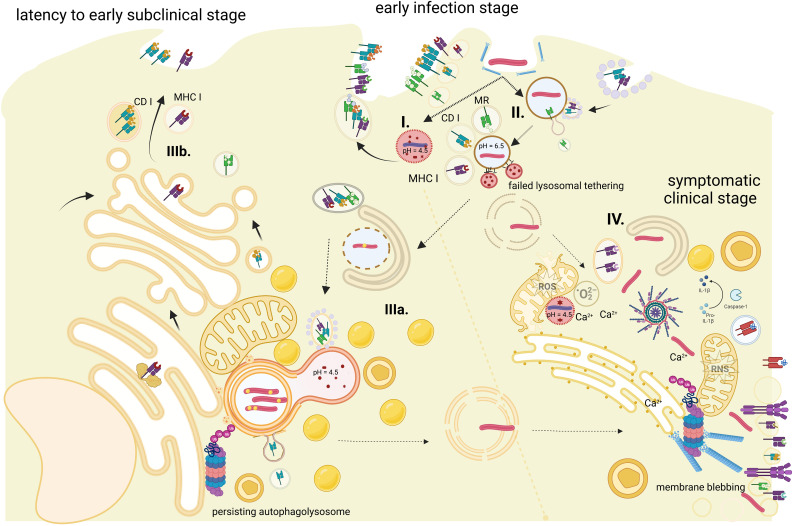
MHC class I antigen processing is an underappreciated area of nonviral host-pathogen interactions, bridging both immunology and cell biology, where the pathogen's natural life cycle involves little presence in the cytoplasm. The effective response to MHC-I foreign antigen presentation is not only cell death but also phenotypic changes in other cells and stimulation of the memory cells ready for the next antigen reoccurrence. This review looks at the MHC-I antigen processing pathway and potential alternative sources of the antigens, focusing on () as an intracellular pathogen that co-evolved with humans and developed an array of decoy strategies to survive in a hostile environment by manipulating host immunity to its own advantage. As that happens the selective antigen presentation process, reinforcement of the effective antigen recognition on MHC-I molecules may stimulate subsets of effector cells that act earlier and more locally. Vaccines against tuberculosis (TB) could potentially eliminate this disease, yet their development has been slow, and success is limited in the context of this global disease's spread. This review's conclusions set out potential directions for MHC-I-focused approaches for the next generation of vaccines.
MHC I 类抗原加工是一个未被充分认识的非病毒宿主-病原体相互作用领域,涉及免疫学和细胞生物学,病原体的自然生命周期很少涉及细胞质。对 MHC-I 外来抗原呈递的有效反应不仅是细胞死亡,还包括其他细胞的表型变化和对准备应对下一次抗原再次出现的记忆细胞的刺激。这篇综述探讨了 MHC-I 抗原加工途径和潜在的替代抗原来源,重点关注 () 作为一种与人类共同进化的细胞内病原体,它开发了一系列诱饵策略,通过操纵宿主免疫来为自己的利益而生存,从而逃避宿主的免疫防御。随着这种情况的发生,选择性抗原呈递过程中,MHC-I 分子上有效抗原识别的增强可能会刺激更早、更局部起作用的效应细胞亚群。针对结核病 (TB) 的疫苗有可能消除这种疾病,但它们的开发进展缓慢,在这种全球疾病传播的背景下,成功的案例有限。本综述的结论为下一代疫苗的 MHC-I 为重点的方法提出了潜在的方向。