Mengu Deniz, Tabassum Anika, Jarrahi Mona, Ozcan Aydogan
Electrical and Computer Engineering Department, University of California, Los Angeles, CA, 90095, USA.
Bioengineering Department, University of California, Los Angeles, CA, 90095, USA.
Light Sci Appl. 2023 Apr 6;12(1):86. doi: 10.1038/s41377-023-01135-0.
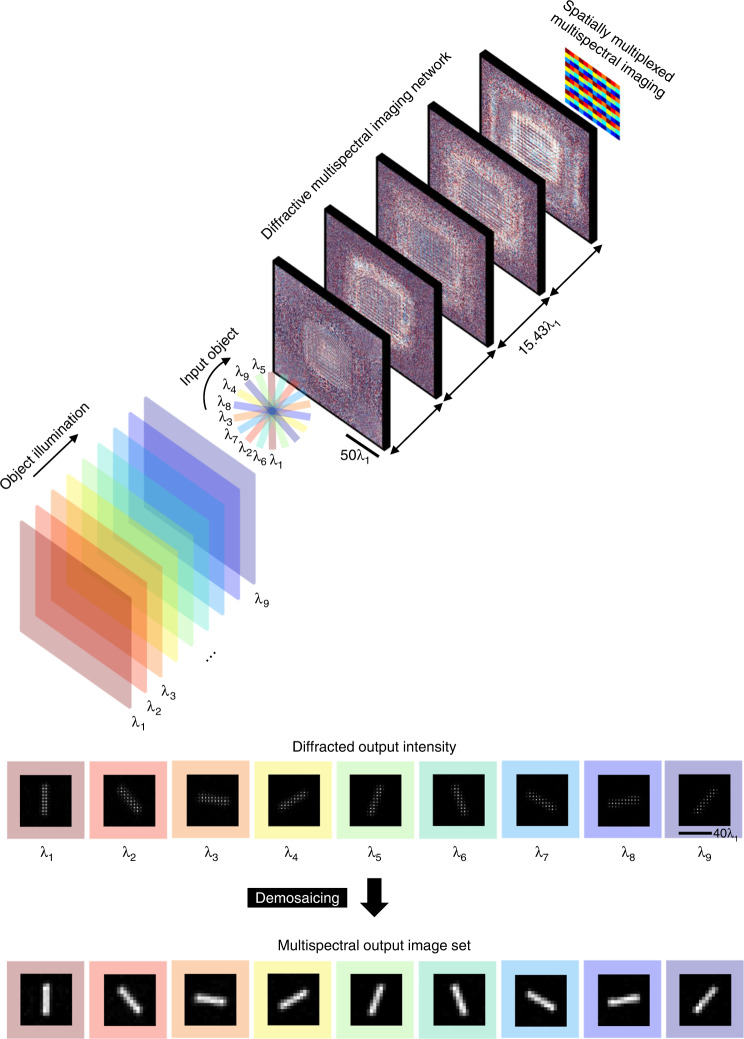
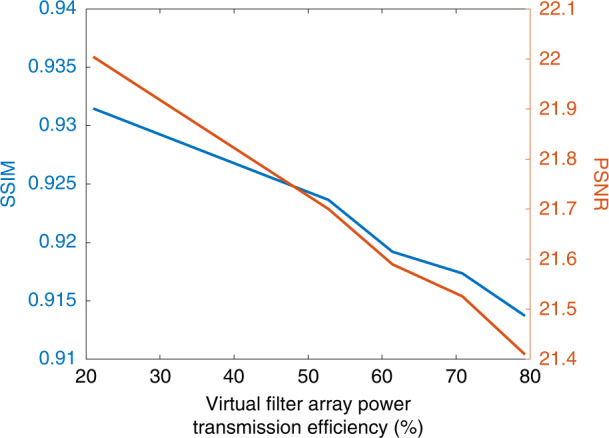
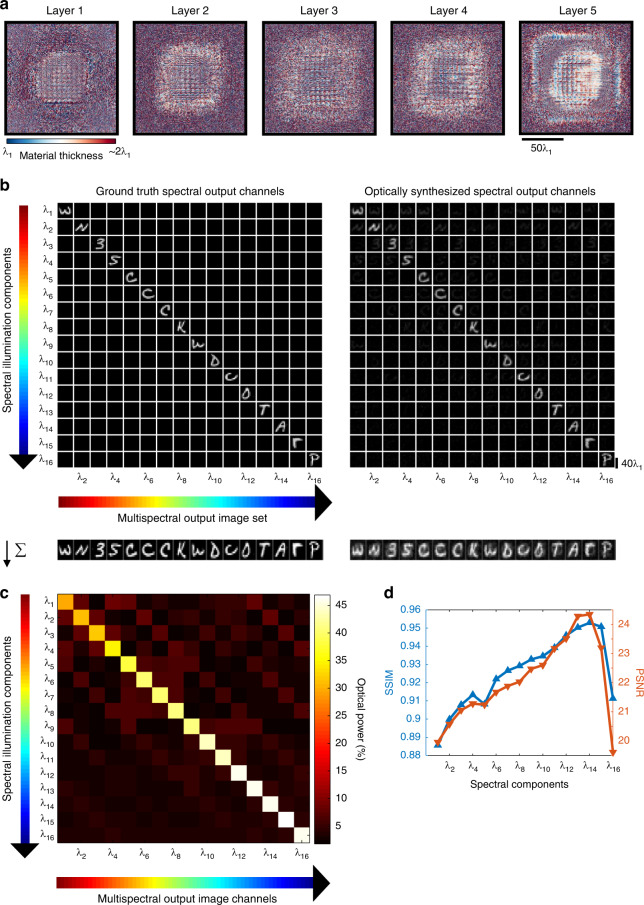
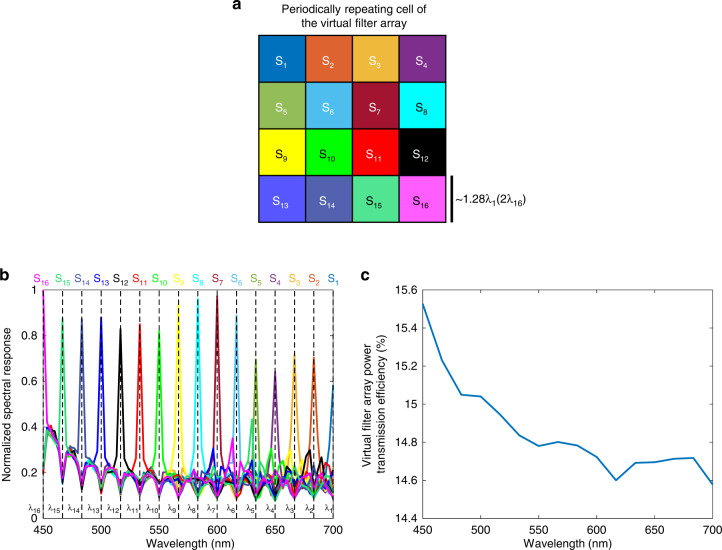
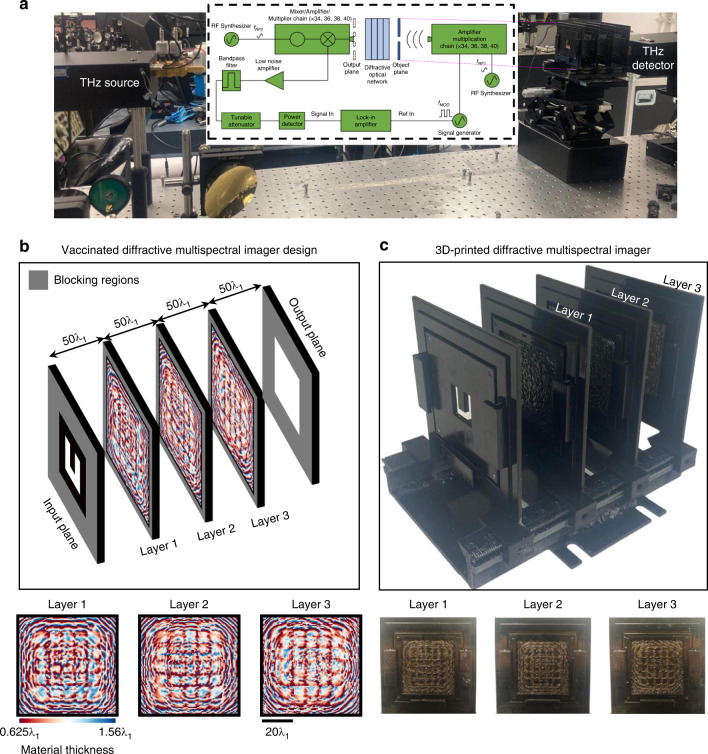
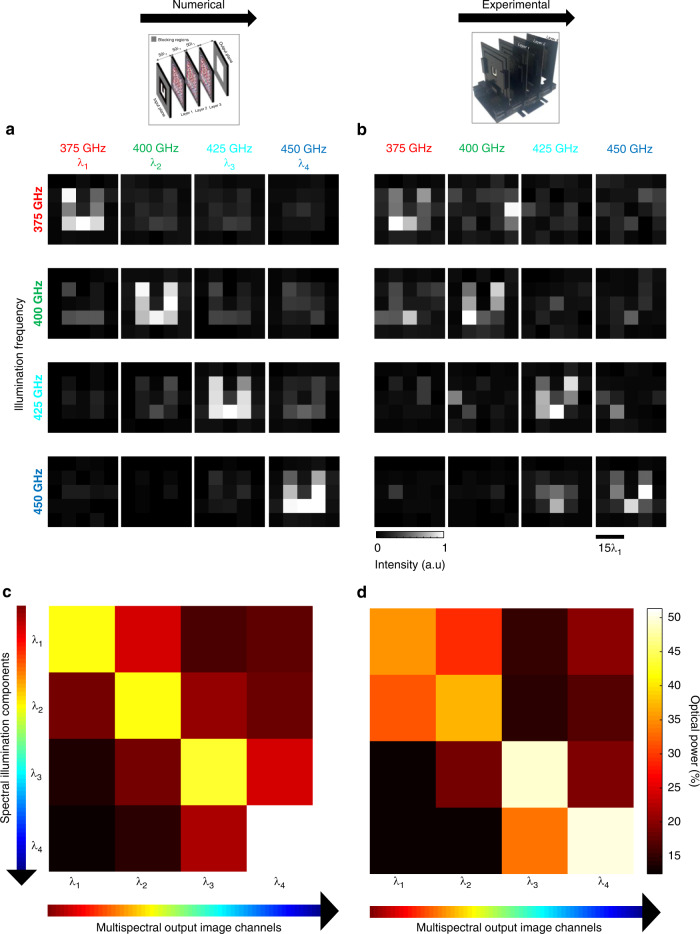
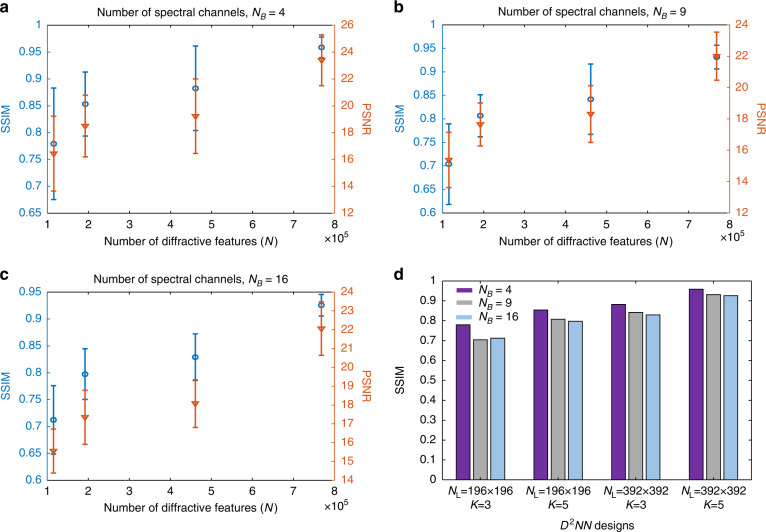
Multispectral imaging has been used for numerous applications in e.g., environmental monitoring, aerospace, defense, and biomedicine. Here, we present a diffractive optical network-based multispectral imaging system trained using deep learning to create a virtual spectral filter array at the output image field-of-view. This diffractive multispectral imager performs spatially-coherent imaging over a large spectrum, and at the same time, routes a pre-determined set of spectral channels onto an array of pixels at the output plane, converting a monochrome focal-plane array or image sensor into a multispectral imaging device without any spectral filters or image recovery algorithms. Furthermore, the spectral responsivity of this diffractive multispectral imager is not sensitive to input polarization states. Through numerical simulations, we present different diffractive network designs that achieve snapshot multispectral imaging with 4, 9 and 16 unique spectral bands within the visible spectrum, based on passive spatially-structured diffractive surfaces, with a compact design that axially spans ~72λ, where λ is the mean wavelength of the spectral band of interest. Moreover, we experimentally demonstrate a diffractive multispectral imager based on a 3D-printed diffractive network that creates at its output image plane a spatially repeating virtual spectral filter array with 2 × 2 = 4 unique bands at terahertz spectrum. Due to their compact form factor and computation-free, power-efficient and polarization-insensitive forward operation, diffractive multispectral imagers can be transformative for various imaging and sensing applications and be used at different parts of the electromagnetic spectrum where high-density and wide-area multispectral pixel arrays are not widely available.
多光谱成像已被应用于众多领域,如环境监测、航空航天、国防和生物医学等。在此,我们展示了一种基于衍射光学网络的多光谱成像系统,该系统通过深度学习进行训练,以在输出图像视场中创建虚拟光谱滤波器阵列。这种衍射多光谱成像仪在大光谱范围内执行空间相干成像,同时将一组预定的光谱通道路由到输出平面的像素阵列上,从而将单色焦平面阵列或图像传感器转换为无需任何光谱滤波器或图像恢复算法的多光谱成像设备。此外,这种衍射多光谱成像仪的光谱响应度对输入偏振态不敏感。通过数值模拟,我们展示了不同的衍射网络设计,这些设计基于无源空间结构衍射表面,在可见光谱范围内实现了具有4、9和16个独特光谱带的快照多光谱成像,其紧凑设计在轴向跨度约为72λ,其中λ是感兴趣光谱带的平均波长。此外,我们通过实验展示了一种基于3D打印衍射网络的衍射多光谱成像仪,该成像仪在其输出图像平面上创建了一个空间重复的虚拟光谱滤波器阵列,在太赫兹光谱范围内具有2×2 = 4个独特的波段。由于其紧凑的外形尺寸以及无需计算、节能且对偏振不敏感的正向操作,衍射多光谱成像仪可对各种成像和传感应用产生变革性影响,并可用于电磁频谱的不同部分,在这些地方高密度和大面积的多光谱像素阵列并不广泛可用。