School of Public Health (Shenzhen), Sun Yat-sen University-Shenzhen Campus, Shenzhen, Guangdong, China.
National Institute for Viral Disease Control and Prevention, Chinese Center for Disease Control and Prevention, Beijing, China.
BMC Infect Dis. 2023 Apr 6;23(1):211. doi: 10.1186/s12879-023-08158-3.
The influenza viruses pose a threat to human health and medical services, and vaccination is an important way to prevent infection. However, the effectiveness of influenza vaccines is affected by various aspects. This study aimed to explore factors related to the immune response to influenza vaccines.
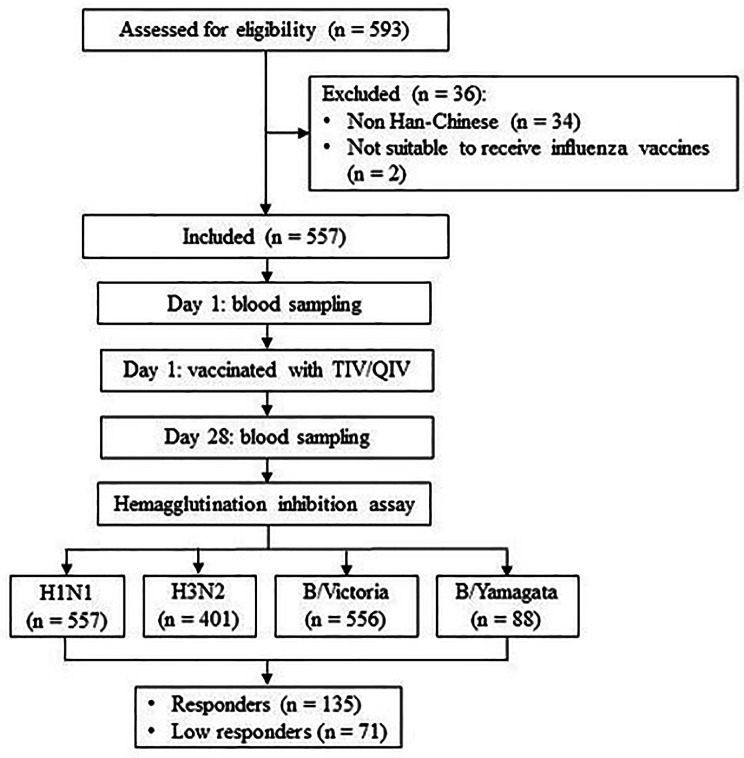
The study was conducted from September 2019 to September 2021, and a total of 593 volunteers were recruited from the Center for Disease Control and Prevention in 3 provinces in China. The hemagglutination inhibition assay was used to measure antibody levels. The Chi-square test, multivariable logistic regression analysis, and sum-rank test were used to analyze the factors associated with influenza vaccine immune response.
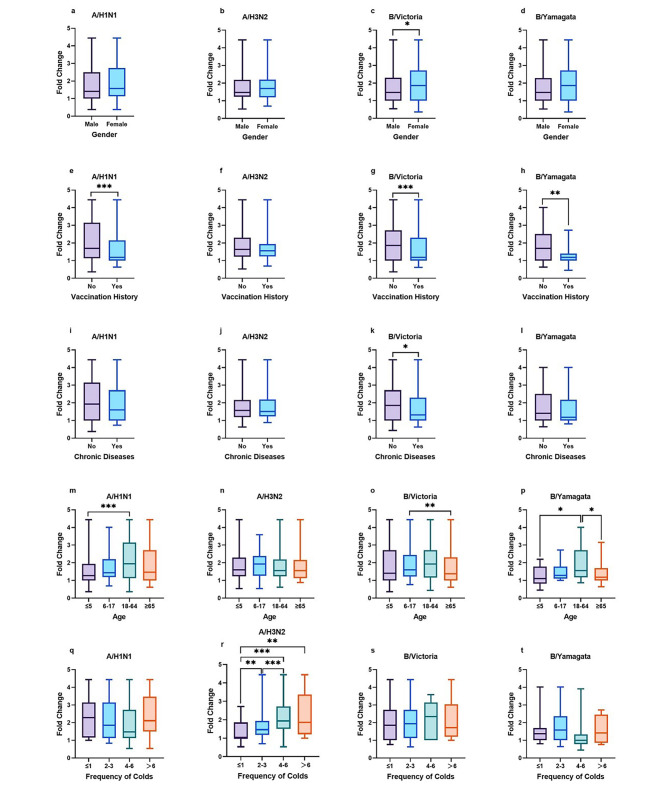
The Chi-square test showed that seroconversion rates and response rate were associated with age group, vaccination history, chronic conditions, the frequency of colds, and region (P < 0.05). The multivariable logistic regression analysis showed that age was an important factor that affected participants' seroconversion rates for A/H1N1, A/H3N2, B/Victoria, and response status (18-64 vs. ≤5: OR = 2.77, P < 0.001; ≥65 vs. ≤5: OR = 0.38, P = 0.01; 18-64 vs. ≤5: OR = 2.64, P = 0.03). Vaccination history was also an affecting factor for A/H1N1, B/Victoria, and response status (yes vs. no: OR = 0.4 / 0.44 / 0.25, P < 0.001). The frequency of colds and chronic conditions were also affecting factors for participants' seroconversion rates and response levels to different degrees. The sum-rank test showed that the fold changes for A/H1N1, B/Victoria, and B/Yamagata were associated with age group and vaccination history (P < 0.01). The fold changes for A/H3N2 were associated with the frequency of colds (P < 0.05), and those for B/Victoria were associated with gender and chronic conditions (P < 0.05).
Vaccination history, age, health condition, and frequency of colds were important factors affecting the seroconversion rate of the influenza vaccine in human. There is a need for developing optimized vaccination strategies for vulnerable groups to improve the efficacy of influenza vaccines in human.
流感病毒对人类健康和医疗服务构成威胁,接种疫苗是预防感染的重要手段。然而,流感疫苗的效果受到多种因素的影响。本研究旨在探讨与流感疫苗免疫反应相关的因素。
本研究于 2019 年 9 月至 2021 年 9 月在中国 3 个省份的疾病预防控制中心招募了 593 名志愿者。采用血凝抑制试验测量抗体水平。采用卡方检验、多变量逻辑回归分析和总和秩检验分析与流感疫苗免疫反应相关的因素。
卡方检验显示,血清转化率和反应率与年龄组、接种史、慢性疾病、感冒频率和地区有关(P<0.05)。多变量逻辑回归分析显示,年龄是影响参与者 A/H1N1、A/H3N2、B/Victoria 血清转化率和反应状态的重要因素(18-64 岁与≤5 岁:OR=2.77,P<0.001;≥65 岁与≤5 岁:OR=0.38,P=0.01;18-64 岁与≤5 岁:OR=2.64,P=0.03)。接种史也是影响 A/H1N1、B/Victoria 和反应状态的因素(是与否:OR=0.4/0.44/0.25,P<0.001)。感冒频率和慢性疾病也是影响参与者对不同程度血清转化率和反应水平的因素。总和秩检验显示,A/H1N1、B/Victoria 和 B/Yamagata 的倍数变化与年龄组和接种史有关(P<0.01)。A/H3N2 的倍数变化与感冒频率有关(P<0.05),B/Victoria 的倍数变化与性别和慢性疾病有关(P<0.05)。
接种史、年龄、健康状况和感冒频率是影响流感疫苗人体血清转化率的重要因素。需要为弱势群体制定优化的疫苗接种策略,以提高流感疫苗在人体中的效果。