Barria Patricio, Riquelme Matías, Reppich Hannah, Cisnal Ana, Fraile Juan-Carlos, Pérez-Turiel Javier, Sierra David, Aguilar Rolando, Andrade Asterio, Nuñez-Espinosa Cristian
Centro de Rehabilitación, Club de Leones Cruz del Sur, Punta Arenas, Chile.
School of Medicine, University of Magallanes (UMAG), Punta Arenas, Chile.
Front Robot AI. 2023 Mar 22;10:1146018. doi: 10.3389/frobt.2023.1146018. eCollection 2023.
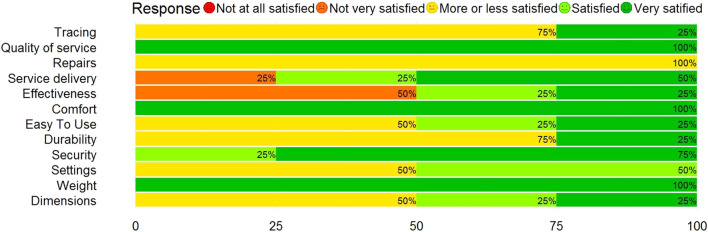
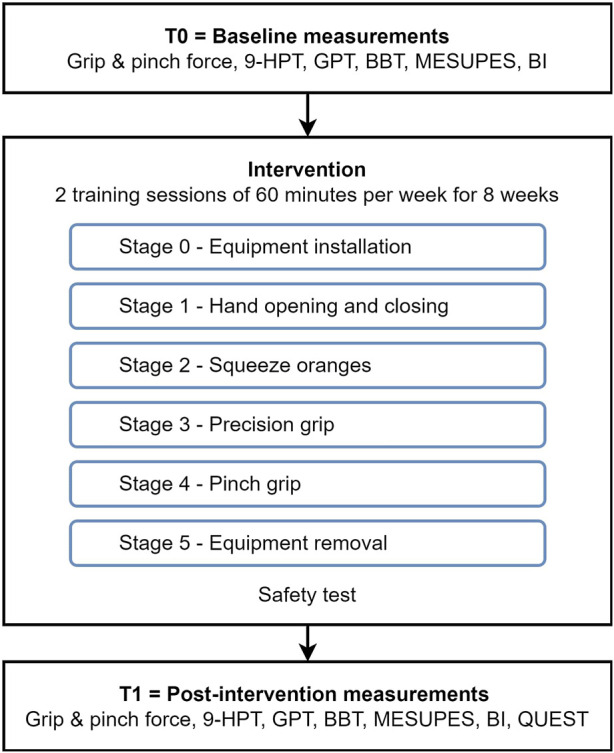
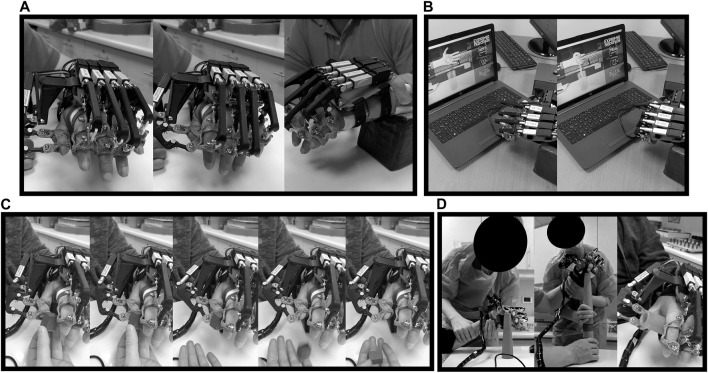
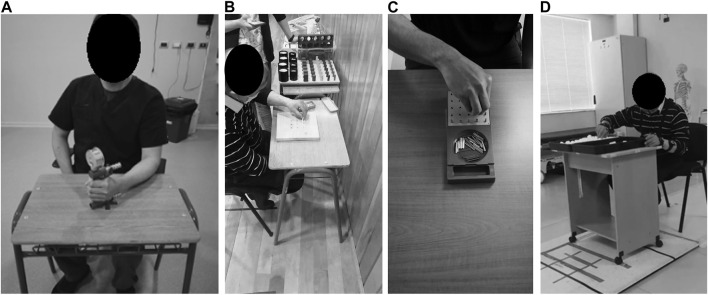
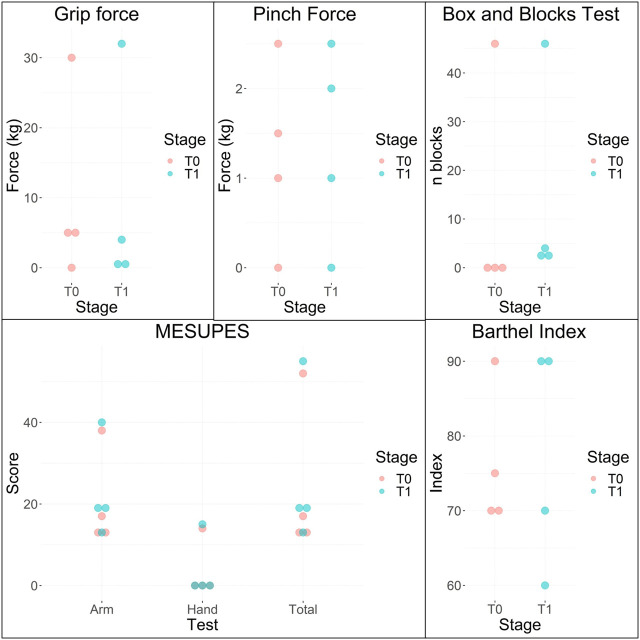
The RobHand (Robot for Hand Rehabilitation) is a robotic neuromotor rehabilitation exoskeleton that assists in performing flexion and extension movements of the fingers. The present case study assesses changes in manual function and hand muscle strength of four selected stroke patients after completion of an established training program. In addition, safety and user satisfaction are also evaluated. The training program consisted of 16 sessions; two 60-minute training sessions per week for eight consecutive weeks. During each session, patients moved through six consecutive rehabilitation stages using the RobHand. Manual function assessments were applied before and after the training program and safety tests were carried out after each session. A user evaluation questionnaire was filled out after each patient completed the program. The safety test showed the absence of significant adverse events, such as skin lesions or fatigue. An average score of 4 out of 5 was obtained on the Quebec User Evaluation of Satisfaction with Assistive Technology 2.0 Scale. Users were very satisfied with the weight, comfort, and quality of professional services. A Kruskal-Wallis test revealed that there were not statistically significant changes in the manual function tests between the beginning and the end of the training program. It can be concluded that the RobHand is a safe rehabilitation technology and users were satisfied with the system. No statistically significant differences in manual function were found. This could be due to the high influence of the stroke stage on motor recovery since the study was performed with chronic patients. Hence, future studies should evaluate the rehabilitation effectiveness of the repetitive use of the RobHand exoskeleton on subacute patients. https://clinicaltrials.gov/ct2/show/NCT05598892?id=NCT05598892&draw=2&rank=1, identifier NCT05598892.
RobHand(手部康复机器人)是一种用于神经运动康复的外骨骼机器人,可辅助手指进行屈伸运动。本案例研究评估了四名选定的中风患者在完成既定训练计划后手部功能和手部肌肉力量的变化。此外,还评估了安全性和用户满意度。训练计划包括16节课程;连续八周,每周两次,每次60分钟。在每次课程中,患者使用RobHand依次完成六个连续的康复阶段。在训练计划前后进行手部功能评估,每次课程后进行安全性测试。每位患者完成训练计划后填写一份用户评价问卷。安全性测试显示没有出现重大不良事件,如皮肤损伤或疲劳。在魁北克辅助技术满意度用户评价2.0量表上的平均得分为4分(满分5分)。用户对其重量、舒适度和专业服务质量非常满意。克鲁斯卡尔-沃利斯检验显示,训练计划开始和结束时的手部功能测试没有统计学上的显著变化。可以得出结论,RobHand是一种安全的康复技术,用户对该系统感到满意。在手部功能方面未发现统计学上的显著差异。这可能是由于该研究针对的是慢性病患者,中风阶段对运动恢复的影响较大。因此,未来的研究应评估重复使用RobHand外骨骼对亚急性患者的康复效果。https://clinicaltrials.gov/ct2/show/NCT05598892?id=NCT05598892&draw=2&rank=1,标识符NCT05598892。