Tao Jiasheng, Yan Zijian, Huang Wenmian, Feng Tao
The First Clinical Medical College, Guangzhou University of Chinese Medicine, Guangzhou, Guangdong Province, China.
Affiliated Stomatological Hospital, Guangzhou Medical University, Guangzhou, Guangdong Province, China.
Front Med (Lausanne). 2023 Mar 22;10:1120083. doi: 10.3389/fmed.2023.1120083. eCollection 2023.
Some studies had reported that patients with viral hepatitis are at increased risk of reduced bone mineral density and even osteoporosis. However, the interaction between reduced bone mineral density (BMD) and viral hepatitis remains inconclusive. Therefore, our study collected hepatitis test results and bone mineral density from respondents in the NHANES database. The aim of this study was to investigate whether there is an association between hepatitis and a decrease in bone mineral density.
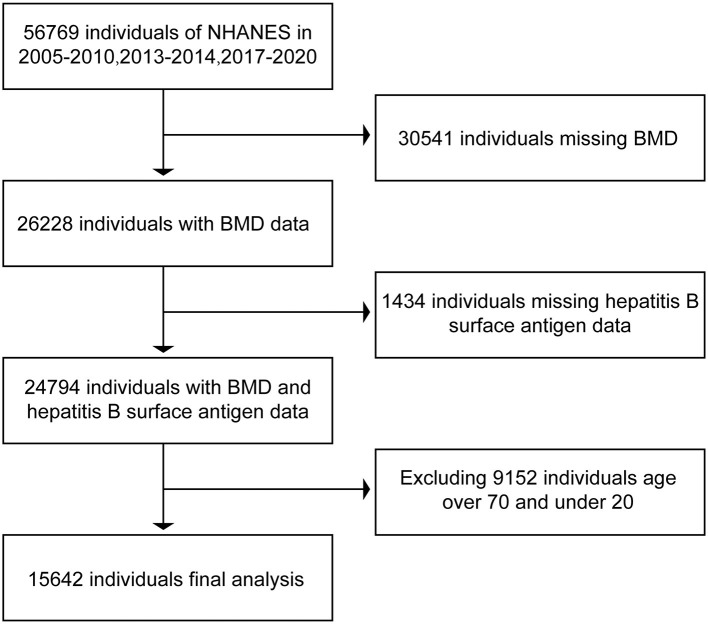
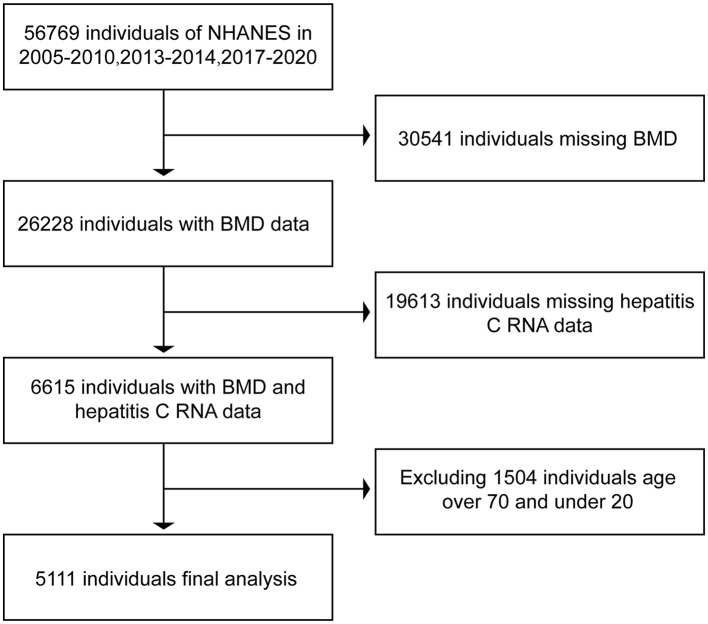
The respondents with both hepatitis- and BMD-related indicators from the NHANES database in the United States from 2005-2010, 2013-2014, to 2017-2020 were collected for this study. BMD were compared between respondents who were positive and negative for respondents related to hepatitis B and C. BMD was measured using dual-energy X-ray absorptiometry of the femur and lumbar spine. Finally, multiple regression analysis was performed between hepatitis B surface antigen (HBsAg) and hepatitis C RNA (HCV-RNA) and BMD in the respondents.
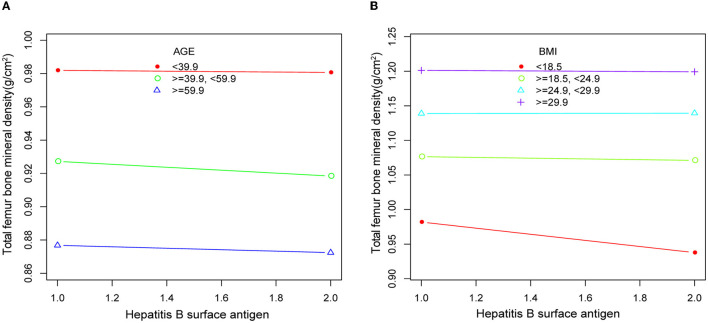
A total of 15,642 respondents were included in the hepatitis B surface antigen-related survey. Of these, 1,217 respondents were positive for hepatitis B surface antigen. A total of 5111 hepatitis C RNA-related responders were included. Hepatitis C RNA-positive had 268 respondents. According to the results of the multiple regression analysis, the femoral BMD was significantly lower in HBsAg (+) respondents compared to HBsAg (-) respondents: -0.018 (-0.026, -0.009) ( < 0.01). Moreover, spinal BMD was significantly lower in HBsAg (+) respondents compared to HBsAg (-) respondents: -0.020 (-0.030, -0.010) ( < 0.01). According to the results of multiple regression analysis for hepatitis C RNA, HCV-RNA (+) respondents had significantly lower BMD compared to HCV-RNA (-) respondents: -0.043 (-0.059, -0.026) ( < 0.01).
During the analysis of respondents in the NHANES database in the United States, positive tests for hepatitis B surface antigen and hepatitis C RNA were found to be associated with a reduction in BMD. Positive serology for these hepatitis indicators may increase the risk of reduced BMD. Of course, this conclusion still needs to be further confirmed by more large clinical trials.
一些研究报告称,病毒性肝炎患者骨密度降低甚至患骨质疏松症的风险增加。然而,骨密度降低(BMD)与病毒性肝炎之间的相互作用仍无定论。因此,我们的研究收集了美国国家健康与营养检查调查(NHANES)数据库中受访者的肝炎检测结果和骨密度数据。本研究的目的是调查肝炎与骨密度降低之间是否存在关联。
收集了2005 - 2010年、2013 - 2014年以及2017 - 2020年美国NHANES数据库中同时具有肝炎和骨密度相关指标的受访者进行本研究。比较了乙肝和丙肝相关受访者中阳性和阴性受访者的骨密度。使用双能X线吸收法测量股骨和腰椎的骨密度。最后,对受访者的乙肝表面抗原(HBsAg)、丙肝RNA(HCV - RNA)和骨密度进行多元回归分析。
共有15642名受访者纳入乙肝表面抗原相关调查。其中,1217名受访者乙肝表面抗原呈阳性。共有5111名丙肝RNA相关受访者。丙肝RNA阳性者有268名受访者。根据多元回归分析结果,与HBsAg(-)受访者相比,HBsAg(+)受访者的股骨骨密度显著降低:-0.018(-0.026,-0.009)(P < 0.01)。此外,与HBsAg(-)受访者相比,HBsAg(+)受访者的脊柱骨密度显著降低:-0.020(-0.030,-0.010)(P < 0.01)。根据丙肝RNA的多元回归分析结果,与HCV - RNA(-)受访者相比,HCV - RNA(+)受访者的骨密度显著降低:-0.043(-0.059,-0.026)(P < 0.01)。
在美国NHANES数据库受访者分析过程中,发现乙肝表面抗原和丙肝RNA检测呈阳性与骨密度降低有关。这些肝炎指标的血清学阳性可能会增加骨密度降低的风险。当然,这一结论仍需更多大型临床试验进一步证实。