Department of Health Sciences, University of Jaén, Campus Las Lagunillas, s/n, Jaén, Spain.
FREMAP, Mutual Collaborator With Social Security Nº 61, Santo Reino, 7, Jaén, Spain.
J Neuroeng Rehabil. 2023 Apr 11;20(1):42. doi: 10.1186/s12984-023-01174-z.
This study aims to conduct a meta-analysis to assess the effect of virtual reality-based therapy (VRBT) on balance dimensions and fear of falling in patients with multiple sclerosis (PwMS). Secondarily, to determine the most recommendable dose of VRBT to improve balance.
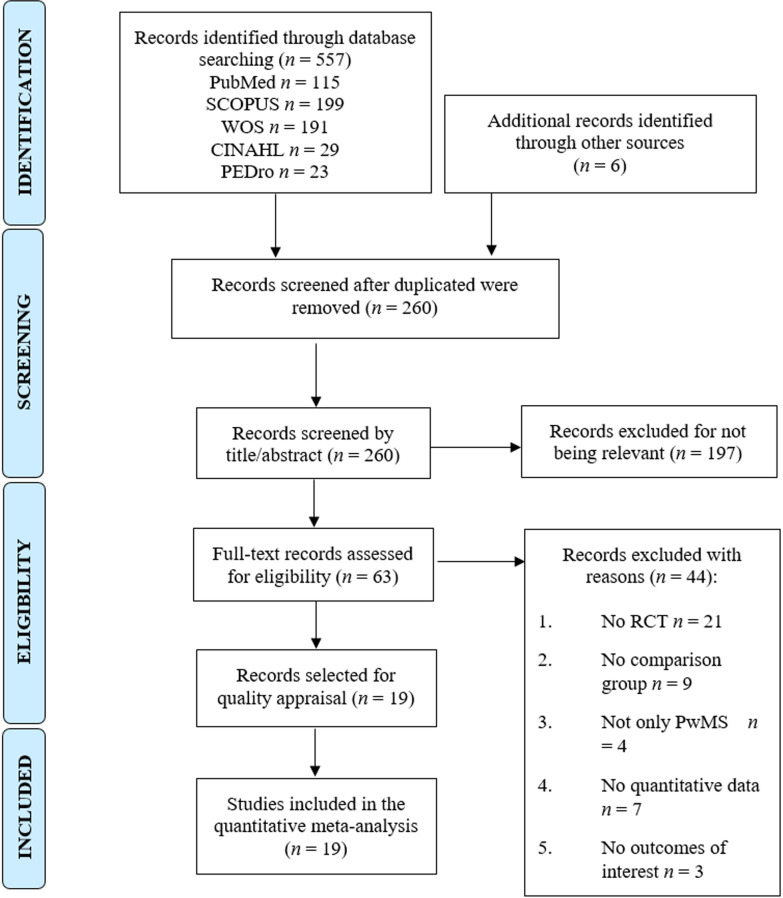
PubMed Medline, Web of Science, Scopus, CINAHL and PEDro were screened, without publication date restrictions, until September 30th, 2021. Randomized controlled trials (RCTs) comparing the effectiveness of VRBT against other interventions in PwMS were included. Functional and dynamic balance, confidence of balance, postural control in posturography, fear of falling and gait speed were the variables assessed. A meta-analysis was performed by pooling the Cohen's standardized mean difference (SMD) with 95% confidence interval (95% CI) using Comprehensive Meta-Analysis 3.0.
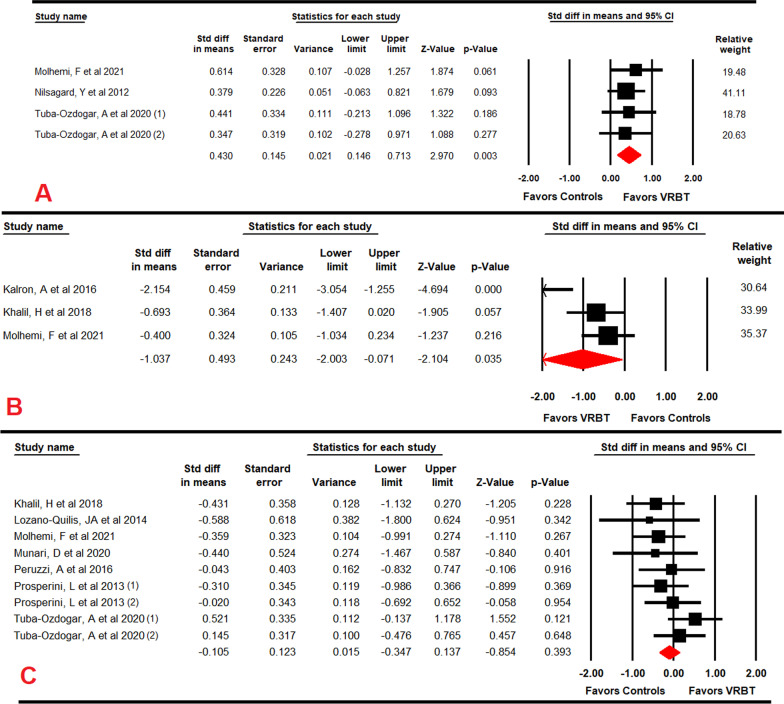
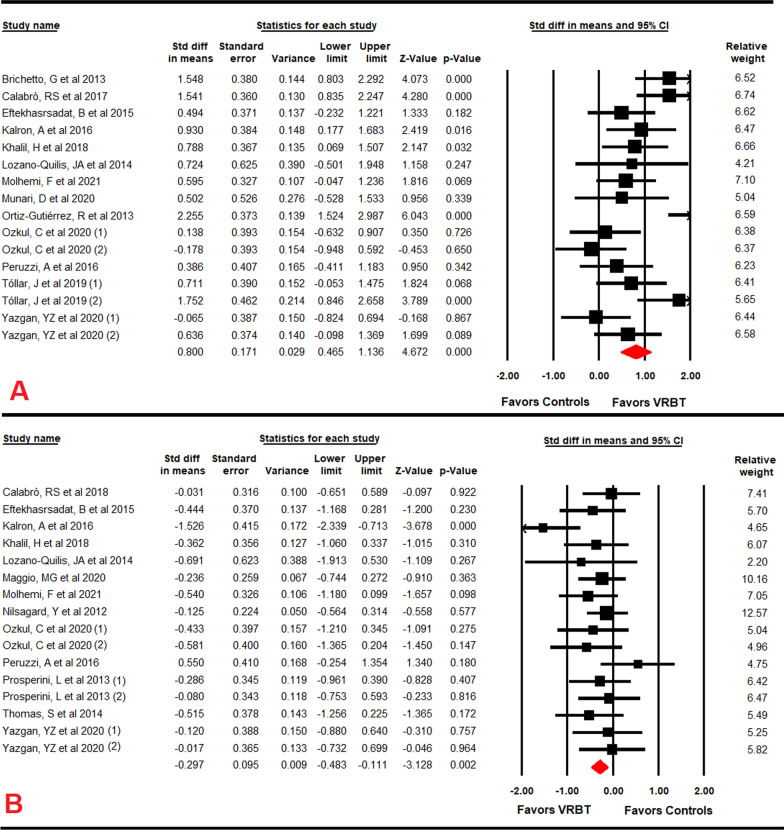
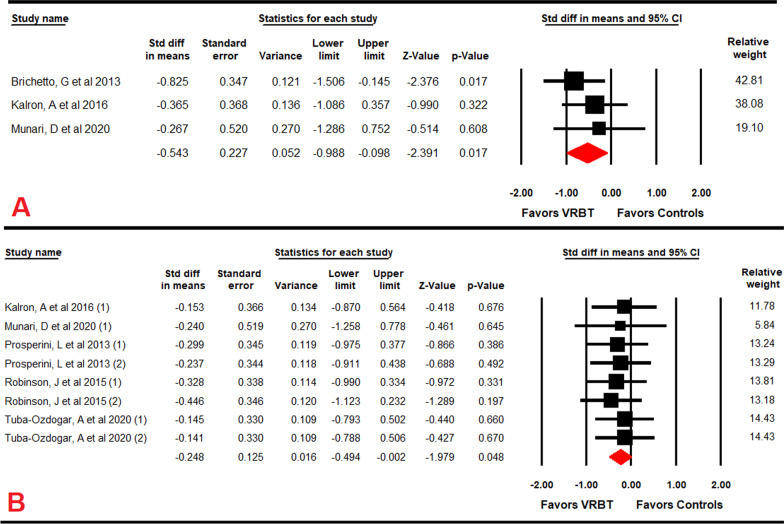
Nineteen RCTs, reporting 858 PwMS, were included. Our findings reported that VRBT is effective in improving functional balance (SMD = 0.8; 95%CI 0.47 to 1.14; p < 0.001); dynamic balance (SMD = - 0.3; 95%CI - 0.48 to - 0.11; p = 0.002); postural control with posturography (SMD = - 0.54; 95%CI - 0.99 to - 0.1; p = 0.017); confidence of balance (SMD = 0.43; 95%CI 0.15 to 0.71; p = 0.003); and in reducing fear of falling (SMD = - 1.04; 95%CI - 2 to - 0.07; p = 0.035); but not on gait speed (SMD = - 0.11; 95%CI: - 0.35 to 0.14; p = 0.4). Besides, the most adequate dose of VRBT to achieve the greatest improvement in functional balance was at least 40 sessions, five sessions per week and 40-45 min per sessions; and for dynamic balance, it would be between 8 and 19 weeks, twice a week and 20-30 min per session.
VRBT may have a short-term beneficial role in improving balance and reducing fear of falling in PwMS.
本研究旨在进行荟萃分析,评估虚拟现实疗法(VRBT)对多发性硬化症患者(PwMS)平衡维度和跌倒恐惧的影响。其次,确定改善平衡最推荐的 VRBT 剂量。
检索 PubMed Medline、Web of Science、Scopus、CINAHL 和 PEDro,无出版日期限制,截至 2021 年 9 月 30 日。纳入比较 VRBT 与 PwMS 中其他干预措施有效性的随机对照试验(RCT)。评估的变量包括功能性和动态平衡、平衡信心、姿势控制、跌倒恐惧和步态速度。使用 Comprehensive Meta-Analysis 3.0 汇总 Cohen 标准化均数差(SMD)及其 95%置信区间(95%CI)进行荟萃分析。
纳入 19 项 RCT,共报告 858 名 PwMS。我们的研究结果表明,VRBT 可有效改善功能性平衡(SMD=0.8;95%CI 0.47 至 1.14;p<0.001);动态平衡(SMD=-0.3;95%CI-0.48 至 -0.11;p=0.002);姿势控制(SMD=-0.54;95%CI-0.99 至 -0.1;p=0.017);平衡信心(SMD=0.43;95%CI 0.15 至 0.71;p=0.003);并降低跌倒恐惧(SMD=-1.04;95%CI-2 至 -0.07;p=0.035);但对步态速度没有影响(SMD=-0.11;95%CI:-0.35 至 0.14;p=0.4)。此外,VRBT 最适剂量为至少 40 次治疗,每周 5 次,每次 40-45 分钟,可最大程度改善功能性平衡;对于动态平衡,最佳剂量为 8-19 周,每周 2 次,每次 20-30 分钟。
VRBT 可能对改善 PwMS 的平衡和减少跌倒恐惧有短期的有益作用。