Department of Bromatology, Faculty of Pharmacy with the Division of Laboratory Medicine, Medical University of Białystok, 15-222 Białystok, Poland.
Nutrients. 2023 Mar 27;15(7):1614. doi: 10.3390/nu15071614.
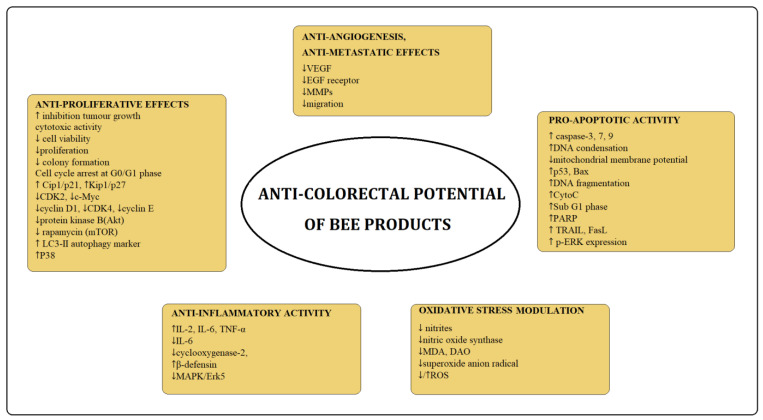
Colorectal cancer is one of the most common malignancies in the world. Lifestyle and eating patterns may have a significant impact on the prevention of this type of cancer. Bioactive food ingredients influence the gut microbiome and can have a protective effect. Bee products (honey, propolis, royal jelly, and bee venom) or pharmacologically active fractions obtained from them are widely used in many fields of medicine, pharmacy, and cosmetics. Some evidence suggests that bee products may have anti-cancer potential. The main bioactive components with anti-colon cancer potential from propolis and bee honey are polyphenols such as pinocembrin, galangin, luteolin, CAPE, Artepilin C, chrysin, caffeic, and p-coumaric acids. This review is focused on the new data on epidemiology, risk factors for colon cancer, and current reports on the potential role of bee products in the chemoprevention of this type of cancer.
结直肠癌是世界上最常见的恶性肿瘤之一。生活方式和饮食习惯可能对预防这种癌症有重大影响。生物活性食物成分会影响肠道微生物组,并可能具有保护作用。蜂产品(蜂蜜、蜂胶、蜂王浆和蜂毒)或从中获得的具有药理活性的成分广泛应用于医学、药学和化妆品等多个领域。有证据表明,蜂产品可能具有抗癌潜力。蜂胶和蜂蜜中具有抗结肠癌潜力的主要生物活性成分是多酚类物质,如 pinocembrin、galangin、luteolin、CAPE、Artepilin C、chrysin、咖啡酸和对香豆酸。本文重点介绍了有关结直肠癌的流行病学、风险因素的新数据,以及关于蜂产品在预防这种癌症方面的潜在作用的最新报告。