
用于儿童牙科的光固化复合材料在人口腔成纤维细胞中的组织相容性
Histocompatibility of Light-Curing Composites Used in Pediatric Dentistry in Human Oral Fibroblast Cells.
作者信息
Arab-Nozari Milad, Zamani Ehsan, Evazalipour Mehdi, Soleimani Banafsheh, Jorbonian Ali, Nahvi Azam
机构信息
Dept. of Toxicology and Pharmacology, Faculty of Pharmacy, Ayatollah Amoli Branch, Islamic Azad University, Amol, Iran.
Dept. of Pharmacology and Toxicology, School of Pharmacy, Guilan University of Medical Sciences, Rasht, Iran.
出版信息
J Dent (Shiraz). 2023 Mar;24(1 Suppl):112-117. doi: 10.30476/dentjods.2022.92358.1631.
STATEMENT OF THE PROBLEM
Tooth-colored composites are used to repair caries lesions and other dental defects, particularly in anterior regions in children. Although a wide range of composites is using, little attention has been paid to the important indicators such as biological profiles or products released from these materials.
PURPOSE
The current study aimed to compare the histocompatibility and cytotoxicity of light-curing resin used to repair children's teeth with different brands (3M, DenFil, and Opallis) in curing times of 20 and 40 seconds in human oral fibroblast cells (HGF1).
MATERIALS AND METHOD
In this study, Three types of flow composites (3M, Opallis, and DenFil), all at A2 shade, were used. The composites were at 4×2mm with separate exposure times of 20 and 40 seconds. MTT test was used to determine the cytotoxicity of composites on oral fibroblast cells. This test is based on the conversion of tetrazolium bromide to a purple compound known as formazan that its color intensity can be evaluated using the ELISA. The higher intensity of the color reveals the higher survival rate of the mitochondria, which indicates less toxicity. One-way variance analysis and unpaired t-test were used to compare the cytotoxicity of each brand in two conditions of 20 and 40 seconds of curing. Statistical significance was considered when < 0.05.
RESULTS
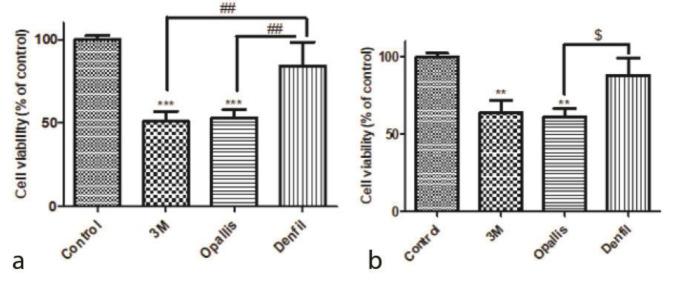
3M and Opallis composites were significantly reduced vitality of cells compared to control group in both 20s and 40s curing status. While DenFil brand did not show marked cytotoxicity. In each brand, there are no significant deference between 20s and 40s curing times.
CONCLUSION
Histocompatibility depends on the type of composite resin. In the current study, DenFil brand showed the highest histocompatibility, followed by 3M and Opallis.
问题陈述
牙齿颜色的复合材料用于修复龋损和其他牙齿缺陷,尤其是儿童的前牙区域。尽管使用了多种复合材料,但对于这些材料的生物学特性或释放的产物等重要指标却很少关注。
目的
本研究旨在比较用于修复儿童牙齿的不同品牌(3M、DenFil和Opallis)的光固化树脂在20秒和40秒固化时间下对人口腔成纤维细胞(HGF1)的组织相容性和细胞毒性。
材料与方法
在本研究中,使用了三种均为A2色号的流动复合材料(3M、Opallis和DenFil)。复合材料尺寸为4×2mm,分别有20秒和40秒的曝光时间。采用MTT试验来测定复合材料对口腔成纤维细胞的细胞毒性。该试验基于溴化四氮唑转化为一种称为甲臜的紫色化合物,其颜色强度可使用酶联免疫吸附测定法进行评估。颜色强度越高表明线粒体的存活率越高,这意味着毒性越小。采用单因素方差分析和非配对t检验来比较每个品牌在20秒和40秒固化条件下的细胞毒性。当P<0.05时认为具有统计学意义。
结果
在20秒和40秒固化状态下,3M和Opallis复合材料与对照组相比,细胞活力均显著降低。而DenFil品牌未表现出明显的细胞毒性。在每个品牌中,20秒和40秒固化时间之间没有显著差异。
结论
组织相容性取决于复合树脂的类型。在本研究中,DenFil品牌表现出最高的组织相容性,其次是3M和Opallis。

 Zotero 插件