Department of Clinical Psychology, Leiden University, Leiden, The Netherlands.
PsyQ, Parnassiagroep, The Hague, The Netherlands.
Eur J Psychotraumatol. 2023;14(1):2171752. doi: 10.1080/20008066.2023.2171752.
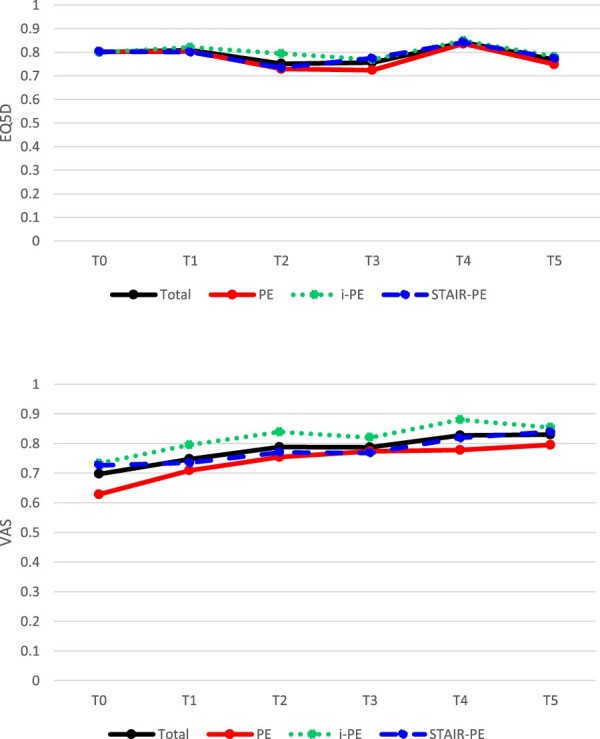
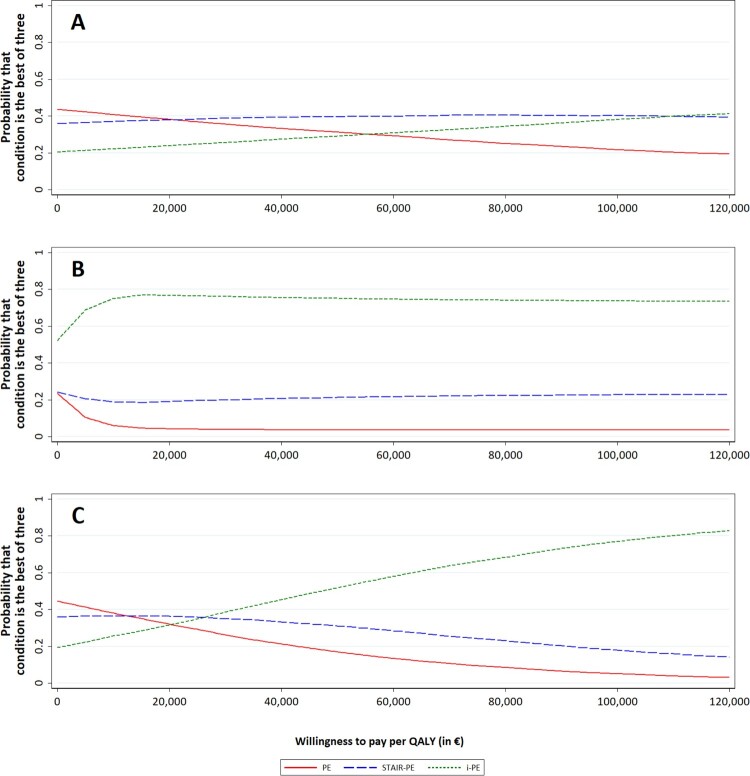
Prolonged exposure (PE) is an effective treatment for post-traumatic stress disorder (PTSD). This study aimed to analyse the cost-effectiveness of three exposure-based treatments in patients with childhood abuse-related PTSD. A net-benefit analysis was conducted alongside a pragmatic randomized controlled trial with participants (= 149) randomized to three conditions: PE (48), intensified PE (i-PE, = 51), and phase-based PE [Skills Training in Affective and Interpersonal Regulation (STAIR) + PE, = 50]. Assessments took place at baseline (T0), post-treatment (T3), 6 month follow-up (T4), and 12 month follow-up (T5). Costs stemming from healthcare utilization and productivity losses were estimated using the Trimbos/iMTA questionnaire for Costs associated with Psychiatric Illness. Quality-adjusted life-years (QALYs) were based on the 5-level EuroQoL 5 Dimensions (EQ-5D-5L) using the Dutch tariff. Missing values of costs and utilities were multiply imputed. To compare i-PE to PE and STAIR + PE to PE, pair-wise unequal-variance -tests were conducted. Net-benefit analysis was used to relate costs to QALYs and to draw acceptability curves. Intervention costs did not differ across the three treatment conditions. Total medical costs, productivity losses, total societal costs, and EQ-5D-5L-based QALYs did not differ between treatment conditions either (all > .10). At the relevant €50,000/QALY threshold, the probability of one treatment being more cost-effective than another was 32%, 28%, and 40% for PE, i-PE, and STAIR-PE, respectively. Three equally effective treatments were compared and no differences in cost-effectiveness between treatments were found. Therefore, we advocate the implementation and adoption of any of the treatments and endorse shared decision making.
延长暴露疗法(PE)是治疗创伤后应激障碍(PTSD)的有效方法。本研究旨在分析三种基于暴露的治疗方法在治疗与儿童期虐待相关的 PTSD 患者中的成本效益。在一项实用随机对照试验中,对参与者(n=149)进行了净效益分析,参与者被随机分配到三种治疗条件下:PE(48 人)、强化 PE(i-PE,51 人)和基于阶段的 PE [情感和人际调节技能训练(STAIR)+PE,50 人]。评估在基线(T0)、治疗后(T3)、6 个月随访(T4)和 12 个月随访(T5)进行。使用 Trimbos/iMTA 精神病相关成本问卷评估与医疗保健利用和生产力损失相关的成本。使用荷兰关税,基于 5 级欧洲五维健康量表(EQ-5D-5L)的质量调整生命年(QALY)。成本和效用的缺失值采用多重插补法进行填补。为了比较 i-PE 与 PE 以及 STAIR+PE 与 PE,进行了两两不等方差 t 检验。净效益分析用于将成本与 QALY 相关联,并绘制可接受性曲线。三种治疗条件下的干预成本没有差异。治疗条件之间的总医疗费用、生产力损失、总社会成本和基于 EQ-5D-5L 的 QALY 也没有差异(均>.10)。在相关的 50,000 欧元/QALY 阈值下,PE、i-PE 和 STAIR-PE 分别有 32%、28%和 40%的概率一种治疗比另一种更具成本效益。比较了三种同样有效的治疗方法,发现治疗方法之间的成本效益没有差异。因此,我们提倡实施和采用任何一种治疗方法,并支持共同决策。