Zhang Brenda, Settineri Joseph P, Chajet Alan, Muthukanagaraj Purushothaman
Medicine, Upstate Medical University at Norton College of Medicine, Syracuse, USA.
Psychiatry, SUNY (State University of New York) Upstate Medical University, Binghamton Clinical Campus, Binghamton, USA.
Cureus. 2023 Mar 13;15(3):e36075. doi: 10.7759/cureus.36075. eCollection 2023 Mar.
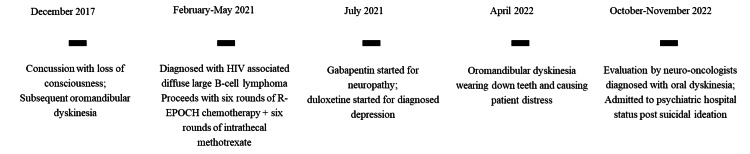
We present a rare case of concussion-induced chronic oromandibular dyskinesia. The patient is a 51-year-old Caucasian male with complex medical history (including a history of multiple concussions) who presented to the emergency department for suicidal and paranoid ideation. At the time of the visit, the patient was noted to be exhibiting an oromandibular dyskinesia in the form of "teeth-chattering." The first documented episode of his oromandibular dyskinesia dates back to a medical visit in December 2017. During this visit, the patient presented with teeth-chattering and tremors in his legs, hands, and head after a concussive event. Similar symptoms were noted by two different providers during two unrelated appointments one month later in January 2018. These symptoms were not mentioned in his records for four years and three months following the initial onset. They were noted again during an outpatient encounter for insomnia. During these four years, he was treated for a variety of conditions in both inpatient and outpatient settings, including gout, human immunodeficiency virus (HIV), stage four lymphoma, insomnia, and hepatitis C. Curiously, the dyskinesia symptoms reappeared several months after the completion of six cycles of etoposide, prednisone, vincristine, cyclophosphamide, and doxorubicin hydrochloride (R-EPOCH) chemotherapy in May 2021. Since reappearing, the symptoms have been worsening and significantly impacting the patient's quality of life. Although concussion-induced dyskinesia has been previously described in the literature, this is to our knowledge the first described case of concussion-induced oromandibular dyskinesia.
我们报告一例罕见的脑震荡诱发的慢性口颌运动障碍病例。患者为一名51岁的白种男性,有复杂的病史(包括多次脑震荡史),因自杀和偏执观念就诊于急诊科。就诊时,注意到患者表现出以“牙齿打颤”形式的口颌运动障碍。其口颌运动障碍的首次记录发作可追溯到2017年12月的一次就诊。在这次就诊中,患者在一次脑震荡事件后出现牙齿打颤以及腿部、手部和头部震颤。一个月后的2018年1月,在两次不相关的预约就诊中,两位不同的医生也注意到了类似症状。在最初发作后的四年零三个月里,他的病历中未提及这些症状。在一次因失眠的门诊就诊时再次被注意到。在这四年里,他在住院和门诊环境中接受了多种疾病的治疗,包括痛风、人类免疫缺陷病毒(HIV)、四期淋巴瘤、失眠和丙型肝炎。奇怪的是,在2021年5月完成六个周期的依托泊苷、泼尼松、长春新碱、环磷酰胺和盐酸多柔比星(R-EPOCH)化疗几个月后,运动障碍症状再次出现。自再次出现以来,症状一直在恶化,严重影响了患者的生活质量。虽然脑震荡诱发的运动障碍此前在文献中已有描述,但据我们所知,这是首例描述的脑震荡诱发的口颌运动障碍病例。