MacKinnon Jenna, McCoy Carolyn
McMaster Children's Hospital, Hamilton, ON, Canada.
Canadian Society of Respiratory Therapists, Ottawa, ON, Canada.
Can J Respir Ther. 2023 Apr 11;59:111-116. doi: 10.29390/cjrt-2022-056. eCollection 2023.
Endotracheal intubation and positive pressure ventilation following delivery are required in 32.9% of neonates <31 weeks gestational age and in 5.9% of older newborn babies [1]. Competency in intubation is important, yet opportunities for learners to develop this skill in the clinical environment are limited. Direct laryngoscopy (DL) provides a direct view of the airway during intubation. Unfortunately, visualization of the airway is only available to the primary operator, preventing supervising instructors from simultaneously viewing the airway and allowing them to provide real-time feedback to learners. Video laryngoscopy (VL) is a specialized clinical instrument that utilizes an indirect view of the airway that is digitally projected onto a screen via camera, which allows multiple simultaneous viewers to view the airway during intubation attempts and permits instructors to provide real-time feedback to learners accordingly.
This systematic review explores whether VL-supported learning is superior to DL for the development of skill in neonatal intubation.
Systematic searches of MEDLINE, EMBASE, CINAHL and the Cochrane Library were conducted without language restrictions. Studies published between January 2011 and November 2021 were examined. Randomized controlled trials (RCTs) comparing the effectiveness of VL versus DL for supporting neonatal intubation learning were included. Rate of successful intubation was the primary outcome measure. Both authors independently extracted study data and conducted risk of bias assessment.
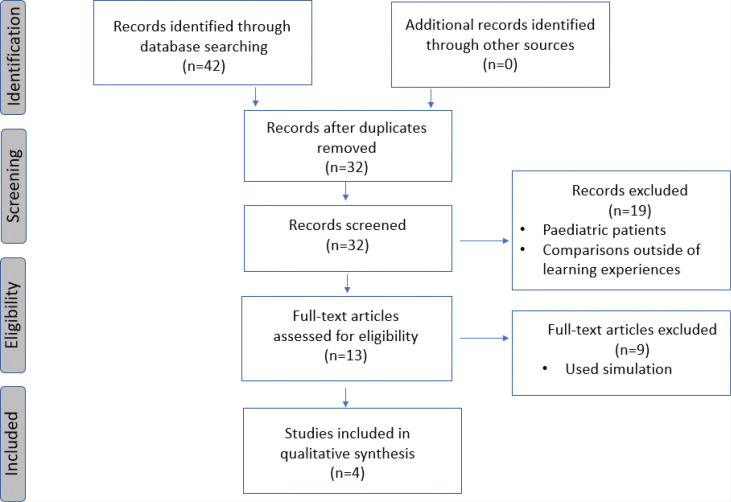
Four RCTs met the inclusion criteria, with two incorporating crossover designs. Each examined the effectiveness of VL versus DL, with concurrent supervisor support, as a tool for learning neonatal intubation in medical residents. All studies reported significantly higher intubation success rates with VL.
VL and real-time supervisor feedback is a more effective tool for supporting the development of neonatal intubation skill, compared with DL. Future investigations should include learners from other professions whose scope of practice includes neonatal intubation (eg, respiratory therapists).
胎龄小于31周的新生儿中有32.9%以及较大的新生儿中有5.9%在出生后需要进行气管插管和正压通气[1]。插管能力很重要,但学习者在临床环境中培养这项技能的机会有限。直接喉镜检查(DL)在插管过程中可直接观察气道。不幸的是,只有主操作者能看到气道,这使得指导教师无法同时观察气道,也无法向学习者提供实时反馈。视频喉镜检查(VL)是一种专门的临床仪器,它利用气道的间接视图,通过摄像头将其数字投影到屏幕上,这使得多个观察者在尝试插管时可以同时观察气道,并允许指导教师相应地向学习者提供实时反馈。
本系统评价探讨在新生儿插管技能培养方面,视频喉镜辅助学习是否优于直接喉镜检查。
对MEDLINE、EMBASE、CINAHL和Cochrane图书馆进行系统检索,无语言限制。检索了2011年1月至2021年11月发表的研究。纳入比较视频喉镜与直接喉镜在支持新生儿插管学习有效性的随机对照试验(RCT)。插管成功率是主要结局指标。两位作者独立提取研究数据并进行偏倚风险评估。
四项RCT符合纳入标准,其中两项采用交叉设计。每项研究都在有现场指导教师支持的情况下,检验了视频喉镜与直接喉镜作为医学住院医师学习新生儿插管工具的有效性。所有研究均报告视频喉镜的插管成功率显著更高。
与直接喉镜检查相比,视频喉镜和实时指导教师反馈是支持新生儿插管技能发展的更有效工具。未来的研究应纳入来自其他执业范围包括新生儿插管的专业人员(如呼吸治疗师)。